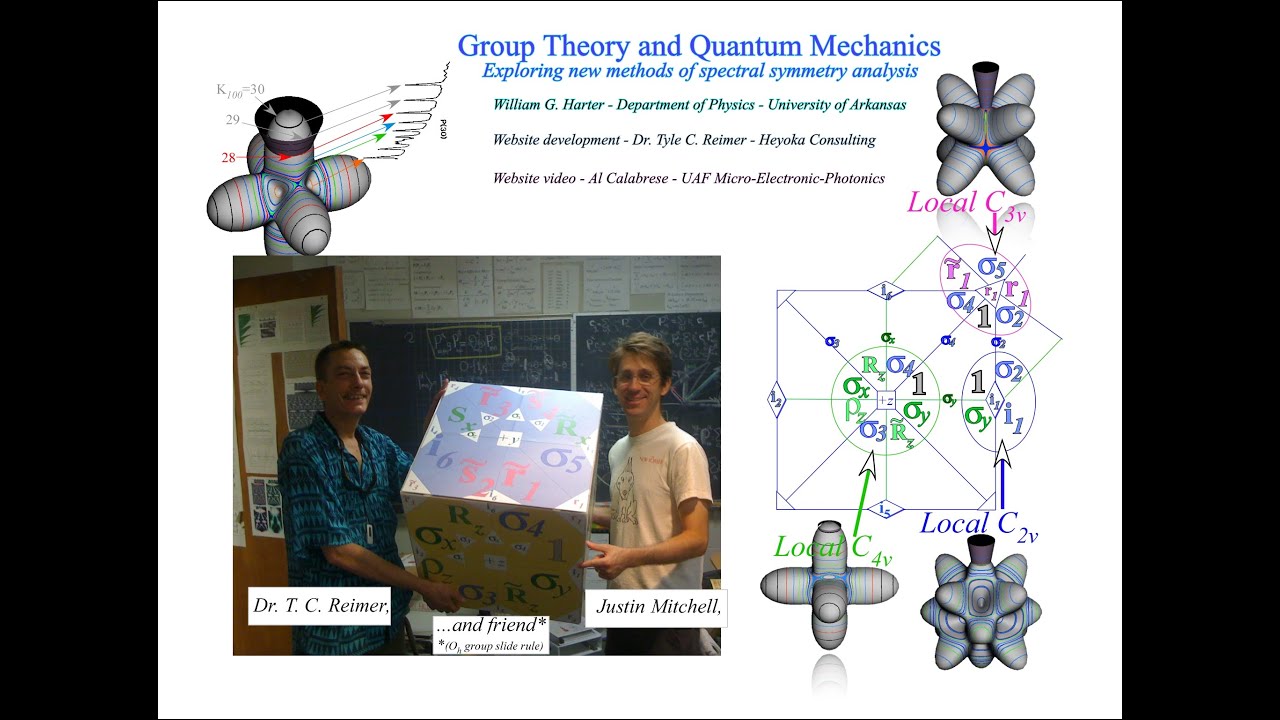
Applications of Group Theory to Physics - Lecture 2
Keywords
Summary
187 words
Critical Evaluation
Value of the Information & Strength of the Argument
The lecture provides valuable insights into the foundational connections between classical electromagnetism and quantum mechanics. Harter’s argumentation is solid, as he derives the quantum field constant step-by-step, linking classical energy density to the photon number. He addresses Planck’s historical doubts and resolves them using the harmonic oscillator formalism, which is a standard approach. The use of concrete examples, such as the electric field of a single photon, makes the abstract concepts more tangible. The argumentation is coherent and pedagogically effective, though it assumes a strong background in physics and mathematics.
99 words
Title / Content Match
The title accurately reflects the content: the lecture applies group theory concepts to quantum mechanics, focusing on symmetry and photon quantization.
Quality & Reliability
8/10
Lecture by a university professor, part of a graduate course, with clear pedagogical structure and references to established textbooks. The content is consistent with standard quantum mechanics and group theory, though it is a lecture and not peer-reviewed.
Key Moments
Markers derived by PSI from the transcript: the creator did not define chapters.
- Introduction and review of previous lecture on symmetry and transformations.
- Discussion of Planck's energy quantization and his doubts.
- Derivation of the quantum field constant relating electric field to wavefunction.
- Introduction of analyzers as sorters and filters, using light polarization.
- Explanation of the harmonic oscillator Hamiltonian and creation/annihilation operators.
- Numerical examples: energy of a single photon and electric field strength.
- Discussion of the zero-point energy and its role in the quantum field constant.
- Connection to group theory: unitary groups and symmetry of the oscillator.
- Further elaboration on the relationship between classical and quantum descriptions.
- Conclusion and preview of next lecture.
Cited Sources
- Course Web site — Course materials and additional content for the group theory in quantum mechanics course.
- Lecture 2 slide presentation (pdf) — Slides used in this lecture, containing the derivations and examples discussed.
Concurring Sources
- Feynman Lectures on Physics, Vol. III — Feynman's approach to quantum mechanics, which the lecture references and builds upon.
Contribution & Novelties
This lecture offers a pedagogical approach that emphasizes the physical intuition behind quantum mechanics, using symmetry and group theory to clarify the connection between classical and quantum descriptions. It provides a clear derivation of the quantum field constant and addresses historical misconceptions. The use of light polarization as a tangible example helps demystify abstract concepts.
Pour aller plus loin :
- Group theory — Foundational mathematical framework used throughout the lecture.
- Quantum harmonic oscillator — Central to the resolution of Planck’s paradox.
- Photon polarization — Concrete example used to illustrate analyzers and quantum states.
93 words
Radar Profile
The radar profile shows high scores in technical level and information quality, indicating a rigorous and detailed lecture. The lower score in information quantity relative to the others suggests a focused, in-depth treatment rather than a broad overview.
💬 No comments were provided for analysis.