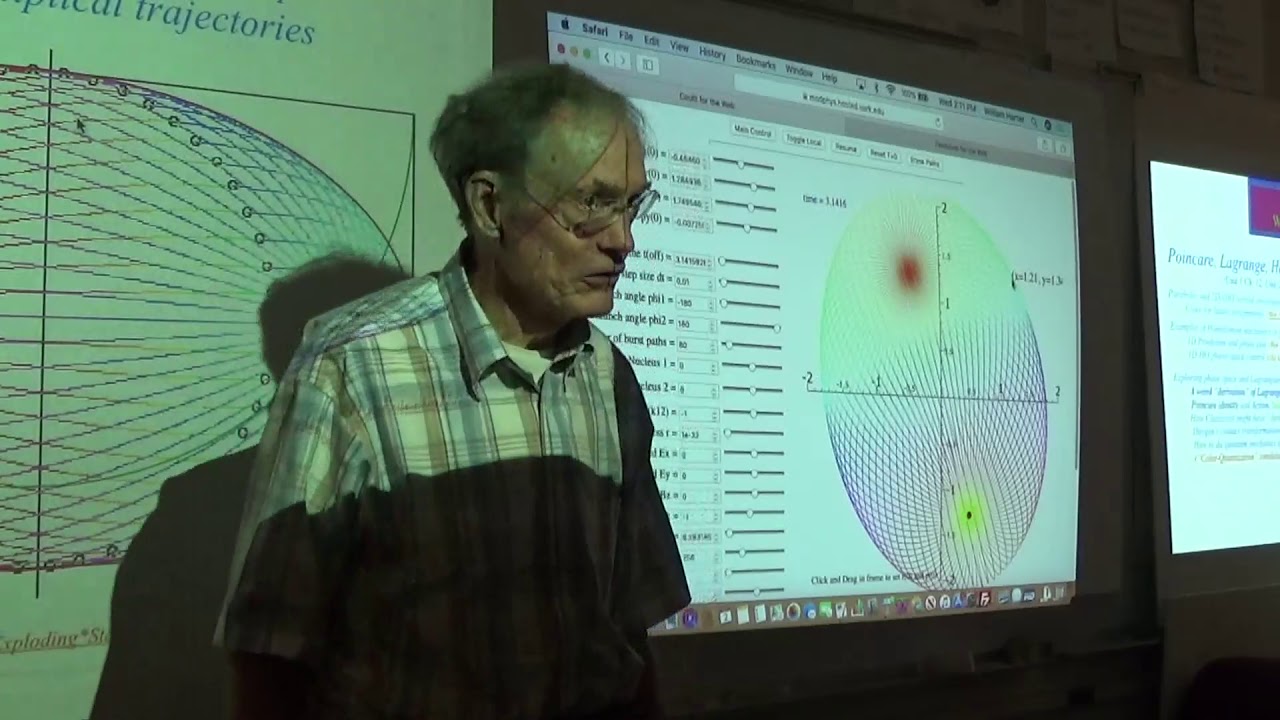
Classical Mechanics with a Bang! (2019 Fall) - Lecture #11
Keywords
Summary
145 words
Critical Evaluation
Value of the Information & Strength of the Argument
The lecture provides valuable insights into nonlinear dynamics and the limitations of the simple pendulum as a timekeeper. The argumentation is solid, built on mathematical derivations and physical reasoning. The instructor effectively uses simulations to illustrate concepts, making abstract ideas more tangible. The discussion of elliptic integrals and their connection to Bose-Einstein condensates adds depth and shows the relevance of classical mechanics to modern physics.
Scientific Rigor, Source Quality, Title Accuracy
The lecture is scientifically rigorous, with clear derivations and references to historical developments. The instructor mentions Huygens and his work on the cycloidal pendulum, and the course website provides additional resources. The title accurately reflects the content, which is a lecture on classical mechanics with a focus on geometric methods. The lecture is part of a structured course, and the instructor’s expertise is evident.
144 words
Title / Content Match
The title accurately reflects the content, which is a lecture on classical mechanics with a focus on geometric methods and nonlinear oscillations.
Quality & Reliability
8/10
Lecture by a university professor, part of a graduate course, with detailed mathematical derivations and simulations. The content is rigorous and based on established physics, but it is a lecture, not peer-reviewed research.
Key Moments
Markers derived by PSI from the transcript: the creator did not define chapters.
- Introduction to the lecture and the problem set.
- Discussion of the Hamiltonian and symplectic structure.
- Analysis of the simple pendulum and its period dependence on amplitude.
- Introduction of elliptic integrals and functions.
- Simulation of the pendulum showing poor timekeeping at large amplitudes.
- Introduction of Huygens' cycloidal pendulum and its isochronous property.
- Explanation of the evolute and involute of the cycloid.
- Discussion of the connection to quantum mechanics and wave functions.
- Assignment details and concluding remarks.
Cited Sources
- Course Website — Course website with additional resources.
- Lecture Slides (PDF) — PDF slides for this lecture.
Concurring Sources
- Classical Mechanics (Goldstein et al.) — Standard textbook covering Hamiltonian mechanics and elliptic functions.
Contribution & Novelties
The lecture provides a clear geometric interpretation of Hamiltonian mechanics, emphasizing the symplectic structure and phase space. It offers a detailed analysis of the pendulum’s nonlinear behavior and introduces elliptic functions as essential tools. The discussion of Huygens’ cycloidal pendulum highlights a historical solution to the problem of isochronous timekeeping. The connection to quantum mechanics, via the phase of wave functions, is a novel perspective that bridges classical and quantum concepts.
Pour aller plus loin :
- Hamiltonian mechanics — Foundational concept.
- Elliptic integral — Mathematical background.
- Cycloid — Geometry of the cycloid and its properties.
- Christiaan Huygens — Historical context.
100 words
Radar Profile
The radar profile shows high scores in technical level and information quality, reflecting the advanced nature of the lecture. The lower score in quantity of information is due to the lecture's focus on a few key topics in depth rather than a broad overview.