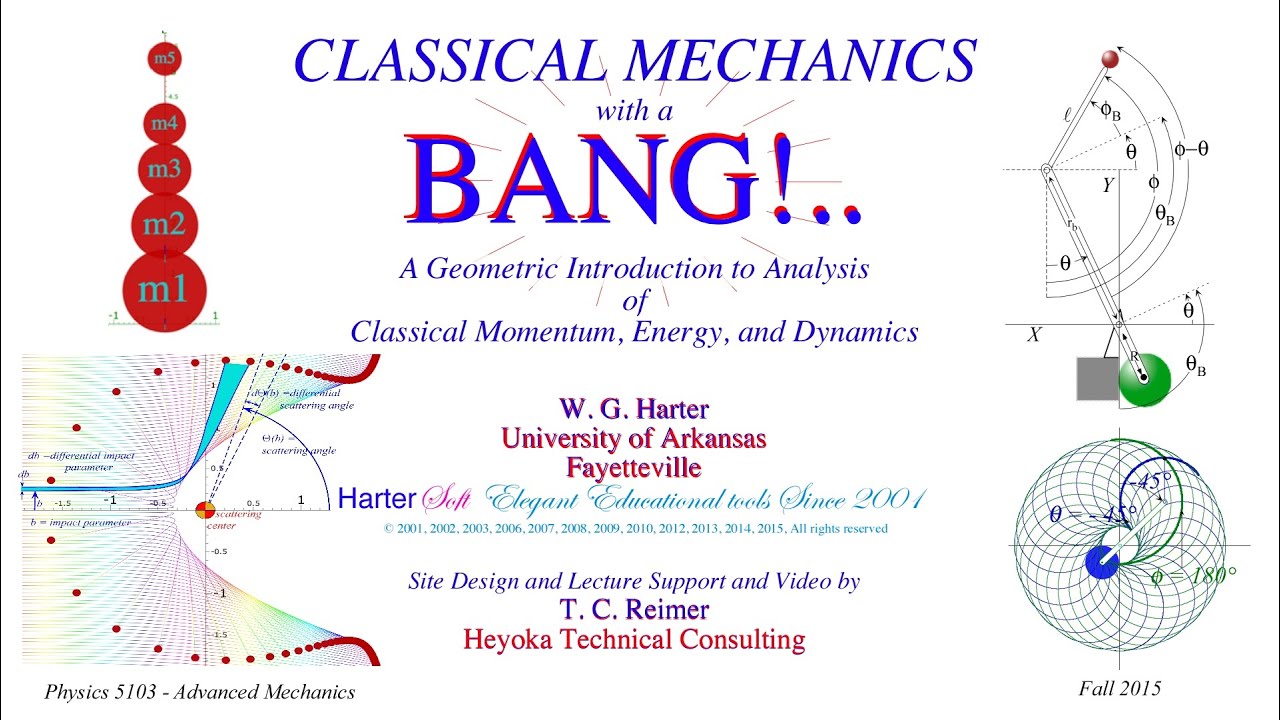
Classical Mechanics with a Bang! (2015Fa) - Lecture #23 (1/2)
Keywords
Summary
184 words
Critical Evaluation
Value of the Information & Strength of the Argument
The lecture provides a deep and original perspective on classical mechanics by linking it to quantum mechanics through group theory and geometric visualization. The argumentation is rigorous, building on previous lectures and specific page references. The instructor demonstrates the power of using operators to characterize states, addressing the Feynman path integral conundrum by considering only group-generated paths. The value lies in the clear exposition of how a simple Hamiltonian can generate complex dynamics, and how different representations (phasors, ellipses, spin vectors) offer complementary insights. The argumentation is solid, though it may be challenging for those not already familiar with the formalism.
Scientific Rigor, Source Quality, Title Accuracy
The lecture is scientifically rigorous, with references to specific pages in the course text and to historical papers by Stokes, Feynman, Vernon, Hellwarth, Ramsey, and Schwinger. The sources are credible and directly relevant. The title accurately reflects the content, which is a lecture on classical mechanics with a modern geometric approach. The lecture is part of a well-structured graduate course, and the instructor is an expert in the field. The adéquation between title and content is excellent.
193 words
Title / Content Match
The title accurately reflects the content, which is a lecture on classical mechanics with a focus on geometric and group-theoretic methods.
Quality & Reliability
8/10
Lecture by a university professor, part of a graduate course, with references to specific pages and historical papers. The content is technical and appears accurate, though not peer-reviewed.
Key Moments
Markers derived by PSI from the transcript: the creator did not define chapters.
- Introduction to the lecture, reviewing the previous lecture and outlining the topics.
- Discussion of the Euler angle machine and its use in visualizing spin states.
- Explanation of the three visualization methods: phasors, real-space trajectories, and spin vectors.
- Introduction of the crank vector and its role in time evolution.
- Derivation of the unitary operator in terms of Euler angles and comparison with the crank vector representation.
- Discussion of the historical context, including Stokes' work on polarization and the Feynman-Vernon-Hellwarth paper.
- Equating the Euler angle and crank vector expressions to derive the coordinate transformations.
- Conclusion and summary of the lecture's main points.
Cited Sources
- Course Web site — Course materials and information for PHYS 5103.
- Lecture #23.1 slide presentation (pdf) — Slides for this lecture, providing visual aids and detailed derivations.
Concurring Sources
- Classical Mechanics with a Bang! (course text) — The textbook used for the course, which the lecture follows closely.
Contribution & Novelties
The lecture offers a unique pedagogical approach by using group theory and geometric visualization to unify classical and quantum mechanics. It provides a clear framework for understanding two-level systems and their dynamics, which is applicable to various fields such as spin physics, polarization optics, and quantum computing. The emphasis on operator-based characterization of states is a powerful tool that goes beyond standard wavefunction treatments.
Pour aller plus loin :
- Bloch sphere — Visual representation of a two-level quantum system, directly related to the spin vector discussed.
- Euler angles — The coordinate system used to parameterize rotations, central to the lecture.
- Pauli matrices — The basis for the operator expansion used in the lecture.
- Stokes parameters — Used in ellipsometry and polarization, mentioned in the lecture.
- Feynman path integral — The concept the instructor addresses with group theory.
137 words
Radar Profile
The radar profile shows high scores in technical level and information quality, reflecting the advanced and rigorous nature of the lecture. The lower score in quantity of information is due to the focused scope of a single lecture, while the overall reliability is high given the academic context.