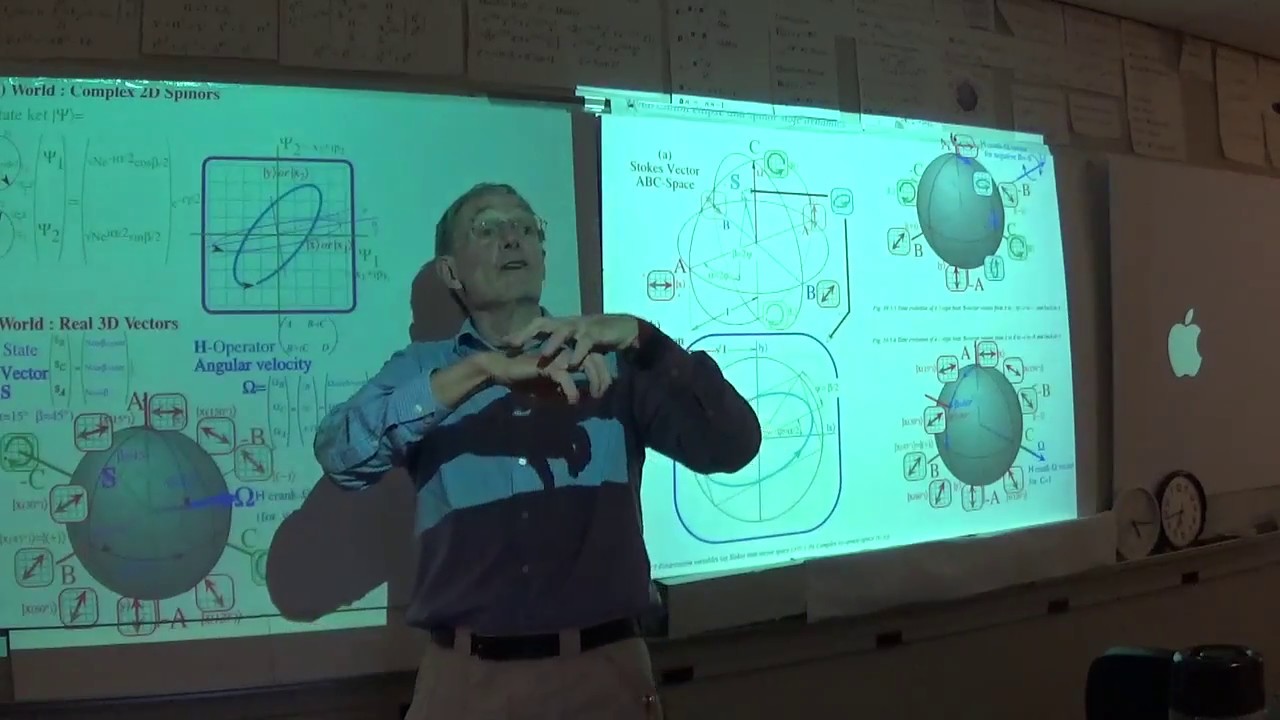
Group Theory in Quantum Mechanics (2017 Sp) - Lecture #7 (Part 2 of 2)
Keywords
Summary
151 words
Critical Evaluation
Value of the Information & Strength of the Argument
The lecture provides valuable insights into the geometric phase and its connection to spin rotations, a topic often treated abstractly. Harter’s use of the Poincaré sphere and explicit matrix representations makes the argument concrete and visual. He carefully derives the double covering of SO(3) by SU(2) and explains the physical consequences, such as the sign change of spinors under 2π rotation. The argumentation is solid, building from simple examples to general principles, and he addresses student questions to clarify potential misunderstandings. The value lies in the pedagogical clarity and the emphasis on physical intuition over formal mathematics.
Scientific Rigor, Source Quality, Title Accuracy
The lecture is based on Harter’s own textbooks, which are authoritative in the field. However, no external sources are cited during the lecture, and the video is an unedited classroom recording. The title accurately reflects the content, which is a continuation of a series on group theory in quantum mechanics. The mathematical derivations are rigorous and consistent, and the lecture is well-structured despite its informal setting.
178 words
Title / Content Match
The title accurately describes the content: a continuation of a graduate lecture on group theory applied to quantum mechanics.
Quality & Reliability
8/10
Lecture by a professor with deep expertise in group theory and quantum mechanics, based on his own textbooks. The content is mathematically rigorous and internally consistent, but the video is an unedited classroom recording with no external citations or peer review.
Key Moments
Markers derived by PSI from the transcript: the creator did not define chapters.
- Recap of previous lecture and introduction to the Poincaré sphere.
- Discussion of Berry phase and its relation to spin textures.
- Explanation of double covering of SO(3) by SU(2) using the Poincaré sphere.
- Derivation of rotation operators and their action on vectors.
- Application to spin-1/2 systems and the sign change under 2π rotation.
- Introduction of the time-evolution operator as a rotation in Hilbert space.
- Generalization to higher dimensions and relativistic case.
- Student questions and clarifications on the geometric phase.
- Summary of key concepts and advice for further study.
Cited Sources
- Course Web site — Course materials and additional content for the Group Theory in Quantum Mechanics course.
- Lecture #7 slide presentation (pdf) — Slides used in this lecture, providing visual aids and derivations.
- YouTube video of Part 1 — First part of this lecture, covering introductory material.
Concurring Sources
- Berry, M. V. (1984). Quantal phase factors accompanying adiabatic changes. — Original paper introducing the Berry phase, which is a central topic of the lecture.
Contribution & Novelties
This lecture provides a clear and intuitive explanation of the geometric phase and its connection to spin rotations, using the Poincaré sphere as a visual tool. It emphasizes the double covering of SO(3) by SU(2) and its physical consequences, such as the sign change of spinors under 2π rotation. The lecture bridges abstract group theory with concrete physical examples, making it valuable for graduate students and researchers.
Pour aller plus loin :
- Berry phase — The geometric phase concept introduced by Michael Berry.
- Poincaré sphere — A representation of polarization states used in the lecture.
- Spinor — Mathematical objects that transform under SU(2) and exhibit double-valuedness.
106 words
Radar Profile
The radar profile shows high scores in technical level and information quality, reflecting the advanced and rigorous content. The lower score in information quantity is due to the short duration and focused scope of the lecture.