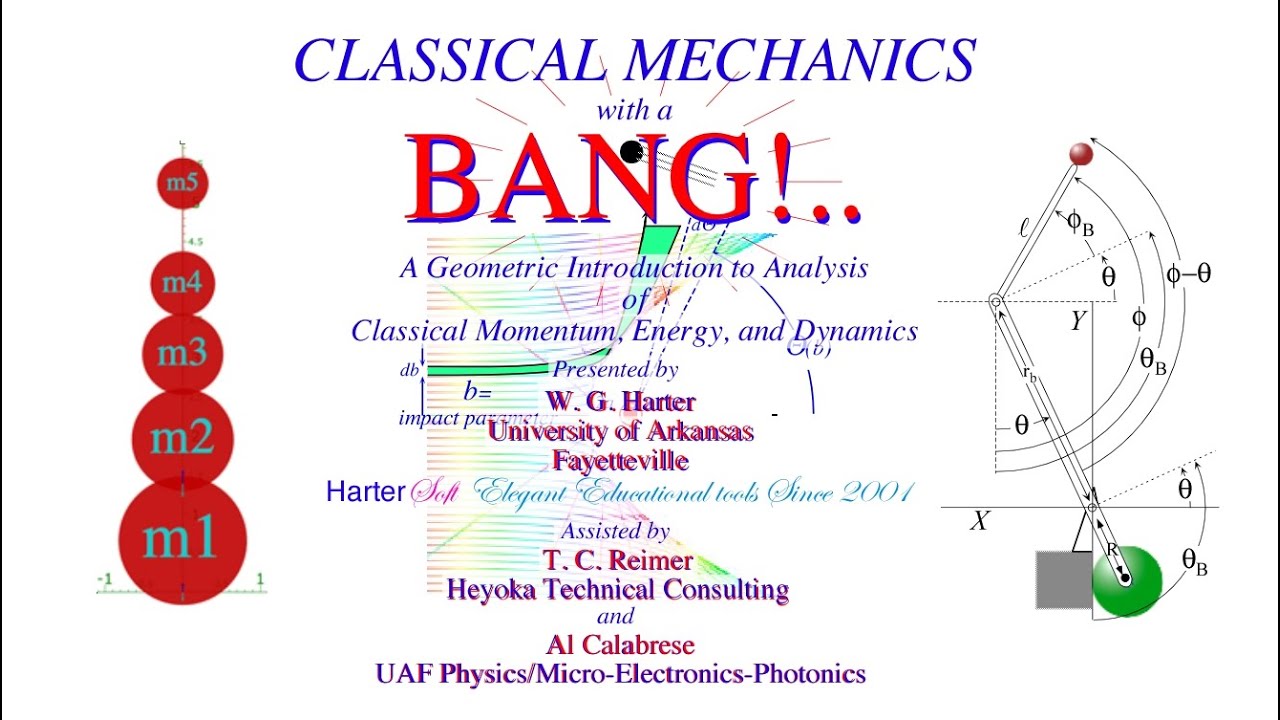
Classical Mechanics with a Bang! - Lecture 3
Keywords
Summary
151 words
Critical Evaluation
Value of the Information & Strength of the Argument
The lecture provides valuable insights into classical mechanics through a geometric lens, emphasizing the use of matrices and symmetry operators. The argumentation is solid, with clear mathematical derivations and visual demonstrations. The professor effectively connects classical mechanics to quantum mechanics, highlighting the importance of symmetry and periodicity. The use of interactive simulations enhances understanding, and the problems assigned encourage deeper exploration. The lecture is well-structured, building from simple reflections to complex group theory, and the reasoning is logical and coherent.
89 words
Title / Content Match
The title accurately reflects the content, which focuses on classical mechanics with a geometric approach, including the 'bang' of collisions.
Quality & Reliability
8/10
The lecture is part of a graduate course by a professor, with clear mathematical derivations and references to course materials. The content is rigorous, but the video is a recording of a live lecture with occasional informal remarks and minor errors, which slightly reduces the score.
Key Moments
Markers derived by PSI from the transcript: the creator did not define chapters.
- Introduction to symmetry operators and Pauli matrices
- Discussion of reflections and rotations using mirrors
- Rescaling velocity space to turn ellipses into circles
- Derivation of the rotation matrix for collisions
- Demonstration of periodic and quasi-periodic motion
- Introduction to group theory and dihedral groups
- Comparison of Lagrangian and Hamiltonian formulations
- Assignment of problems for calculating mass ratios
Cited Sources
- BounceIt Web App — Interactive simulation used for demonstrations
- Course Website: Classical Mechanics with a Bang! — Course materials and textbook information
Concurring Sources
- Classical Mechanics with a Bang! — Course textbook and materials align with the lecture content
Contribution & Novelties
The lecture offers a unique geometric perspective on classical mechanics, using matrices and symmetry operators to simplify collision problems. It bridges classical and quantum mechanics by emphasizing the role of symmetry and periodicity. The interactive simulations provide a hands-on learning experience.
Pour aller plus loin :
- Group theory — Provides foundational concepts for understanding symmetry in physics.
- Pauli matrices — Relevant to the spin operators mentioned in the lecture.
- Dihedral group — Explains the symmetry groups discussed in the lecture.
80 words
Radar Profile
The radar profile shows high scores in technical level and information quality, indicating a rigorous and detailed lecture. The lower scores in quantity and reliability are due to the informal nature of a live lecture and occasional minor errors.