Classical Mechanics with a Bang! (2018 Fall) - Lecture #18 Part 2/2
Keywords
Summary
133 words
Critical Evaluation
Value of the Information & Strength of the Argument
The lecture provides a rigorous mathematical derivation of the cycloid motion, using complex analysis to simplify the equations. The argumentation is solid, building step-by-step from the equations of motion to the final solution. The use of a mechanical analog and computer simulations enhances understanding and provides physical intuition. The instructor’s explanations are clear and detailed, making the content valuable for advanced students.
Scientific Rigor, Source Quality, Title Accuracy
The scientific rigor is high, as the lecture is part of a formal graduate course and the instructor is a professor. The sources are not explicitly cited in the video, but the course website and lecture slides are provided in the description, which serve as references. The title accurately reflects the content, focusing on classical mechanics with a geometric approach. The video is a raw lecture, so production quality is minimal, but the content is well-structured.
153 words
Title / Content Match
The title accurately reflects the content: a lecture on classical mechanics with a focus on geometric methods and a 'bang' (cyclotron motion).
Quality & Reliability
8/10
Lecture by a university professor, part of a graduate course, with detailed mathematical derivations and demonstrations. The content is based on established physics and the instructor's expertise. However, the video is a raw lecture with no external citations or peer review, and the low view count limits external validation.
Key Moments
Markers derived by PSI from the transcript: the creator did not define chapters.
- Introduction and recap of previous content
- Derivation of velocity solution using complex numbers
- Integration to find position and coordinate solution
- Introduction of generalized cycloid and geometric interpretation
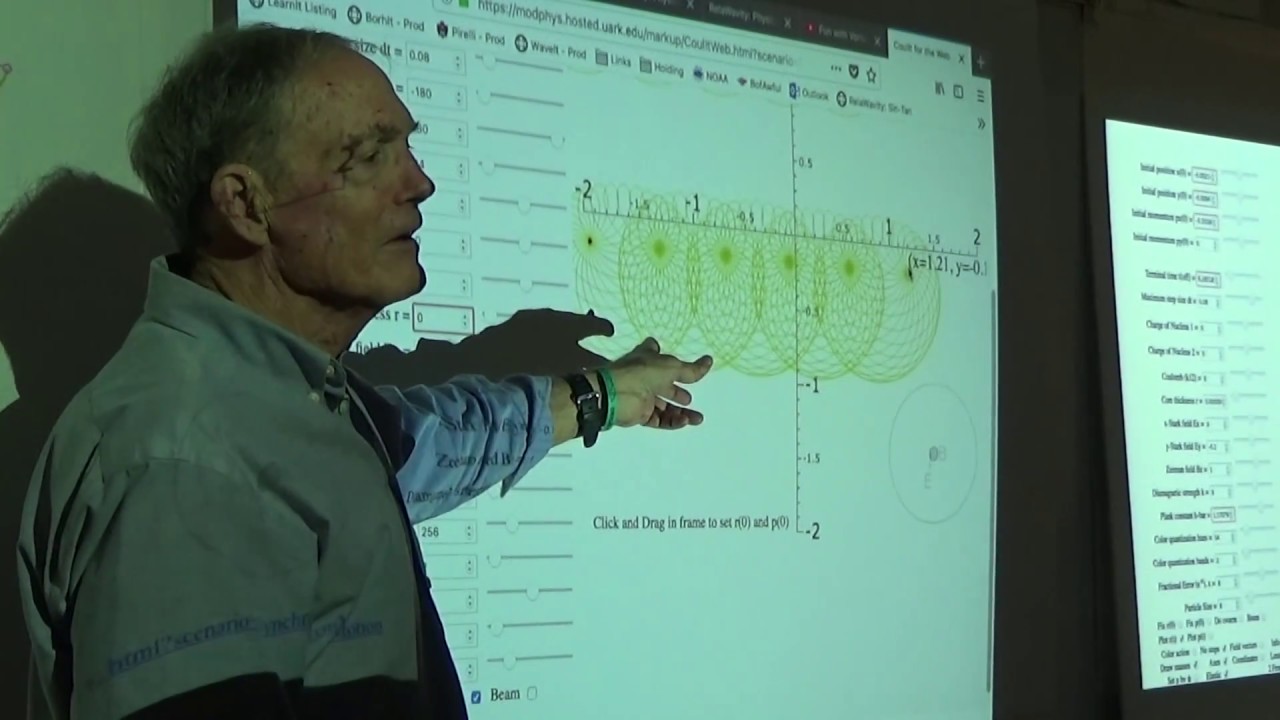
- Demonstration of computer simulation with different parameters
- Explanation of mechanical analog: ball on rotating table
- Video of mechanical analog and discussion of center of percussion
- Discussion of parametric resonance and concluding remarks
Cited Sources
- Course Website: Classical Mechanics with a Bang! — Course website for the textbook and lectures
- Lecture #18 Slides (PDF) — Slides used in this lecture
Concurring Sources
- Classical Mechanics with a Bang! (textbook) — The textbook used for the course, which likely contains similar derivations.
Contribution & Novelties
The lecture provides a unique geometric perspective on classical mechanics, using complex numbers to simplify the analysis of charged particle motion. The mechanical analog of a ball on a rotating table offers a tangible demonstration of cyclotron motion, which is rarely shown in such detail. The inclusion of computer simulations and the discussion of parametric resonance add depth to the topic.
Pour aller plus loin :
- Cyclotron — Background on cyclotron motion and its applications.
- Phasor — Explanation of phasors used in the lecture.
- Center of percussion — Concept relevant to the mechanical analog.
94 words
Radar Profile
The radar profile shows high scores in all dimensions, indicating a technically rigorous and informative lecture. The balance between quantitative information, technical depth, and reliability is strong, making it a valuable resource for advanced physics students.