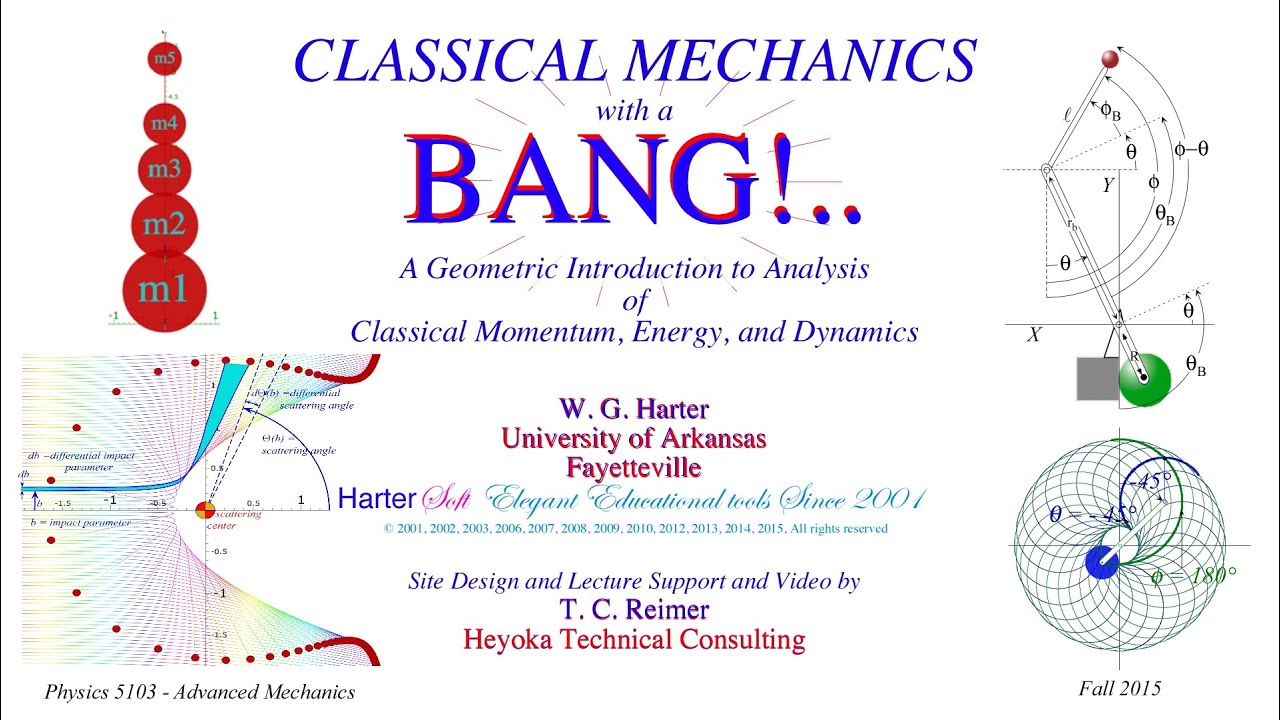
Classical Mechanics with a Bang! (2015Fa) - Lecture #24
Keywords
Summary
164 words
Critical Evaluation
Value of the Information & Strength of the Argument
The lecture provides a deep and insightful connection between classical mechanics and quantum mechanics, specifically linking parametric resonance to band theory. The argumentation is solid, building from fundamental equations and using mathematical analogies to derive physical insights. The instructor demonstrates a strong command of the material and presents a novel perspective that is not commonly discussed. The value lies in the pedagogical clarity of the analogy and the computational approach to solving the Mathieu equation, which is more accessible than traditional methods. However, the lecture is advanced and assumes a strong background in both classical mechanics and quantum mechanics, and the approximate nature of the analogy is acknowledged, which tempers the strength of the conclusions.
Scientific Rigor, Source Quality, Title Accuracy
The lecture is part of a university course and is based on the instructor’s textbook ‘Classical Mechanics with a Bang!’. The course website and lecture slides are provided, which serve as primary sources. The content is mathematically rigorous and consistent with established physics, though it is not peer-reviewed. The title accurately reflects the content, as the lecture indeed discusses ’explosive’ resonance phenomena. The sources cited are the course materials, which are appropriate for a lecture. No external references are given, but the instructor’s expertise and the structured presentation lend credibility.
220 words
Title / Content Match
The title 'Classical Mechanics with a Bang!' is the course textbook title, and this lecture indeed discusses explosive parametric resonance, so it is appropriate.
Quality & Reliability
8/10
Lecture by a university professor, part of a graduate course, with accompanying slides and course website. The content is mathematically rigorous and connects classical and quantum mechanics, but it is a lecture, not peer-reviewed, and the analogy is approximate.
Key Moments
Markers derived by PSI from the transcript: the creator did not define chapters.
- Introduction to the lecture: linear vs nonlinear resonance, and the connection to band theory.
- Derivation of the Mathieu equation and its analogy to the Schrödinger equation.
- Example of parametric amplification: the vibrating stick with a propeller.
- Mapping between classical and quantum parameters: frequency, energy, and wave vector.
- Setting up the matrix eigenvalue problem for the Mathieu equation with n=2.
- Discussion of band edges and the significance of negative eigenvalues for inverted pendulum stability.
- Preview of simulations and the connection to trebuchet dynamics.
Cited Sources
- Course Web site: Classical Mechanics with a Bang! — Course website providing resources and context for the lecture series.
- Lecture #24 slide presentation (pdf) — Slides used in this lecture, containing the mathematical derivations and figures.
Concurring Sources
- Kapitza's pendulum — A classical example of parametric resonance where an inverted pendulum can be stabilized by high-frequency vertical oscillation, consistent with the lecture's discussion.
Contribution & Novelties
This lecture offers a unique pedagogical approach by drawing a direct analogy between classical parametric resonance (e.g., a pendulum with oscillating pivot) and quantum mechanical band theory. It demonstrates that the Mathieu equation, which governs parametric resonance, can be solved using matrix diagonalization, providing a computational method that is more intuitive than traditional Floquet theory. The connection between negative eigenvalues and stable inverted pendulum configurations is a striking illustration of how quantum concepts like band gaps manifest in classical systems. This cross-disciplinary insight is valuable for students and researchers alike.
Pour aller plus loin :
- Mathieu function — Provides a mathematical background on the solutions to the Mathieu equation.
- Floquet theory — A general framework for differential equations with periodic coefficients, relevant to parametric resonance.
- Kapitza pendulum — A specific example of a pendulum with a vertically oscillating pivot, which can be stable in the inverted position, illustrating parametric stabilization.
150 words
Radar Profile
The radar profile shows high scores in technical level and information quality, indicating a dense, advanced lecture. The quantity of information is also high, but the overall note is slightly lower due to the narrow scope and lack of external sources. The profile suggests a specialized audience.