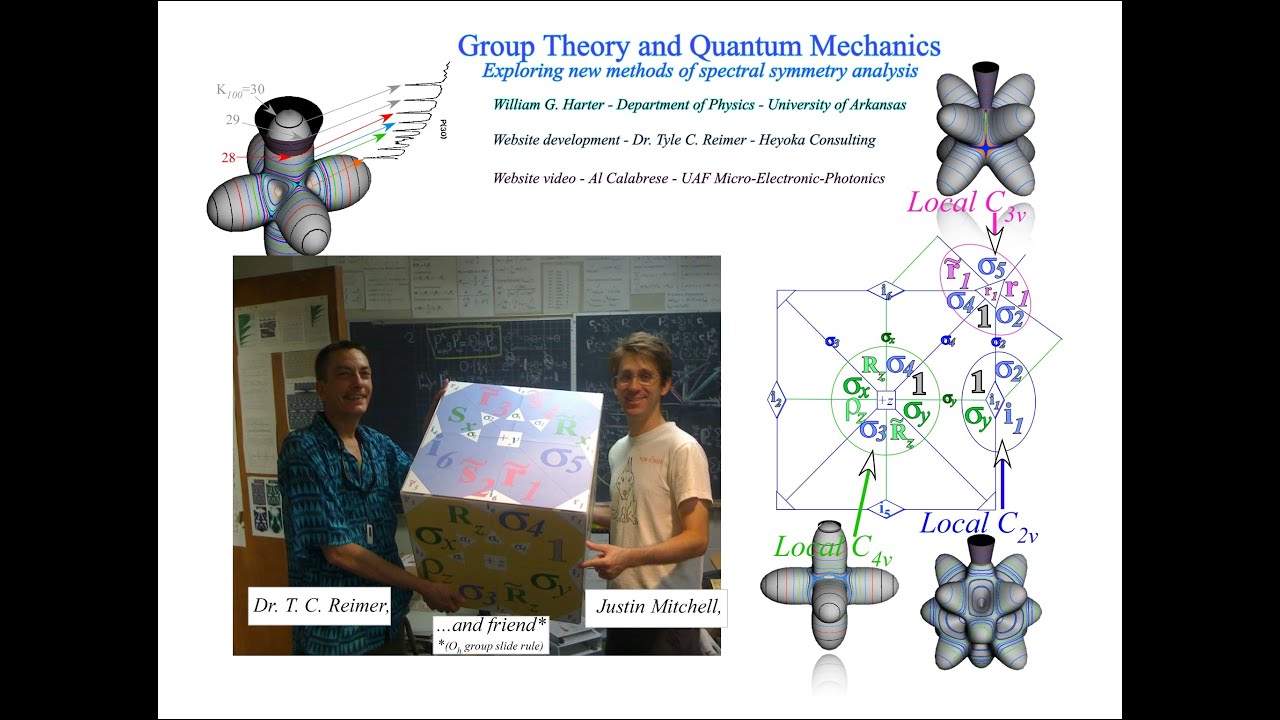
Applications of Group Theory to Physics - Lecture 23
Keywords
Summary
148 words
Critical Evaluation
Value of the Information & Strength of the Argument
The lecture provides a rigorous and detailed exposition of the U(2) group and its application to quantum oscillators, demonstrating the deep connection between oscillator states and angular momentum. The argumentation is solid, building on established mathematical frameworks and clearly explaining the physical implications. The instructor emphasizes the elegance and power of the group-theoretic approach, and the derivations are thorough. The value lies in the advanced level of the content, which is suitable for graduate students and researchers in physics.
Scientific Rigor, Source Quality, Title Accuracy
The lecture is based on the instructor’s own textbooks and the course materials, which are authoritative in the field. The sources cited are the course website and the lecture slides, which are directly relevant. The title accurately reflects the content, which is a lecture on applications of group theory to physics. The scientific rigor is high, with careful mathematical derivations and clear explanations. The lecture is part of a university course, ensuring academic quality.
168 words
Title / Content Match
The title accurately reflects the content, which applies group theory to physics, specifically to quantum mechanics and angular momentum.
Quality & Reliability
8/10
Lecture from a university graduate course, based on established textbooks and research, with rigorous mathematical derivations. The content is advanced and consistent with standard quantum mechanics and group theory.
Key Moments
Markers derived by PSI from the transcript: the creator did not define chapters.
- Introduction to the lecture: U(2) group and two-dimensional oscillators.
- Review of creation and annihilation operators for a single oscillator.
- Discussion of coherent states and their properties.
- Extension to two dimensions: U(2) Hamiltonian and tensor products.
- Introduction to bosonic and fermionic symmetries, Pauli exclusion principle.
- Bookkeeping of multi-dimensional oscillator states and computer implementation.
- Connection between U(2) and angular momentum theory.
- Further discussion on raising and lowering operators in angular momentum.
- Conclusion and summary of key points.
Cited Sources
- Course Web site — Course materials and resources for the group theory in quantum mechanics course.
- Lecture 23 slides (PDF) — Slides used in this lecture, containing the mathematical derivations and figures.
Concurring Sources
- Quantum Theory in the Computer Age — Textbook by William Harter, which is the basis for this course.
- Principles of Symmetry, Dynamics, and Spectroscopy — Textbook by William Harter, also used in this course.
Contribution & Novelties
This lecture provides a clear and detailed exposition of the U(2) group and its application to quantum oscillators, highlighting the elegant connection to angular momentum theory. It bridges the gap between abstract group theory and practical quantum mechanics, offering insights into coherent states and the bookkeeping of multi-dimensional systems. The lecture is particularly valuable for its pedagogical approach, making advanced topics accessible to graduate students.
Pour aller plus loin :
- Coherent states — Wikipedia article on coherent states, which are central to this lecture.
- Angular momentum operator — Wikipedia article on angular momentum operators, relevant to the connection made in the lecture.
- Group theory — Wikipedia article on group theory, providing background on the mathematical framework used.
117 words
Radar Profile
The radar profile shows high scores in technical level and information quality, indicating a rigorous and advanced lecture. The lower score in information quantity suggests that the lecture is focused and does not cover a wide range of topics, but rather goes deep into the subject matter.