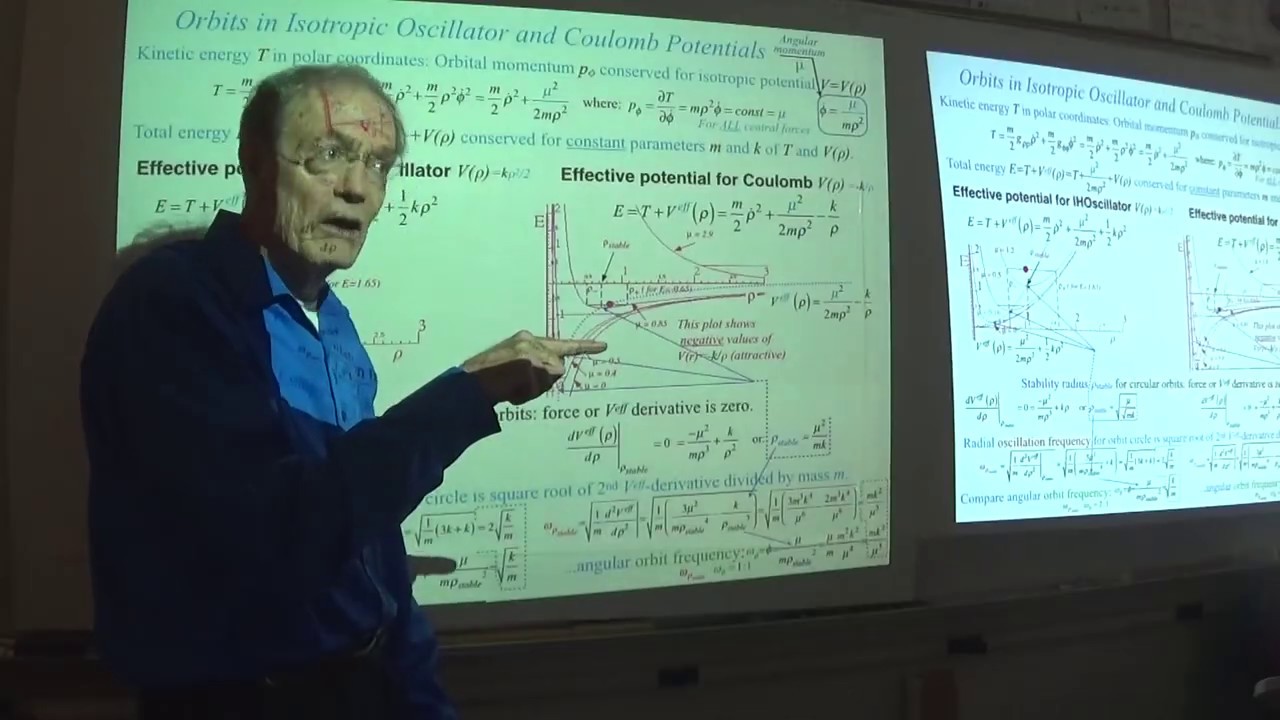
Classical Mechanics with a Bang! (2019 Fall) - Lecture #25
Keywords
Summary
147 words
Critical Evaluation
Value of the Information & Strength of the Argument
The lecture provides a deep and rigorous comparison of two fundamental potentials, highlighting their algebraic similarities and differences. The argumentation is solid, built on step-by-step derivations and geometric interpretations. The value lies in the pedagogical approach that emphasizes symmetry and the connection between classical and quantum mechanics. The professor’s expertise is evident, and the content is suitable for advanced students.
Scientific Rigor, Source Quality, Title Accuracy
The lecture is scientifically rigorous, with careful derivations and references to course materials. The sources cited are the course website and the lecture slides, which are appropriate for a lecture. The title accurately reflects the content. The lecture is part of a structured course, and the professor’s authority is clear.
125 words
Title / Content Match
The title accurately reflects the content: a lecture on classical mechanics, specifically comparing harmonic oscillator and Coulomb potential orbits.
Quality & Reliability
8/10
Lecture by a university professor, part of a graduate course, with detailed mathematical derivations and references to course materials. The content is rigorous and well-structured, though it is a lecture rather than peer-reviewed research.
Key Moments
Markers derived by PSI from the transcript: the creator did not define chapters.
- Introduction: comparing harmonic oscillator and Coulomb potential orbits.
- Discussion of conservation laws and angular momentum.
- Derivation of stability radius and oscillation frequency for both potentials.
- Analysis of turning points and their geometric significance.
- Introduction of polar coordinate equations for orbits.
- Algebraic manipulation and substitution to simplify orbit equations.
- Derivation of orbit equations in terms of sine functions.
- Discussion of the geometry of ellipses and polar parameters.
- Comparison of the two potentials and their symmetry properties.
- Further analysis of the Coulomb orbit geometry.
Cited Sources
- Course Web site — Course materials and resources for 'Classical Mechanics with a Bang!'
- Lecture #25 slides (PDF) — Slides used in this lecture, containing detailed derivations and figures.
Concurring Sources
- Classical Mechanics (Goldstein, Poole, Safko) — Standard textbook covering central force problems and orbit equations.
Contribution & Novelties
The lecture provides a unique side-by-side algebraic comparison of the harmonic oscillator and Coulomb potential, highlighting their symmetry and connections. It offers a geometric perspective that clarifies the calculus and physics, and shows how symmetry principles in classical mechanics underlie quantum theory.
Pour aller plus loin :
- Laplace-Runge-Lenz vector — Central to the extra symmetry of the Coulomb potential.
- Kepler problem — Classical orbits under inverse-square force.
- Supersymmetry — The lecture hints at a ‘supersymmetry’ between the two potentials.
79 words
Radar Profile
The radar profile shows high scores in technical level and information quantity, reflecting the advanced and detailed nature of the lecture. The quality and reliability scores are also high, indicating a trustworthy source. The overall profile suggests a highly technical and rigorous content, suitable for advanced students.
💬 Sur les 0 commentaires analysés, aucune tendance n'est observable.