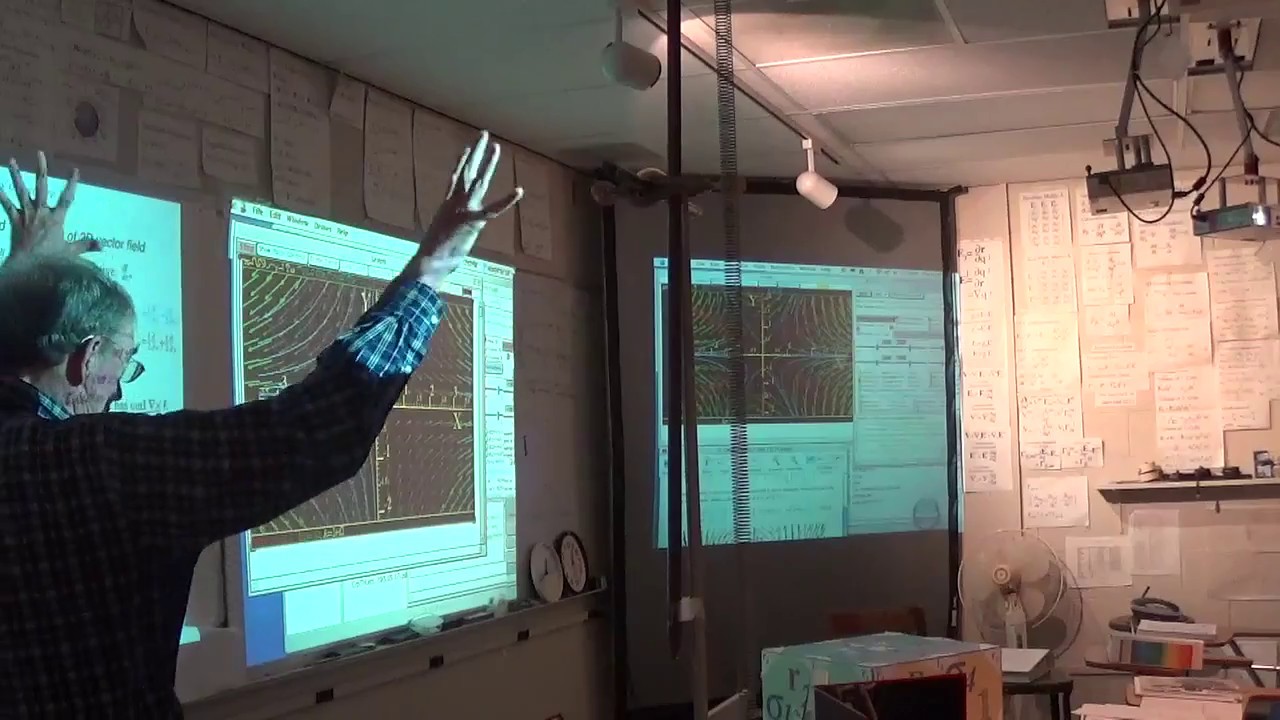
Classical Mechanics with a Bang! (2017 Fall) - Lecture #13
Keywords
Summary
135 words
Critical Evaluation
Value of the Information & Strength of the Argument
The lecture provides a deep and rigorous treatment of the use of complex variables in classical mechanics, offering valuable insights into the structure of vector fields and potential theory. The argumentation is solid, building from basic definitions to more complex concepts, and is supported by mathematical derivations and visualizations. The pedagogical approach is effective, using multiple representations (equations, plots, physical analogies) to clarify abstract ideas. The value lies in its ability to unify concepts like divergence, curl, and potential under the framework of complex analysis, which is not commonly emphasized in standard mechanics courses. The argumentation is coherent and logically structured, though it assumes a high level of mathematical maturity from the audience.
Scientific Rigor, Source Quality, Title Accuracy
The scientific rigor is high, as the lecture is part of a university course and is based on the professor’s textbook ‘Classical Mechanics with a Bang!’. The content is mathematically precise and consistent with established physics. The sources are limited to the course website and the lecture slides, which are appropriate for a lecture. The title accurately reflects the content, which is a lecture on classical mechanics with a geometric approach. The lecture does not cite external references, but this is typical for a lecture and does not detract from its rigor. The adequacy between title and content is excellent.
228 words
Title / Content Match
The title accurately reflects the content: a lecture on classical mechanics with a geometric approach, as part of the course 'Classical Mechanics with a Bang!'.
Quality & Reliability
8/10
Lecture by a university professor, part of a graduate course, with accompanying slides and course website. Content is mathematically rigorous and based on established physics principles. No external citations, but the pedagogical context and internal consistency support reliability.
Key Moments
Markers derived by PSI from the transcript: the creator did not define chapters.
- Introduction and review of complex variable field relationships.
- Discussion of source-free vector fields and the role of analytic functions.
- Derivation of the complex derivative and its relation to divergence and curl.
- Example of the field Z conjugate and its properties.
- Introduction of the complex potential and its use in field representation.
- Comparison of analytic and non-analytic fields, highlighting differences in curl and divergence.
- Discussion of the monopole field and its logarithmic potential.
- Introduction of the dipole field and its generation via differentiation.
- Physical interpretations of the fields, including fluid flow and electrostatics.
- Preview of higher-order multipoles and the role of derivatives.
Cited Sources
- Course Web site — Course website for 'Classical Mechanics with a Bang!' providing resources and materials.
- Lecture #13 slide presentation (pdf) — Slides used in this lecture, containing the visual aids and derivations.
Concurring Sources
- Classical Mechanics with a Bang! — The textbook by Prof. Harter that this course is based on, providing the theoretical framework.
Contribution & Novelties
The lecture offers a unique geometric perspective on classical mechanics by leveraging complex analysis to simplify and unify the treatment of vector fields. It demonstrates how analytic functions can be used to construct source-free fields and potentials, providing a powerful tool for solving problems in mechanics and electrostatics. The approach highlights the deep connection between symmetry principles in classical and quantum theories.
Pour aller plus loin :
- Complex analysis — Foundational for the methods used in the lecture.
- Multipole expansion — Directly related to the discussion of monopoles, dipoles, and quadrupoles.
- Potential theory — Relevant to the concept of complex potentials and their applications.
104 words
Radar Profile
The radar profile shows high scores in technical level and information quality, indicating a rigorous and detailed lecture. The quantity of information is also high, but the global reliability is slightly lower due to the lack of external citations. Overall, the lecture is highly specialized and suitable for advanced students.