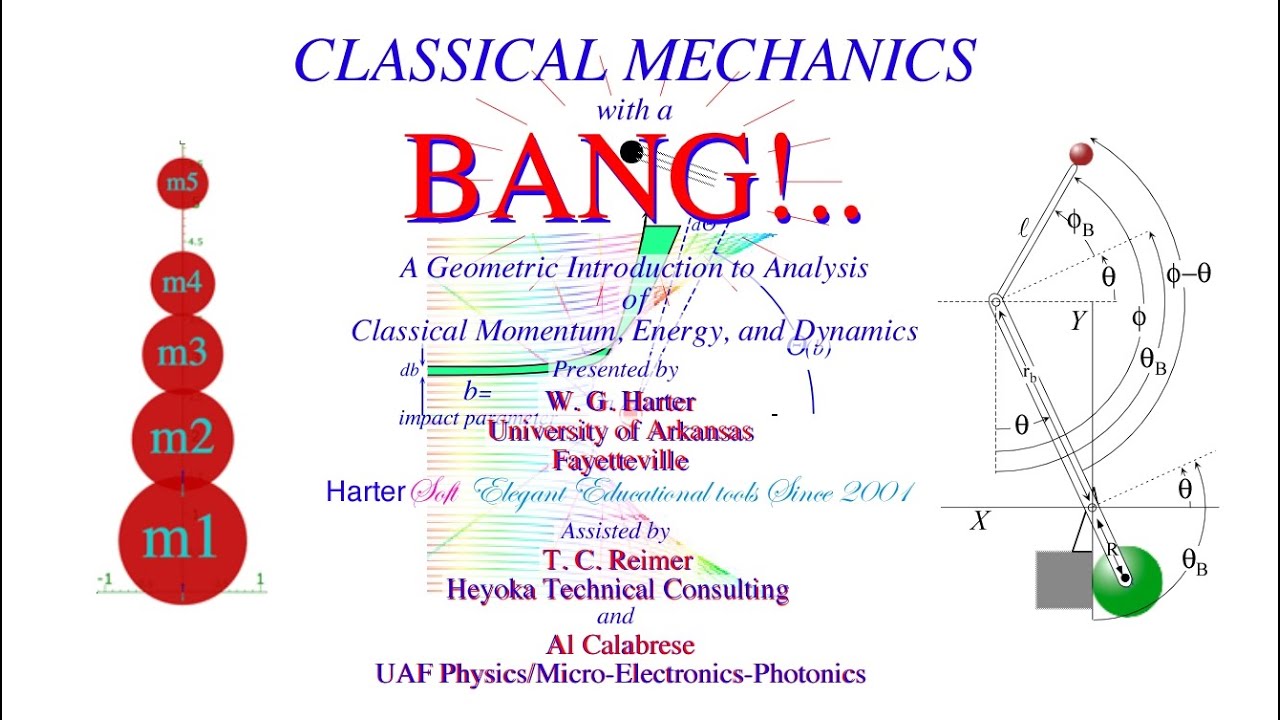
Classical Mechanics with a Bang! - Lecture 17
Keywords
Summary
149 words
Critical Evaluation
Value of the Information & Strength of the Argument
The lecture provides a valuable demonstration of how abstract concepts like generalized coordinates and Jacobians are applied to a real mechanical system. The argumentation is clear and logical, building from the physical setup to the mathematical formulation. The use of simulations and physical demonstrations helps to illustrate the concepts. The professor’s enthusiasm for the subject is evident, and he effectively connects the physics to practical applications in sports and engineering.
Scientific Rigor, Source Quality, Title Accuracy
The lecture is based on the professor’s own textbook and draws on historical references, such as a Scientific American article from 1995. The scientific rigor is high, as it is a university lecture, but it is not peer-reviewed. The title accurately reflects the content, which is a lecture on classical mechanics with a focus on the trebuchet. The lecture is well-structured and the mathematical derivations are presented carefully.
153 words
Title / Content Match
The title accurately reflects the content, which focuses on classical mechanics using the trebuchet as a central example.
Quality & Reliability
8/10
Lecture by a university professor, part of a graduate course, based on a textbook. The content is technically rigorous and includes demonstrations and simulations. However, it is a lecture, not peer-reviewed, and some historical claims are anecdotal.
Key Moments
Markers derived by PSI from the transcript: the creator did not define chapters.
- Introduction to the trebuchet and its historical significance.
- Discussion of human motion and sports as trebuchet-like motions.
- Demonstration of a small trebuchet and its motion.
- Simulation of the trebuchet showing quasi-periodic motion.
- Discussion of the Siege of Kenilworth and chaotic motion.
- Setting up the coordinates and constraints for the trebuchet.
- Derivation of the Jacobian and its singularities.
- Computation of the kinetic energy metric.
Cited Sources
- Scientific American article on trebuchets (July 1995) — Mentioned as the best overall article on trebuchet history and mechanics.
- Classical Mechanics with a Bang! (textbook) — The textbook used for the course, developed by Prof. Harter.
Concurring Sources
- Classical Mechanics (Goldstein) — Standard graduate text covering similar material.
Contribution & Novelties
The lecture provides a unique pedagogical approach by using the trebuchet as a central example to illustrate advanced mechanics concepts. It bridges historical and cultural aspects with rigorous mathematical treatment. The demonstration of chaotic motion in a simple two-degree-of-freedom system is particularly insightful.
Pour aller plus loin :
- Lagrangian mechanics — Foundational concept for the lecture.
- Trebuchet — Historical and mechanical background.
- Chaos theory — Relevant to the observed chaotic motion.
71 words
Radar Profile
The radar profile shows high scores in technical level and information quality, with slightly lower scores in quantity and reliability. This indicates a technically dense and reliable lecture, but with a narrow focus and limited breadth.