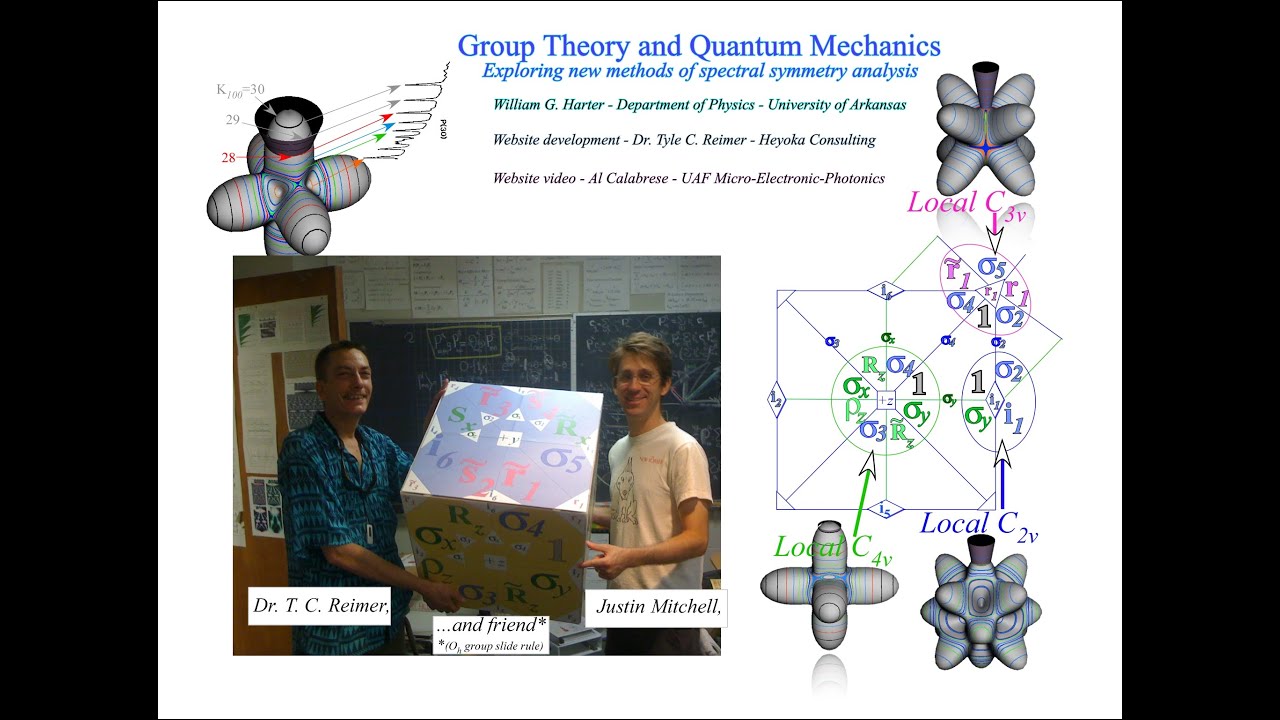
Applications of Group Theory to Physics - Lecture 15
Keywords
Summary
185 words
Critical Evaluation
Value of the Information & Strength of the Argument
The lecture provides a detailed and rigorous exposition of the spectral resolution of the group algebra, a topic that is often treated superficially in physics courses. The instructor emphasizes the physical motivation behind the mathematical formalism, which enhances the value of the information. The argumentation is solid, with clear logical progression from basic definitions to more advanced concepts. The use of concrete examples, such as the D3 group, helps to illustrate abstract ideas. The lecture also highlights the importance of the rank of the algebra, a concept that is not commonly discussed, adding to its value.
Scientific Rigor, Source Quality, Title Accuracy
The lecture is scientifically rigorous, with a clear mathematical foundation. The instructor references his own textbooks, which are established in the field, and provides course materials online. The title accurately reflects the content, as the lecture indeed focuses on applications of group theory to physics. The sources cited are the course website and the lecture slides, which are directly relevant. The lecture is part of a university course, lending credibility to the content. However, as a single lecture, it does not provide a comprehensive review of the entire field, but it is thorough within its scope.
207 words
Title / Content Match
The title accurately reflects the content, which focuses on applications of group theory to physics, specifically the spectral resolution of the group algebra for D3 symmetry.
Quality & Reliability
8/10
Lecture from a university graduate course, presented by a professor with expertise in the field. The content is mathematically rigorous and based on established group theory principles. The lecture is part of a structured course and references textbooks by the lecturer. However, it is not peer-reviewed and is a single perspective, so a score of 8 is appropriate.
Key Moments
Markers derived by PSI from the transcript: the creator did not define chapters.
- Introduction to the three stages of group algebra development
- Review of equivalence classes and class algebra
- Discussion of self-symmetry and Lagrange coset theorem
- Construction of all-commuting class projectors
- Derivation of the character table and spectral resolution
- Block diagonalization of the regular representation
- Introduction to irreducible representations and their traces
- Discussion of the rank of the algebra and its significance
- Application to atomic orbital splitting
- Summary and preview of next lecture
Cited Sources
- Group Theory in Quantum Mechanics Course Website — Course website with additional content and resources
- Lecture 15 Slides (PDF) — Slide presentation for this lecture
Concurring Sources
- Group Theory in Quantum Mechanics Course Website — Course website with additional content and resources
- Lecture 15 Slides (PDF) — Slide presentation for this lecture
Contribution & Novelties
This lecture provides a detailed exposition of the spectral resolution of the group algebra, emphasizing the rank of the algebra, a concept often overlooked in physics-oriented group theory texts. The approach of deriving projectors from the character table and using them to block-diagonalize the regular representation is a powerful technique for solving problems in spectroscopy and quantum mechanics. The lecture also clarifies the distinction between the class algebra and the full group algebra, and demonstrates how to systematically decompose the latter into irreducible representations.
Pour aller plus loin :
- Group representation theory — Provides background on representations and characters.
- Character table — Explains the construction and use of character tables.
- Irreducible representation — Defines irreducible representations and their role.
- Spectral theorem — Underpins the projection operator method used in the lecture.
131 words
Radar Profile
The radar profile shows high scores in technical level and information quality, indicating a mathematically rigorous and well-structured lecture. The quantity of information is also high, but the reliability score is slightly lower, reflecting that it is a single lecture rather than a peer-reviewed source. The overall profile suggests a content that is dense and specialized, suitable for advanced students or researchers.