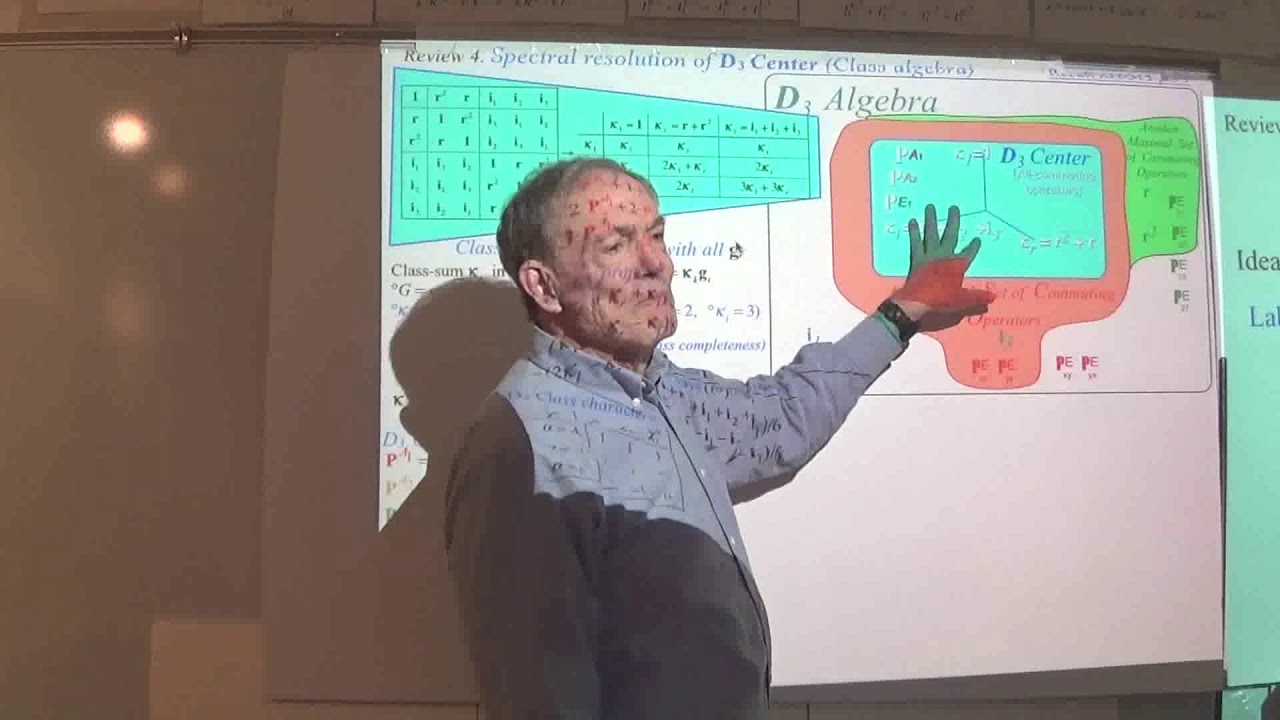
Symmetry Principles for Atomic, Molecular, Optical Physics (2018 Spring) - Lecture #13
Keywords
Summary
140 words
Critical Evaluation
Value of the Information & Strength of the Argument
The lecture provides a thorough and rigorous treatment of group theory applied to quantum mechanics. The argumentation is logical and builds from basic principles to more complex derivations. The instructor clearly explains the significance of each step and connects the mathematical formalism to physical interpretations. The value lies in the detailed derivation of irreducible representation matrices and the clarification of the global vs. local symmetry concept, which is often glossed over in textbooks.
Scientific Rigor, Source Quality, Title Accuracy
The lecture is scientifically rigorous, with careful mathematical derivations and references to the course materials. The sources cited are the course website and the lecture slides, which are directly relevant. The title accurately describes the content, which is a lecture on symmetry principles in AMOP. The lecture is part of a university course, indicating a high level of academic rigor.
148 words
Title / Content Match
The title accurately reflects the content, which is a lecture on symmetry principles in atomic, molecular, and optical physics.
Quality & Reliability
8/10
Lecture by a university professor, part of a graduate course, with detailed mathematical derivations and references to course materials. The content is rigorous and well-structured, though it is a single lecture and not peer-reviewed.
Key Moments
Markers derived by PSI from the transcript: the creator did not define chapters.
- Introduction and review of previous lecture
- Discussion of global vs local symmetry and D3 group
- Construction of class projectors and algebra center
- Splitting of the two-dimensional representation using subgroups
- Introduction of double-index projectors and their physical meaning
- Derivation of matrix elements using the regular representation
- Calculation of off-diagonal matrix elements and nilpotent operators
- Discussion of real vs complex projectors and their physical interpretation
Cited Sources
- AMOP Course Website — Course website providing access to materials and references.
- Lecture #13 Slides (PDF) — Slides used in this lecture, containing the detailed derivations and diagrams.
Concurring Sources
- Course Textbook: Quantum Theory for the Computer Age — Mentioned in the description as a text used for the course.
- Course Textbook: Principles of Symmetry, Dynamics, and Spectroscopy — Mentioned in the description as a text used for the course.
Contribution & Novelties
This lecture provides a detailed and pedagogical exposition of the application of group theory to quantum mechanics, specifically focusing on the D3 group. It clarifies the concept of global vs. local symmetry and demonstrates the construction of irreducible representation matrices through explicit calculations. The lecture is valuable for graduate students and researchers in AMOP.
Pour aller plus loin :
- Group theory — Foundational concepts.
- Representation theory — General framework for irreducible representations.
- Molecular symmetry — Application of group theory in chemistry.
- Quantum mechanics — Context for the use of symmetry in physics.
92 words
Radar Profile
The radar profile shows high scores in technical level and information quality, indicating a rigorous and detailed lecture. The moderate score in quantity of information reflects the focused scope of the lecture, while the high reliability score is consistent with the academic context.