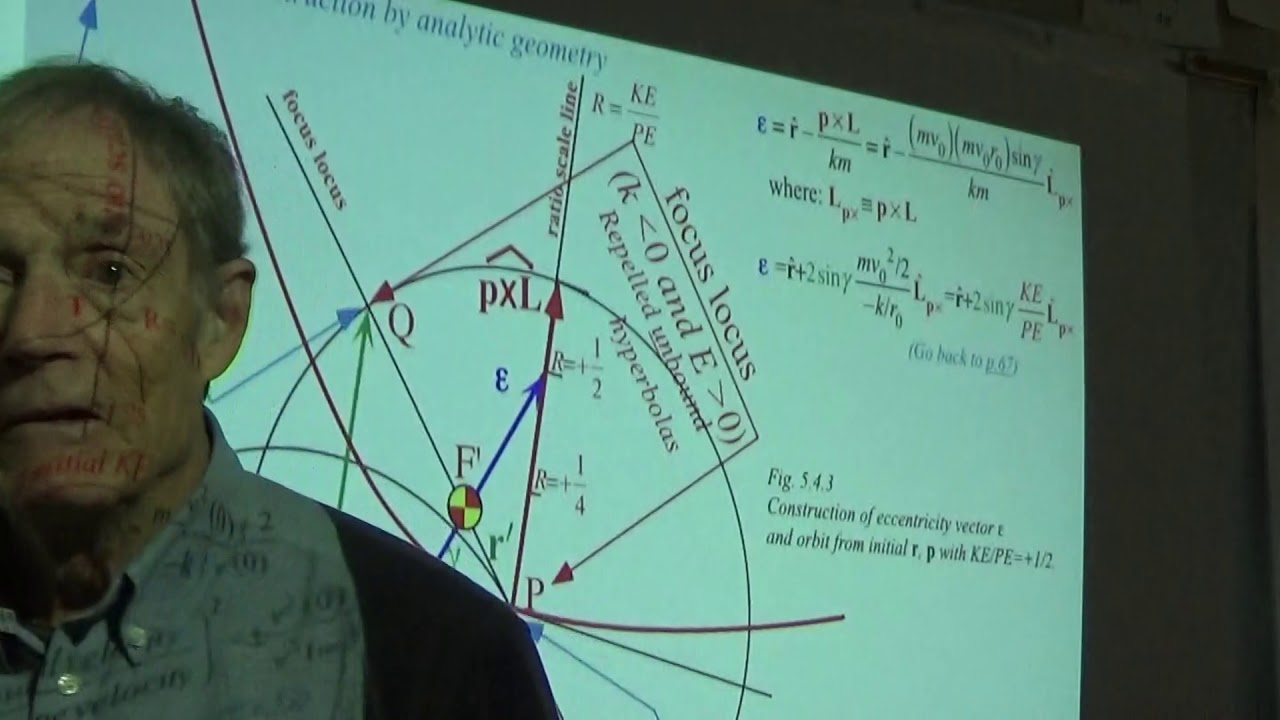
Classical Mechanics with a Bang! (2018 Fall) - Lecture #26 Part 2 / 2
Keywords
Summary
128 words
Critical Evaluation
Value of the Information & Strength of the Argument
The lecture provides valuable insights into the geometric structure of Coulomb orbits, offering a visual and intuitive understanding that complements algebraic treatments. The argumentation is solid, with derivations presented step-by-step and supported by computational demonstrations. The use of the eccentricity vector and the ratio of kinetic to potential energy as parameters simplifies the analysis and reveals deep connections between geometry and physics. The professor’s enthusiasm and the interactive tool enhance the pedagogical value, though the informal style may occasionally obscure the rigor.
91 words
Title / Content Match
The title accurately reflects the content, which is a continuation of a lecture on classical mechanics with a focus on geometric constructions and computational tools.
Quality & Reliability
8/10
Lecture by a university professor, based on a textbook and course materials, with mathematical derivations and computational demonstrations. The content is rigorous but presented in an informal lecture style, with some reliance on visual demonstrations.
Key Moments
Markers derived by PSI from the transcript: the creator did not define chapters.
- Introduction to the geometric construction of Coulomb orbits using ruler and compass.
- Explanation of the focus locus and the role of the eccentricity vector.
- Derivation of the ratio of kinetic to potential energy and its relation to the eccentricity vector.
- Demonstration of the computational tool (TC) for visualizing orbits.
- Discussion of hyperbolic orbits and repulsive force centers.
- Derivation of the momentum circle and its significance.
- Animation showing the momentum vector tracing a circle during an elliptical orbit.
- Introduction to perturbation theory using the geometric parameters.
- Preview of Lecture 27 on exploding orbits and solar wind scenarios.
- Conclusion and reminder of homework due after Thanksgiving.
Cited Sources
- Course Web site: Classical Mechanics with a Bang! — Official course website with resources and materials.
- Lecture #1 slide presentation (pdf) — PDF slides for the first lecture, providing foundational content.
Concurring Sources
- Classical Mechanics with a Bang! (textbook) — The textbook associated with the course, which likely contains the derivations and geometric constructions presented.
Contribution & Novelties
This lecture offers a unique geometric perspective on classical mechanics, emphasizing the construction of orbits using ruler and compass and the use of computational tools for visualization. The derivation of the momentum circle is a particularly elegant result that deepens understanding of orbital dynamics. The lecture also introduces a novel parameterization using the ratio of kinetic to potential energy, which simplifies the analysis of orbits.
Pour aller plus loin :
- Eccentricity vector — Provides background on the eccentricity vector and its role in orbital mechanics.
- Laplace–Runge–Lenz vector — Related conserved vector in the two-body problem.
- Coulomb’s law — Fundamental law governing electrostatic interactions, relevant to the force center discussed.
109 words
Radar Profile
The radar profile shows high scores in technical level and information quality, reflecting the advanced nature of the content and the depth of the presentation. The moderate score in information quantity is due to the lecture's focus on specific geometric aspects rather than a broad overview. Overall, the lecture is highly specialized and rigorous.