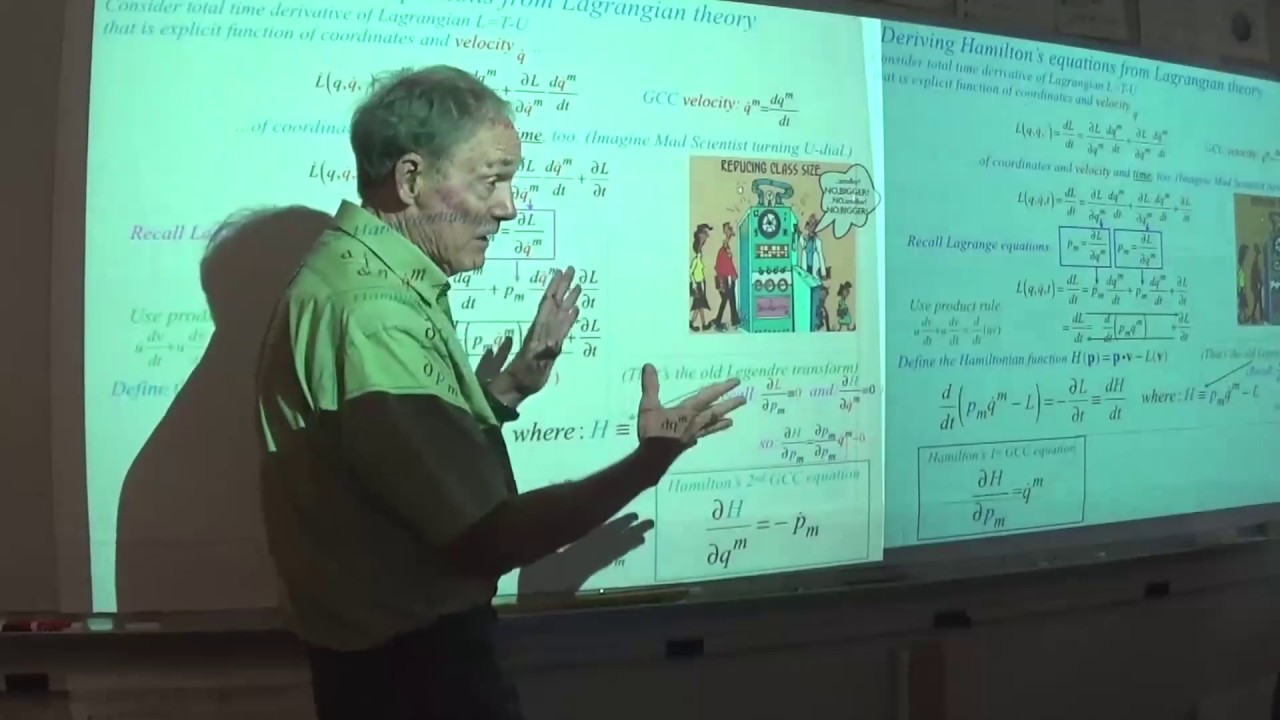
Classical Mechanics with a Bang! (2018 Fall) - Lecture #10
Keywords
Summary
154 words
Critical Evaluation
Value of the Information & Strength of the Argument
The lecture provides a thorough and insightful comparison between Lagrangian and Hamiltonian mechanics, emphasizing the geometric underpinnings. The argumentation is solid, building from first principles and using tensor notation to clarify the role of metrics. The professor effectively demonstrates the algebraic derivation of Hamilton’s equations and applies them to a concrete example (polar coordinates), which strengthens the practical value. The discussion of effective potentials and the connection to quantum mechanics adds depth. However, the transcription is imperfect, and some parts are hard to follow, but the core ideas are clearly presented.
Scientific Rigor, Source Quality, Title Accuracy
The lecture is based on the professor’s own textbook ‘Classical Mechanics with a Bang!’ and is part of a university course. The slides are provided, and the course website is referenced. The content is consistent with standard classical mechanics literature. The title accurately reflects the content, which is a lecture on classical mechanics. The video is not peer-reviewed, but the academic context lends credibility. No external sources are cited beyond the course materials.
179 words
Title / Content Match
The title accurately reflects the content, which is a lecture on classical mechanics with a focus on Hamiltonian mechanics.
Quality & Reliability
8/10
Lecture by a university professor, based on a textbook and accompanied by slides. The content is mathematically rigorous and consistent with standard classical mechanics. However, the transcription is imperfect and the video is not peer-reviewed.
Key Moments
Markers derived by PSI from the transcript: the creator did not define chapters.
- Introduction and overview of the lecture topics.
- Comparison of Lagrangian and Hamiltonian approaches.
- Derivation of the Hamiltonian via Legendre transformation.
- Discussion of explicit time dependence and conservation.
- Application to polar coordinates and construction of Hamiltonian.
- Derivation of Hamilton's equations for polar coordinates.
- Discussion of effective potentials and examples.
- Connection to quantum mechanics and symmetry.
Cited Sources
- Course Web site — Course website for the textbook and lectures.
- Lecture #10 slides (PDF) — Slides used in this lecture.
Concurring Sources
- Classical Mechanics (Goldstein et al.) — Standard graduate textbook covering Hamiltonian mechanics in depth.
Contribution & Novelties
The lecture provides a clear geometric interpretation of Hamiltonian mechanics, emphasizing the role of covariant and contravariant metrics. It offers a detailed derivation of Hamilton’s equations from the Lagrangian via Legendre transformation, which is often glossed over in standard texts. The application to polar coordinates illustrates the practical steps and highlights the advantages of the Hamiltonian for numerical simulations. The connection to quantum mechanics and symmetry principles adds a deeper perspective.
Pour aller plus loin :
- Hamiltonian mechanics — Overview of Hamiltonian mechanics and its formulation.
- Legendre transformation — Mathematical foundation for the transformation between Lagrangian and Hamiltonian.
- Effective potential — Concept used in central force problems, relevant to the examples discussed.
112 words
Radar Profile
The radar profile shows high scores in technical level and information quality, reflecting the advanced and rigorous nature of the lecture. The lower score in fiabilite_globale is due to the lack of peer review and potential transcription errors, but overall the content is reliable.
💬 No comments were provided for analysis.