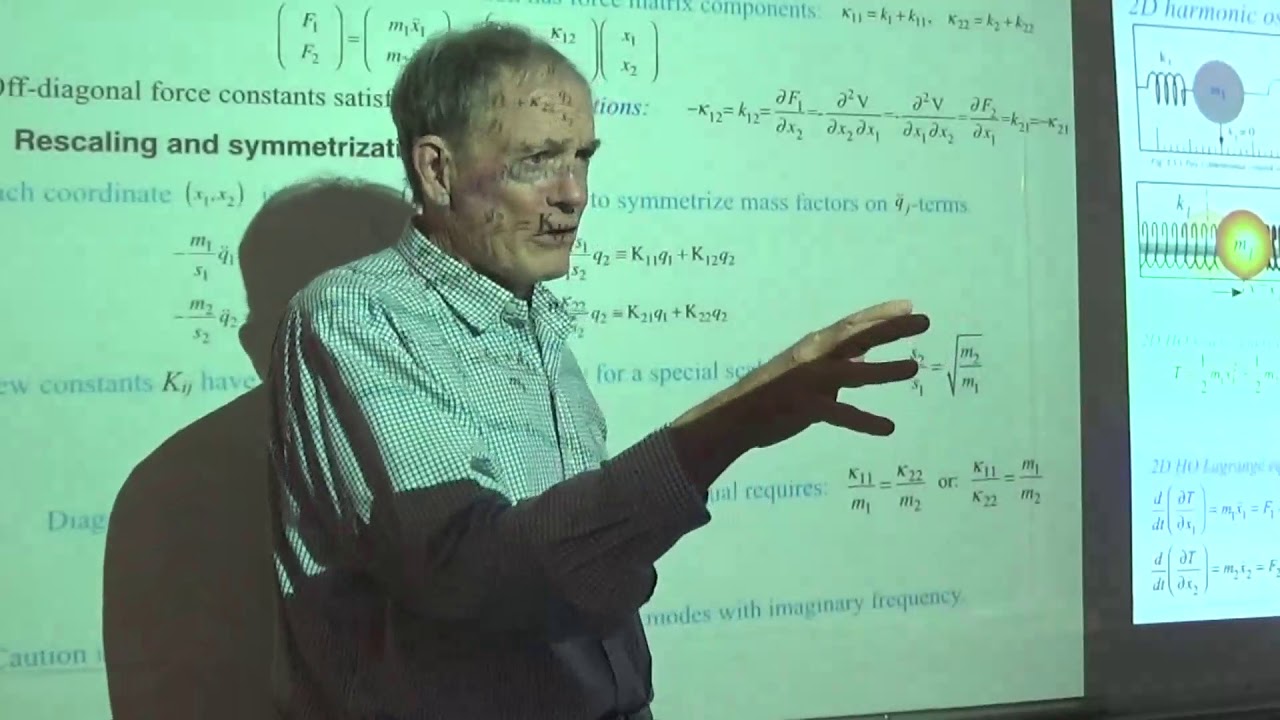
Classical Mechanics with a Bang! (2018 Fall) - Lecture #21
Keywords
Summary
149 words
Critical Evaluation
Value of the Information & Strength of the Argument
The lecture provides a rigorous mathematical derivation of the eigenvalue problem for coupled oscillators, emphasizing the construction of projection operators via the Hamilton-Cayley theorem. The argumentation is logical and builds step-by-step, from setting up the equations to deriving the eigenvectors. The instructor also offers geometric insights, which help visualize the normal modes. The value lies in the clear exposition of a powerful mathematical technique that extends beyond the specific example, applicable to various physical systems. The argumentation is solid, though the pace is fast and assumes prior knowledge of linear algebra and mechanics.
Scientific Rigor, Source Quality, Title Accuracy
The lecture is scientifically rigorous, based on established mathematical theorems (Hamilton-Cayley, Sylvester’s theorem) and classical mechanics principles. The instructor is a professor, and the content aligns with the course textbook ‘Classical Mechanics with a Bang!’. The title accurately reflects the content, which is a lecture on classical mechanics with a focus on matrix methods. The description provides links to the course website and lecture slides, which are credible sources. The lecture is part of a series, indicating a structured curriculum. Overall, the sources are reliable and the title is appropriate.
198 words
Title / Content Match
The title accurately reflects the content: a lecture on classical mechanics, specifically focusing on matrix methods for coupled oscillators.
Quality & Reliability
8/10
Lecture by a university professor, part of a graduate course, with a structured mathematical approach. The content is based on established theory (Hamilton-Cayley, Sylvester's theorem) and includes derivations. However, the video is a raw lecture with no editing, and the audio is sometimes unclear, which may affect comprehension.
Key Moments
Markers derived by PSI from the transcript: the creator did not define chapters.
- Introduction to the lecture, overview of coupled oscillators and matrix methods.
- Setting up the equations of motion for two coupled masses, introducing the mass and stiffness matrices.
- Discussion of the potential energy surface and geometric interpretation of normal modes.
- Introduction to the secular equation and the eigenvalue problem.
- Statement of the Hamilton-Cayley theorem and its application to construct projection operators.
- Derivation of the projection operators and their normalization using Sylvester's theorem.
- Extraction of eigenvectors from the projection operators, demonstration with the 1-2-3-4 matrix.
- Discussion of the properties of projection operators, idempotency, and orthogonality.
- Application to the coupled oscillator problem, obtaining the normal modes.
- Conclusion and preview of next lecture on spinors and quaternions.
Cited Sources
- Course Web site — Official course website with resources and information.
- Lecture #21 slide presentation (pdf) — PDF slides used in the lecture, providing detailed mathematical derivations.
Concurring Sources
- Classical Mechanics with a Bang! (textbook) — The course textbook, which the lecture follows, provides a comprehensive treatment of the subject.
Contribution & Novelties
This lecture offers a clear and detailed exposition of the eigenvalue problem for coupled oscillators using projection operators, a method that is often glossed over in standard treatments. The instructor emphasizes the Hamilton-Cayley theorem and Sylvester’s theorem, providing a powerful algebraic technique that is applicable to a wide range of problems. The geometric interpretation of the potential energy surface adds an intuitive dimension to the understanding of normal modes. The lecture also highlights the connection to quantum mechanics, where similar mathematical structures appear.
Pour aller plus loin :
- Hamilton-Cayley theorem — Fundamental theorem in linear algebra used to construct projection operators.
- Sylvester’s formula — Method for computing functions of matrices, closely related to the projection operators discussed.
- Projection (linear algebra) — Concept of projection operators in vector spaces, central to the lecture’s method.
133 words
Radar Profile
The radar profile shows high scores in technical level and information quality, reflecting the advanced mathematical content and rigorous presentation. The quantity of information is also high, as the lecture covers a substantial amount of material. The reliability is strong, given the academic context. The overall profile indicates a dense, expert-level lecture suitable for graduate students or advanced undergraduates.
💬 No comments were provided for analysis.