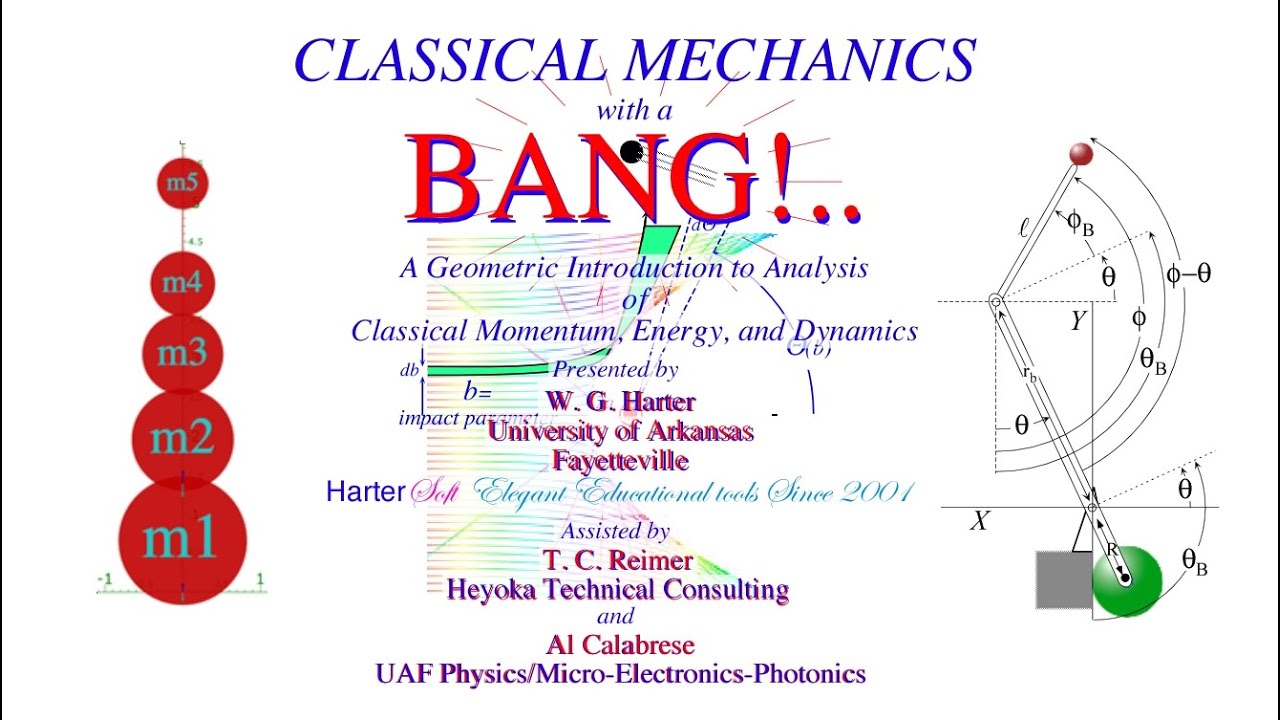
Classical Mechanics with a Bang! - Lecture 19 & 20 (720p)
Keywords
Summary
167 words
Critical Evaluation
Value of the Information & Strength of the Argument
The lecture provides valuable insights into the physics of the trebuchet and the mathematical framework of tensor analysis. The argumentation is solid, with clear derivations and physical reasoning. The professor effectively connects abstract mathematical concepts to practical examples, such as sports and historical siege engines. The use of simulations enhances the understanding of parametric amplification. However, the lecture assumes a high level of mathematical sophistication, which may limit its accessibility.
79 words
Title / Content Match
The title accurately reflects the content, which covers classical mechanics with a focus on the trebuchet and tensor analysis.
Quality & Reliability
8/10
Lecture by a university professor, part of a graduate course, with mathematical derivations and physical demonstrations. The content is rigorous and well-structured, though it is a lecture rather than peer-reviewed material.
Key Moments
Markers derived by PSI from the transcript: the creator did not define chapters.
- Introduction to the lecture topics: trebuchet and tensor analysis.
- Discussion of the trebuchet as an example of parametric amplification.
- Comparison of trebuchet and flinger mechanisms.
- Derivation of energy gain in rotating frame.
- Numerical comparison of trebuchet and flinger velocities.
- Introduction to Riemann-Christoffel equations and Christoffel symbols.
- Definition of covariant derivative and its role in general relativity.
- Example using cylindrical polar coordinates.
- Simulation of parametric amplification with a pendulum.
- Simulation of Schrödinger equation with periodic potential.
Cited Sources
- Classical Mechanics with a Bang! — Course textbook by Prof. William G. Harter.
- Harter-Soft — Software used for simulations.
Concurring Sources
- Classical Mechanics with a Bang! — The course textbook aligns with the lecture content.
Contribution & Novelties
The lecture provides a unique pedagogical approach to classical mechanics by emphasizing geometric and tensorial methods. It connects the physics of the trebuchet to parametric amplification and modern computational tools. The discussion of Christoffel symbols and covariant derivatives is presented in a way that bridges classical mechanics and general relativity.
Pour aller plus loin :
- Christoffel symbols — Overview of the mathematical objects used in the lecture.
- Covariant derivative — Generalization of the derivative to curved spaces.
- Parametric oscillator — Physical system exhibiting parametric amplification.
85 words
Radar Profile
The radar profile shows high scores in technical level and information quality, with slightly lower scores in information quantity and reliability. This indicates a lecture that is dense and rigorous but may be less accessible to a general audience.
💬 No comments were provided for analysis.