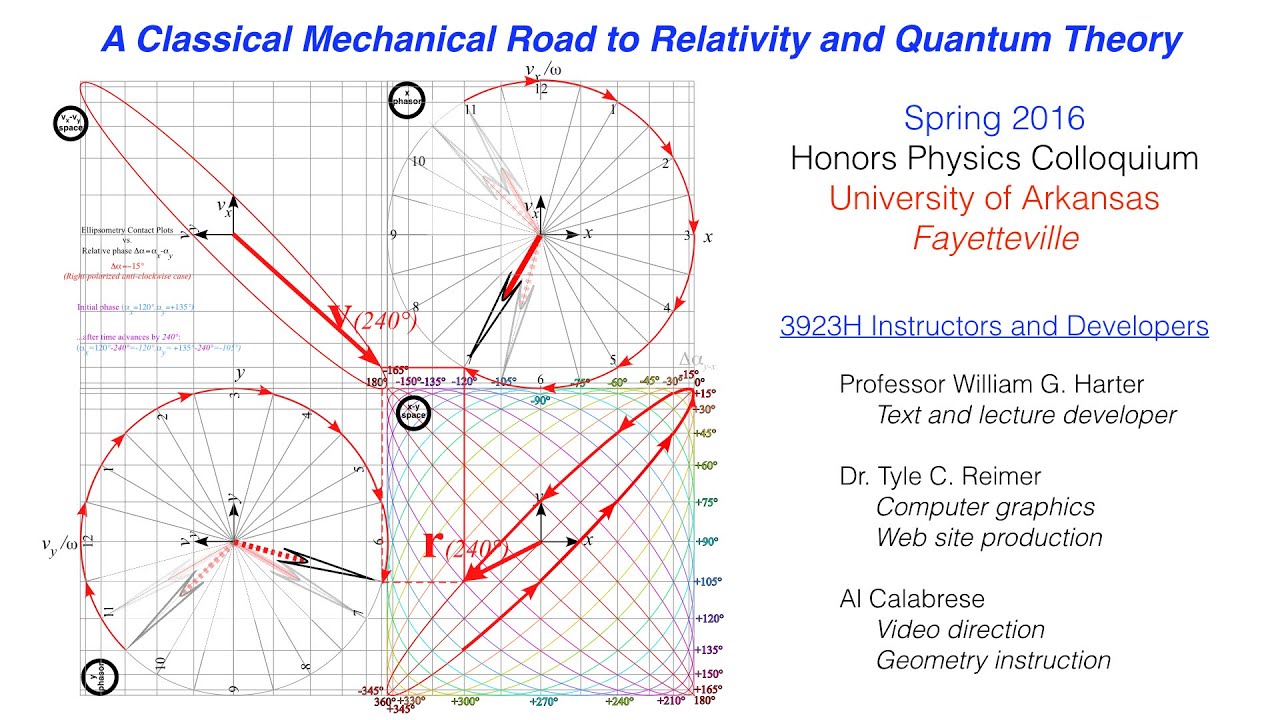
Keywords
Summary
188 words
Critical Evaluation
Value of the Information & Strength of the Argument
The lecture provides valuable insights into the deep connections between classical and quantum mechanics through the lens of quaternions and matrix algebra. The argumentation is solid, building from fundamental concepts to more advanced topics, with clear explanations and mathematical derivations. Harter effectively demonstrates how quaternions, initially a purely mathematical construct, find direct application in quantum mechanics, particularly in the representation of spin. The treatment of matrix diagonalization is thorough, showing the power of the Cayley-Hamilton theorem and the construction of projectors. The lecture is well-structured, with a logical flow that helps the viewer understand the material. However, the presentation is somewhat informal and assumes a certain level of prior knowledge, which may be challenging for beginners.
Scientific Rigor, Source Quality, Title Accuracy
The lecture is scientifically rigorous, with a clear mathematical foundation. Harter references the work of Hamilton, Cayley, and others, and the content aligns with standard treatments in quantum mechanics and linear algebra. The sources cited in the description include the course website and the lecture slides, which provide additional resources for verification. The title accurately reflects the content, as it is a lecture in an honors physics colloquium series. The lecture is based on the textbook ‘A Classical Mechanical Road to Relativity and Quantum Theory’ by the same author, which lends credibility to the material. However, the lecture does not cite external sources beyond the course materials, and the presentation is more of a pedagogical exposition than a review of literature.
252 words
Title / Content Match
The title accurately reflects the content: a lecture in an honors physics colloquium series.
Quality & Reliability
8/10
Lecture by a professor with deep expertise in the subject, based on a textbook and course materials. The content is mathematically rigorous and well-structured, but it is a single lecture without peer review or external validation.
Key Moments
Markers derived by PSI from the transcript: the creator did not define chapters.
- Introduction and overview of the lecture, mentioning St. Patrick's Day and the Irish mathematician Hamilton.
- Review of the connection between classical harmonic oscillator and quantum oscillator, and the introduction of quaternions.
- Discussion of Hamilton's discovery of quaternions in 1843 and their relation to Pauli spin matrices.
- Explanation of how any unit vector can define a Pauli spin matrix, and the properties of these matrices.
- Introduction to the secular equation and the Cayley-Hamilton theorem for matrix diagonalization.
- Derivation of projectors and their role in finding eigenvectors.
- Application of these methods to compute eigenvalues and eigenvectors of a specific 2x2 matrix.
- Discussion of the importance of these mathematical tools in quantum mechanics, particularly for energy eigenvalues.
- Further exploration of the connection between quaternions and spin, and the geometric interpretation.
- Conclusion and assignment of problems related to the lecture content.
Cited Sources
- Course Website — Course website for the Honors Physics Colloquium, providing access to lecture materials.
- Lecture #18 Slides (PDF) — PDF slides for this specific lecture, containing the mathematical derivations and diagrams.
Concurring Sources
- Course Website — The course website provides additional resources and context for the lecture series.
Contribution & Novelties
The lecture provides a unique pedagogical approach by emphasizing the geometric and historical connections between classical mechanics and quantum mechanics, particularly through the use of quaternions. It offers a clear demonstration of how matrix diagonalization and the Cayley-Hamilton theorem are fundamental to quantum mechanics. The lecture also highlights the often-overlooked role of quaternions in physics, which are typically overshadowed by vector analysis.
Pour aller plus loin :
- Quaternions — Wikipedia article on quaternions, providing a comprehensive overview of their mathematical properties and history.
- Pauli matrices — Wikipedia article on Pauli matrices, which are central to the lecture’s discussion of spin.
- Cayley–Hamilton theorem — Wikipedia article on the Cayley-Hamilton theorem, which is used for matrix diagonalization in the lecture.
118 words
Radar Profile
The radar profile shows high scores in quantitative information, qualitative information, technical level, and global reliability, indicating a dense and rigorous lecture. The relatively lower score in 'fiabilite_globale' compared to others might reflect the lack of external verification, but overall the lecture is highly informative and technically sound.
💬 No comments were provided for analysis.