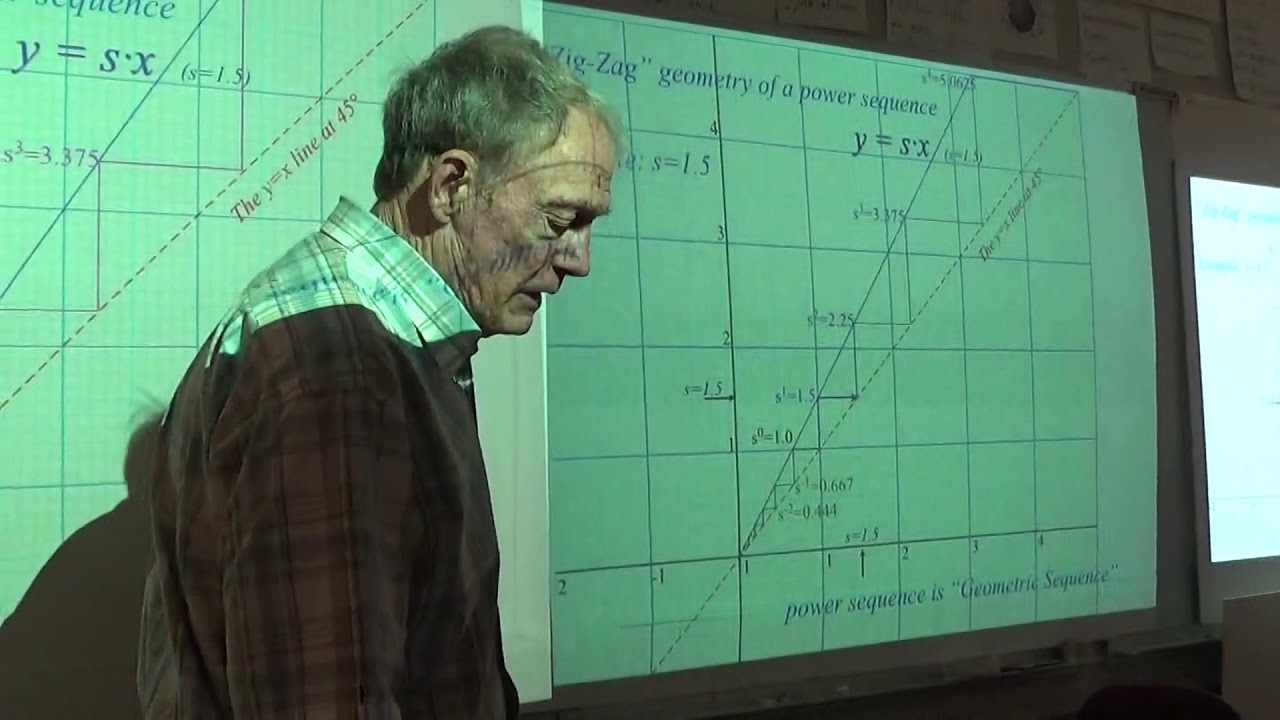
Classical Mechanics with a Bang! (2018 Fall) - Lecture #6 Part 1/2
Keywords
Summary
148 words
Critical Evaluation
Value of the Information & Strength of the Argument
The lecture provides a valuable geometric perspective on classical mechanics, offering intuitive visual constructions for mathematical functions and potentials. The argumentation is solid, building from simple geometric principles to more complex applications. The instructor clearly explains the reasoning behind each construction, making the material accessible despite its advanced nature. The connection between geometry and physics is well-argued, and the lecture sets the stage for deeper exploration of orbits and symmetries.
Scientific Rigor, Source Quality, Title Accuracy
The scientific rigor is high, as the lecture is part of a university course and is based on the instructor’s textbook. The geometric methods are mathematically sound, and the instructor takes care to explain the underlying principles. The sources cited include the course website and PDF slides, which provide additional resources. The title accurately reflects the content, and the lecture stays on topic. No public comments were provided for analysis.
155 words
Title / Content Match
The title accurately reflects the content: a lecture on classical mechanics with a geometric approach, including potentials and orbits.
Quality & Reliability
8/10
Lecture by a university professor, part of a graduate course, with a dedicated course website and PDF slides. The content is mathematically rigorous and based on established physics. However, it is a single lecture, not peer-reviewed, and some geometric constructions are original to the author.
Key Moments
Markers derived by PSI from the transcript: the creator did not define chapters.
- Introduction to the lecture: geometry of potentials, harmonic oscillator and Coulomb field, and the 'sophomore physics earth' model.
- Discussion of magnitudes: comparing Coulomb and gravitational fields, and extreme densities like neutron stars and black holes.
- Introduction to the zigzag method for constructing powers and exponentials graphically.
- Demonstration of the zigzag method to construct parabolas and other curves.
- Discussion of the historical context: Euclidean geometry, algebra, and the development of calculus.
- Application of zigzag to the harmonic oscillator potential and Hooke's law.
- Introduction to conic sections: focus, directrix, and latus rectum of a parabola.
- The 'kite construction' for parabolas and its significance for orbit analysis.
- Geometric construction of the Coulomb potential using zigzag method.
- Discussion of the 'sophomore physics earth' model and its implications.
Cited Sources
- Course Web site — Course website for 'Classical Mechanics with a Bang!' providing resources and information.
- Lecture #6-1 slide presentation (pdf) — PDF slides for this specific lecture, used as visual aid.
Concurring Sources
- Classical Mechanics with a Bang! (textbook) — The textbook by Prof. Harter, which this lecture is based on.
Contribution & Novelties
The lecture offers a unique geometric visualization of classical mechanics, particularly the zigzag method for constructing functions and potentials. This approach provides intuitive insights into the symmetry and behavior of harmonic oscillator and Coulomb potentials, which are foundational for understanding more complex systems. The ‘sophomore physics earth’ model is a pedagogical tool that unifies these potentials in a single framework.
Pour aller plus loin :
- Harmonic oscillator — Fundamental concept in physics, central to the lecture.
- Coulomb’s law — Describes the electrostatic interaction, analogous to the gravitational potential discussed.
- Conic sections — Geometric curves including parabolas, essential for orbit analysis.
- Kepler orbit — Application of conic sections to celestial mechanics.
- Neutron star — Extreme density object mentioned in the lecture.
120 words
Radar Profile
The radar profile shows high scores across all dimensions, indicating a well-rounded lecture with substantial information, solid quality, appropriate technical depth, and reliable content. The lecture excels in providing a rigorous geometric foundation for classical mechanics.