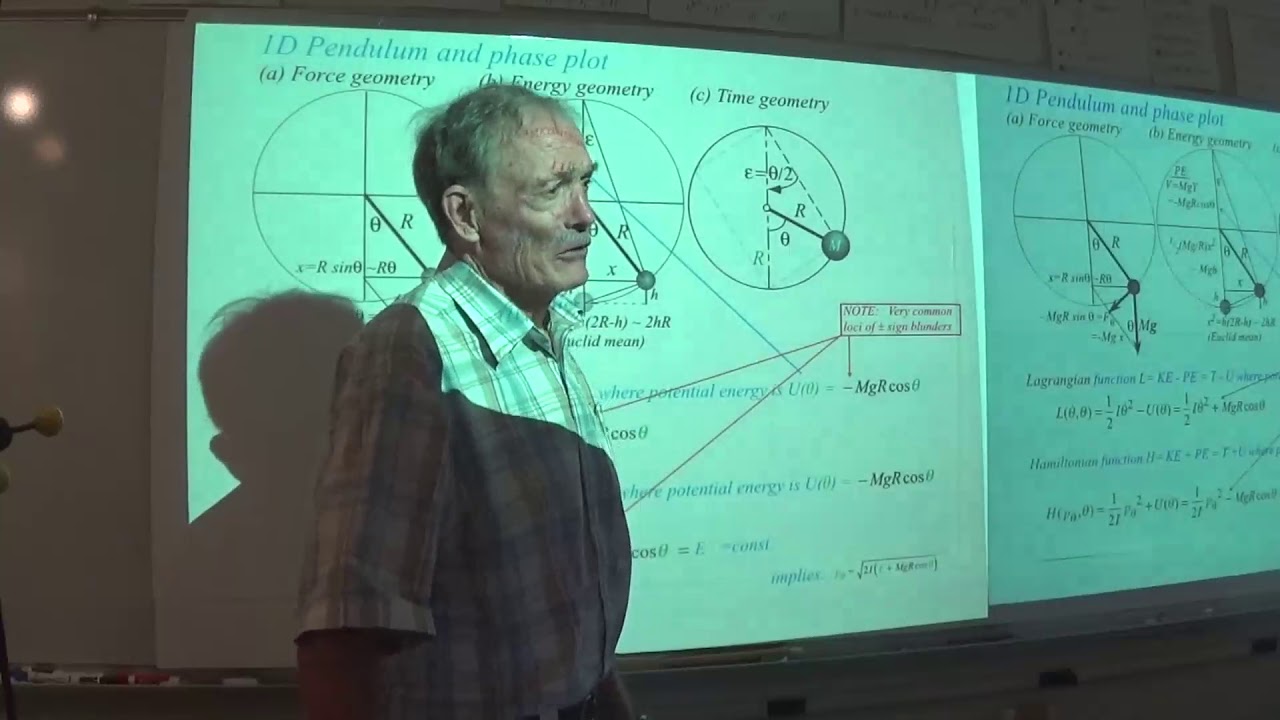
Classical Mechanics with a Bang! (2018 Fall) - Lecture #11
Keywords
Summary
149 words
Critical Evaluation
Value of the Information & Strength of the Argument
The lecture provides valuable insights into advanced classical mechanics, particularly the geometric interpretation of Hamiltonian dynamics and the use of elliptic functions. The argumentation is solid, built on mathematical derivations and physical reasoning, with clear connections to quantum mechanics. The professor demonstrates a deep understanding of the subject and effectively communicates complex ideas through simulations and diagrams. The value lies in the pedagogical approach that unifies classical and quantum concepts, offering a fresh perspective for graduate students.
Scientific Rigor, Source Quality, Title Accuracy
The scientific rigor is high, as the lecture is part of a university course and based on the professor’s textbook. The sources cited include the course website and the lecture slides, which provide additional resources. The title accurately reflects the content, being part of a series. The lecture is well-structured, though occasional technical difficulties with simulations are noted. The content is consistent with established physics, and the professor’s expertise is evident.
163 words
Title / Content Match
The title accurately reflects the content: a lecture on classical mechanics, part of a series titled 'Classical Mechanics with a Bang!'.
Quality & Reliability
8/10
Lecture by a university professor, part of a graduate course, with accompanying slides and course website. Content is advanced and mathematically rigorous, but not peer-reviewed. The video is a recording of a live lecture with occasional technical issues.
Key Moments
Markers derived by PSI from the transcript: the creator did not define chapters.
- Introduction and overview of the lecture topics: Hamilton-Jacobi theory, phase space, and the connection to quantum mechanics.
- Discussion of the harmonic oscillator in phase space, Hamiltonian as a surface, and the cross product formulation of Hamilton's equations.
- Introduction to the anharmonic pendulum, elliptic integrals, and the geometry of energy.
- Simulation of the pendulum showing elliptic function behavior and Fourier transform of the motion.
- Huygens' cycloidal pendulum: the evolute and involute, and how it achieves isochronous motion.
- Further discussion of the cycloid, its properties, and the simulation of the cycloidal pendulum.
- Conclusion and summary of the lecture, emphasizing the geometric approach and its implications.
Cited Sources
- Course Web site — Course website for 'Classical Mechanics with a Bang!' providing resources and materials.
- Lecture #11 slides (PDF) — Slides used in this lecture, containing the detailed mathematical derivations and figures.
Concurring Sources
- Course Web site — Official course website, consistent with the lecture content.
Contribution & Novelties
The lecture provides a unique geometric perspective on classical mechanics, emphasizing the role of phase space and the Hamilton-Jacobi formalism. It bridges classical and quantum mechanics by showing how classical trajectories can be used to construct quantum wave functions via the Lagrangian. The discussion of elliptic functions and the cycloidal pendulum offers deep insights into anharmonic systems. The use of simulations to visualize these concepts is particularly effective.
Pour aller plus loin :
- Hamilton-Jacobi equation — Foundational concept in classical mechanics, connecting to quantum mechanics.
- Elliptic integral — Mathematical tools used to solve the pendulum problem.
- Cycloid — The curve that provides isochronous motion, as used by Huygens.
108 words
Radar Profile
The radar profile shows high scores in technical level and information quality, indicating a rigorous and detailed lecture. The lower score in quantity of information reflects the focused scope of a single lecture, while the high fiability score underscores the academic credibility.