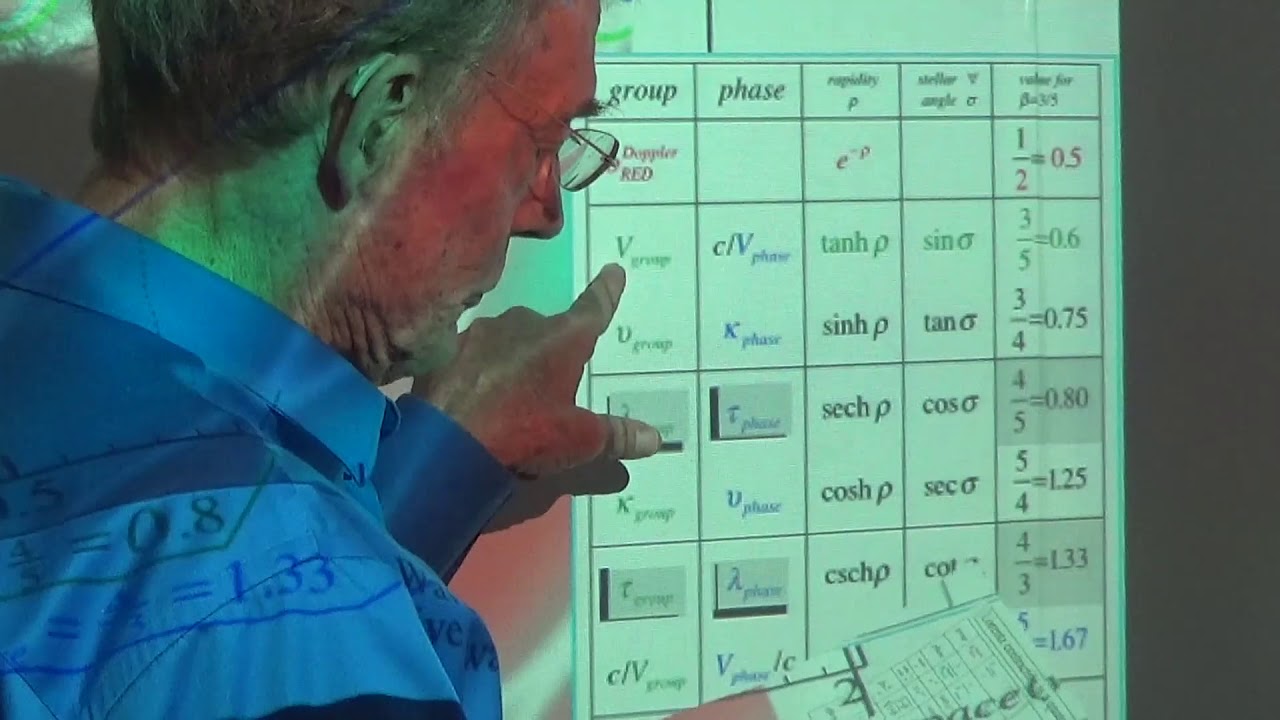
Classical Mechanics with a Bang! (2019 Fall) - Lecture #30
Keywords
Summary
169 words
Critical Evaluation
Value of the Information & Strength of the Argument
The lecture provides a valuable and original perspective by deriving quantum mechanical relations from classical wave mechanics using a geometric framework. The argumentation is solid, building step-by-step from the Doppler effect and wave properties to the energy-momentum relation. The use of hyperbolic functions and the connection to special relativity is elegant and clarifies the underlying unity. However, the presentation is informal and sometimes rambling, which may obscure the logical flow for some viewers. The derivation of E=mc² and the de Broglie relation is convincing, but the treatment of quantum mechanics is introductory and does not delve into the full formalism.
Scientific Rigor, Source Quality, Title Accuracy
The lecture is scientifically rigorous, with a clear mathematical foundation. The professor references his own course materials and the textbook ‘Classical Mechanics with a Bang!’, but does not cite external sources. The title accurately reflects the content, as the lecture indeed connects classical mechanics to quantum phenomena. The informal style and occasional digressions do not detract from the scientific accuracy, but the lack of external references limits the verification of the presented ideas. The course website and lecture slides are provided, which offer additional resources for students.
202 words
Title / Content Match
The title accurately reflects the content: the lecture explores the 'bang' of quantum mechanics emerging from classical mechanics, with a focus on the geometric and relativistic foundations.
Quality & Reliability
7/10
The lecture is part of a graduate physics course by an experienced professor. It presents a geometric approach to classical mechanics and connects it to quantum mechanics. The content is mathematically rigorous, but the presentation is informal and relies on board work, which may be less polished than a textbook. The sources are limited to course materials, but the reasoning is internally consistent.
Key Moments
Markers derived by PSI from the transcript: the creator did not define chapters.
- Introduction and review of previous lecture on Doppler shift and group/phase velocities.
- Discussion of the geometric representation of waves and the relationship between phase and group velocities.
- Introduction of the idea that quantum mechanics arises from the 'heartbeat' of matter, i.e., the phase.
- Derivation of the low-speed approximations for phase frequency and wave number, leading to kinetic energy and momentum.
- Introduction of Planck's constant and the scaling factor to match units, leading to E=mc².
- Presentation of the exact relativistic formulas: E=mc² cosh(ρ) and pc=mc² sinh(ρ).
- Discussion of the de Broglie hypothesis and its connection to the wave nature of matter.
- Explanation of the Schrödinger approximation and the concept of rest mass.
- Summary of the key results and preparation for the final exam.
Cited Sources
- Course Web site — Official course website with materials and resources.
- Lecture #30 slide presentation (pdf) — Slides used in the lecture, containing the diagrams and tables referenced.
Concurring Sources
- Course Web site — The course materials align with the lecture content.
Contribution & Novelties
The lecture offers a unique geometric derivation of quantum mechanical energy and momentum from classical wave mechanics, emphasizing the role of hyperbolic functions and special relativity. It provides a clear connection between the Doppler effect, phase/group velocities, and the de Broglie relation, which is often presented as a postulate. The approach highlights the underlying unity of classical and quantum physics.
Pour aller plus loin :
- De Broglie hypothesis — This concept is central to the lecture, as it connects wave properties to particle momentum.
- Energy–momentum relation — The lecture derives this relation from wave mechanics, and this article provides a standard treatment.
- Schrödinger equation — The lecture mentions the Schrödinger approximation; this article gives a comprehensive overview.
- Special relativity — The lecture uses relativistic concepts; this article provides background.
129 words
Radar Profile
The radar profile shows high scores in quantity of information and technical level, reflecting the dense and advanced content. The quality and reliability scores are slightly lower due to the informal presentation and lack of external references. Overall, the lecture is a solid resource for advanced students.