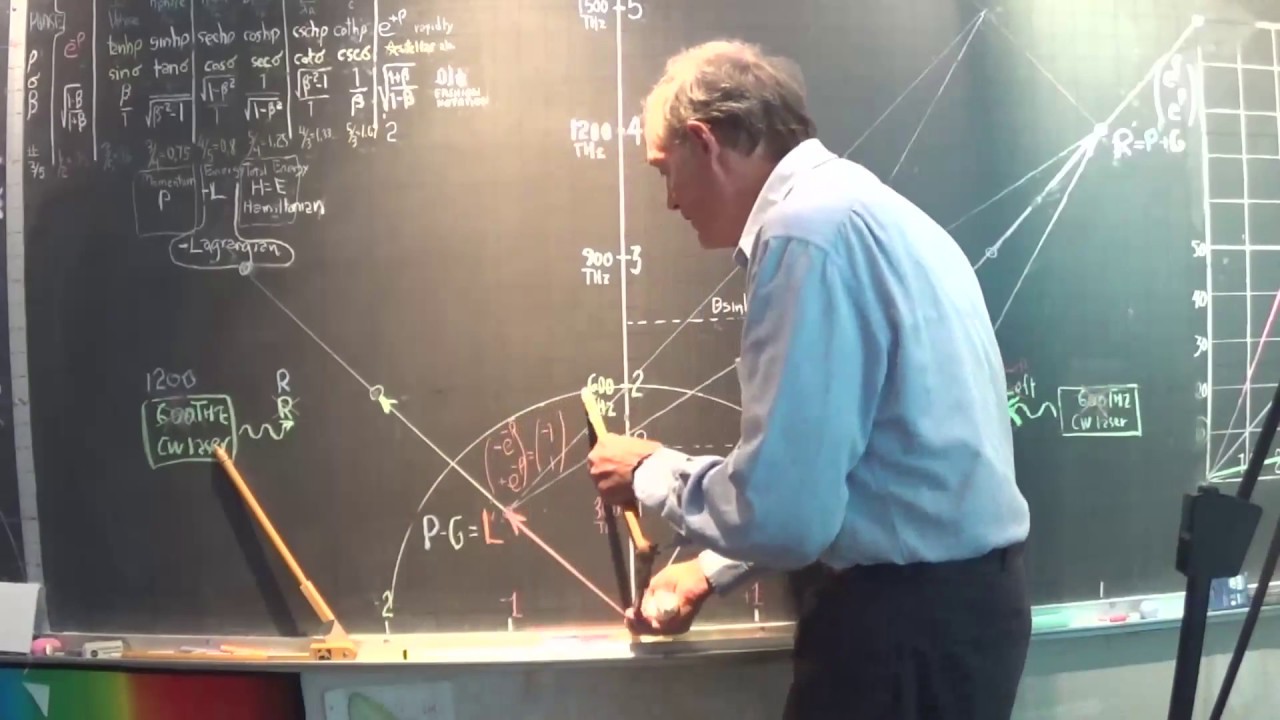
Classical Mechanics with a Bang! (2018 Fall) - Lecture #29 Part II
Keywords
Summary
163 words
Critical Evaluation
Value of the Information & Strength of the Argument
The lecture provides a deep and original geometric insight into classical mechanics, connecting it to relativity and quantum mechanics. The argumentation is rigorous, building from the Doppler shift to hyperbolic geometry and the invariance of area. The instructor uses diagrams and examples to make the abstract concepts tangible. The value lies in the unified perspective it offers, which is not commonly found in standard textbooks.
Scientific Rigor, Source Quality, Title Accuracy
The lecture is scientifically rigorous, based on established physics and the instructor’s own textbook. The sources cited are the course website and the lecture slides, which are appropriate for a university course. The title accurately reflects the content. The lecture is part of a series, and the instructor references previous and future lectures, indicating a coherent curriculum.
137 words
Title / Content Match
The title accurately reflects the content: a lecture on classical mechanics with a geometric approach, part of a series.
Quality & Reliability
8/10
Lecture by a university professor, part of a graduate course, with a structured geometric approach. The content is rigorous and based on established physics, but it is a lecture, not peer-reviewed, and the video has low viewership.
Key Moments
Markers derived by PSI from the transcript: the creator did not define chapters.
- Introduction and recap of previous lecture.
- Discussion of the geometry of the 'pitcher's mound' diagram.
- Derivation of hyperbolic sine and cosine from the sum and difference of vectors.
- Construction of circles to represent the hyperbolic functions.
- Example with two lasers and the resulting group and phase velocities.
- Discussion of the invariance of area and its relation to the relativistic invariant.
- Student questions about the reciprocal nature of the vectors and the invariance of area.
- Explanation of how to calculate velocity from frequency and wave number.
- Preview of how the geometry will be used in quantum mechanics.
Cited Sources
- Course Web site — Course website for the textbook and lectures.
- Lecture #29 Part II slide presentation (pdf) — Slides for this specific lecture.
Concurring Sources
- Course Web site — The course website provides additional materials and context for the lecture.
Contribution & Novelties
The lecture offers a unique geometric visualization of the relationship between classical mechanics, relativity, and quantum mechanics, using the Doppler shift as a unifying concept. It emphasizes the invariance of area in phase space as a fundamental principle. This approach is not commonly presented in standard textbooks, providing an original perspective for advanced students.
Pour aller plus loin :
- Rapidity — The hyperbolic angle used in relativity, directly related to the hyperbolic functions discussed.
- Phase velocity — The velocity of a phase front, which can exceed the speed of light, as discussed in the lecture.
- Group velocity — The velocity of the envelope of a wave packet, which is limited by the speed of light, as contrasted with phase velocity.
120 words
Radar Profile
The radar profile shows high scores in technical level and information quality, with slightly lower scores in quantity and reliability, reflecting the advanced and specialized nature of the content.