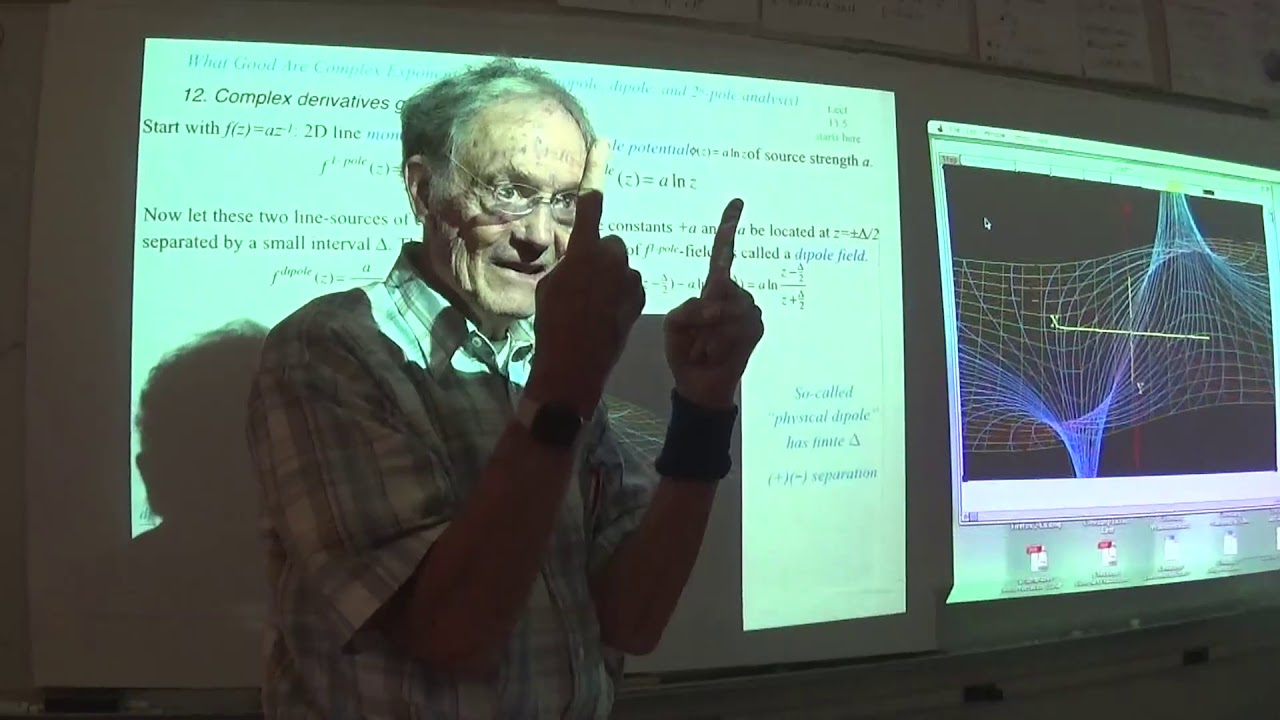
Classical Mechanics with a Bang! (2019 Fall) - Lecture #13.5
Keywords
Summary
154 words
Critical Evaluation
Value of the Information & Strength of the Argument
The lecture provides valuable insights into the geometric interpretation of multipole expansions, which are fundamental in physics. The argumentation is solid, as the instructor builds the concepts step by step, using numerical demonstrations to illustrate the properties of dipole and quadrupole fields. He clearly explains the mathematical derivation of the dipole as a derivative of the monopole and highlights the special role of the logarithm in the potential. The connection to the Smith chart and resonance is well-motivated, showing the practical applications of these abstract concepts. The presentation is rigorous and suitable for an advanced audience, though it assumes prior knowledge of complex analysis and electrostatics.
Scientific Rigor, Source Quality, Title Accuracy
The lecture is scientifically rigorous, as it is based on well-established mathematical physics. The instructor uses live numerical simulations to support his explanations, which adds credibility. However, no external sources are cited within the lecture, and the only references are the course website and lecture slides provided in the description. The title accurately reflects the content, as the lecture is indeed about classical mechanics with a focus on multipole expansions. The lecture is part of a structured course, which enhances its reliability.
203 words
Title / Content Match
The title accurately reflects the content: a lecture on classical mechanics, specifically focusing on multipole expansions and complex analysis.
Quality & Reliability
8/10
Lecture by a university professor, part of a graduate course, with a clear pedagogical structure. The content is based on established mathematical physics, and the presentation includes live numerical demonstrations. However, the video is a raw lecture with no external citations or references to peer-reviewed sources, and the audio/visual quality is basic.
Key Moments
Markers derived by PSI from the transcript: the creator did not define chapters.
- Introduction to multipole expansions and review of monopole.
- Demonstration of physical dipole equipotential and field lines.
- Discussion of the circles formed by equipotentials and streamlines.
- Transition to mathematical dipole via infinitesimal separation.
- Explanation of the dipole as a derivative of the monopole.
- Introduction to the Smith chart and its connection to resonance.
- Discussion of higher-order multipoles (quadrupole, octupole).
- Stereographic projection to understand fields at infinity.
Cited Sources
- Course Web site — Official course website for the textbook and lecture materials.
- Lecture #13.5 slide presentation (pdf) — Slides used in this lecture, providing detailed figures and derivations.
Concurring Sources
- Classical Mechanics with a Bang! (textbook) — The textbook associated with this course, which covers the same material in more depth.
Contribution & Novelties
This lecture offers a unique geometric perspective on multipole expansions, emphasizing the role of complex analysis and the Smith chart in classical mechanics. It bridges the gap between abstract mathematical concepts and practical engineering tools, making it a valuable resource for advanced students. The use of live numerical demonstrations enhances understanding.
Pour aller plus loin :
- Multipole expansion — Provides a comprehensive overview of multipole expansions in physics.
- Smith chart — A graphical tool used in electrical engineering for impedance matching, directly related to the lecture’s discussion.
- Stereographic projection — A mathematical mapping used to visualize the behavior of fields at infinity, as discussed in the lecture.
107 words
Radar Profile
The radar profile shows high scores in quantitative information, technical level, and reliability, reflecting the advanced and rigorous nature of the lecture. The qualitative information score is also high, indicating that the content is well-presented and insightful. The overall profile suggests a highly specialized and reliable educational resource.
💬 No comments were provided for analysis.