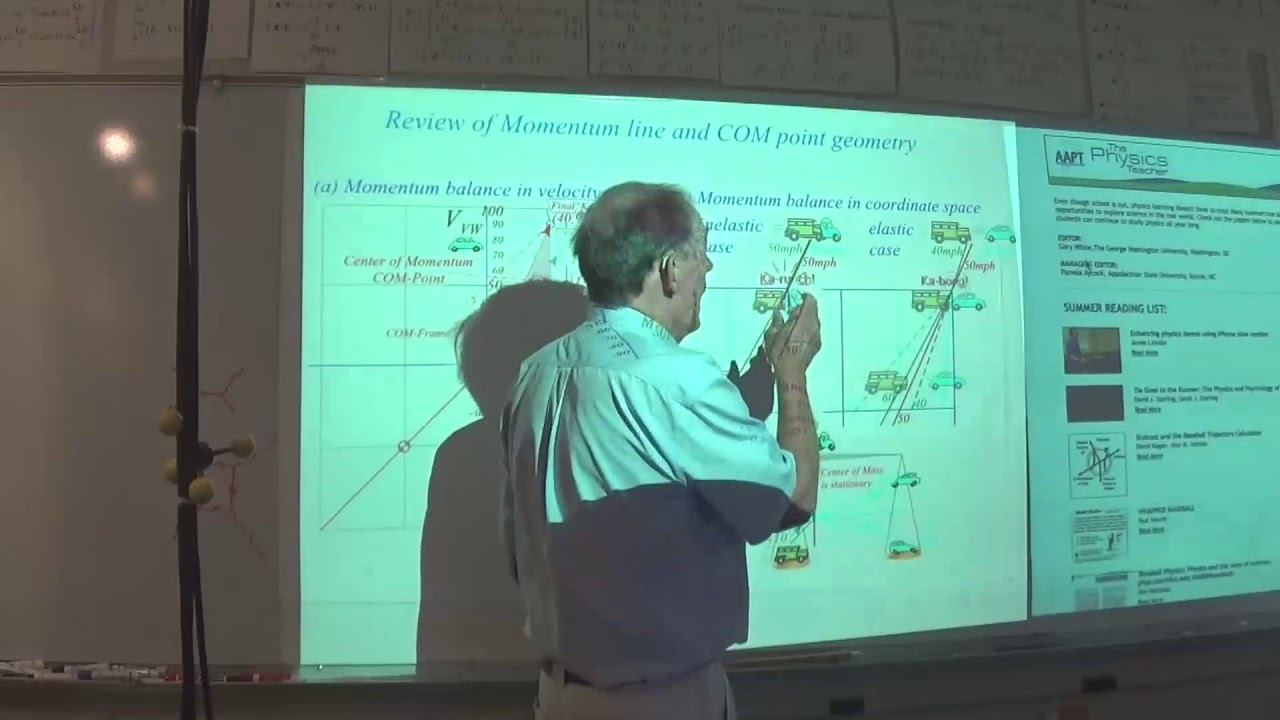
Classical Mechanics with a Bang! (2018 Fall) - Lecture #2
Keywords
Summary
165 words
Critical Evaluation
Value of the Information & Strength of the Argument
The lecture provides a valuable pedagogical approach to classical mechanics by using geometry to visualize collisions. The demonstration of the superball and pin is engaging and effectively illustrates the principles of conservation of momentum and energy. The argumentation is clear and logical, building from simple cases to more complex ones. The instructor’s enthusiasm and personal anecdotes add to the value, making the material accessible and memorable. The geometric method offers a fresh perspective that can enhance understanding for students who think visually.
Scientific Rigor, Source Quality, Title Accuracy
The lecture is scientifically rigorous, grounded in well-established physics principles. The instructor is a professor with expertise in the field, and the course is part of a graduate curriculum. The sources cited include the course website and the lecture slides, which provide supplementary material. The title accurately reflects the content, focusing on classical mechanics with a ‘bang’ (the superball demonstration). The lecture does not cite external peer-reviewed sources, but it is based on the instructor’s own textbook and research, which is appropriate for a course lecture.
183 words
Title / Content Match
The title accurately reflects the content: a lecture on classical mechanics using a geometric approach, with a focus on the 'bouncing ball' demonstration.
Quality & Reliability
8/10
Lecture by a university professor, part of a graduate course, with accompanying course materials and slides. The content is based on established physics principles and the instructor's own research, but it is a lecture rather than peer-reviewed publication.
Key Moments
Markers derived by PSI from the transcript: the creator did not define chapters.
- Introduction and demonstration of the superball effect
- History of the superball and its accidental discovery
- Introduction to the geometric approach using velocity-velocity space
- Construction of the momentum line and energy ellipse for a collision
- Application to the superball and pin collision with mass ratio 7:1
- Discussion of the center-of-mass frame and its significance
- Explanation of the coefficient of restitution and its role in real collisions
- Practical considerations for using the demonstration in teaching
Cited Sources
- Course Website: Classical Mechanics with a Bang! — Course website with materials and information about the textbook and lectures.
- Lecture #2 Slides (PDF) — The slide presentation for this specific lecture, containing the graphs and diagrams used.
Concurring Sources
- Classical Mechanics with a Bang! (textbook) — The textbook developed by Prof. Harter, which the lecture follows.
Contribution & Novelties
The lecture presents a unique geometric approach to classical mechanics, emphasizing visualization of collisions in velocity space. This method provides intuitive insights into conservation laws and the effects of mass ratios, which are often obscured in algebraic treatments. The demonstration of the superball and pin is a classic example that vividly illustrates these concepts.
Pour aller plus loin :
- Center of mass — Fundamental concept used throughout the lecture.
- Coefficient of restitution — Key parameter in collision analysis.
- Lagrangian mechanics — Related to the geometric approach, as mentioned in the lecture.
- Hamiltonian mechanics — Another formulation of classical mechanics, also mentioned.
101 words
Radar Profile
The radar profile shows high scores in quantity and quality of information, with a moderate level of technical depth. The reliability is also high, reflecting the academic nature of the lecture. The profile suggests a well-structured and informative presentation suitable for a graduate-level audience.