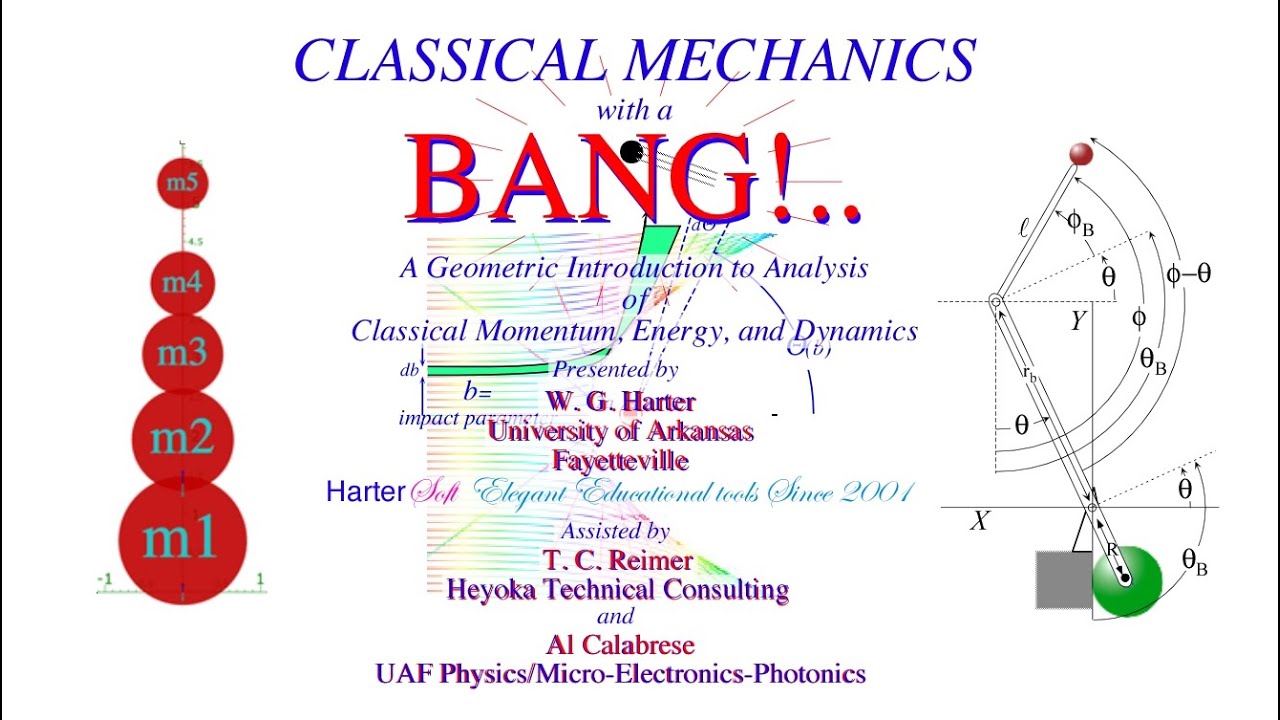
Classical Mechanics with a Bang! - Lecture 23
Keywords
Summary
123 words
Critical Evaluation
Value of the Information & Strength of the Argument
The lecture provides a comprehensive comparison of different techniques for dealing with constraints, which is valuable for students learning advanced mechanics. The argumentation is solid, as the instructor systematically derives equations using each method and compares the results. The use of a simple example helps clarify the abstract concepts of covariant and contravariant vectors, and the geometric interpretation enhances understanding. However, the lecture is dense and may be challenging for those not already comfortable with the material.
Scientific Rigor, Source Quality, Title Accuracy
The scientific rigor is high, as the lecture is based on established principles of classical mechanics and the instructor is a professor in the field. However, no external sources are cited within the lecture, and the description only mentions the textbook ‘Classical Mechanics with a Bang!’ by the same author. The title is somewhat informal but accurately reflects the course content. The lecture is part of a series, and the description indicates it is a component of a graduate course, which adds to its credibility.
177 words
Title / Content Match
The title 'Classical Mechanics with a Bang!' is a catchy name for a course, and this lecture indeed covers classical mechanics, but the 'Bang' aspect is not explicitly addressed in this particular lecture.
Quality & Reliability
8/10
Lecture by a university professor, part of a graduate course, with a rigorous mathematical treatment of classical mechanics. The content is well-structured and based on established theory, though it lacks external citations and is presented as a single lecture.
Key Moments
Markers derived by PSI from the transcript: the creator did not define chapters.
- Introduction to the problem of a particle constrained to a parabolic curve and overview of four methods to handle constraints.
- Method 1: Direct substitution of the constraint into the Lagrangian, leading to a one-dimensional equation of motion.
- Method 2: Using generalized curvilinear coordinates (GCC) to derive covariant and contravariant forces and the metric tensor.
- Derivation of the equations of motion in GCC, including the constraint forces and the centripetal force at the bottom of the parabola.
- Method 3: Introduction of orthogonal curvilinear coordinates, specifically parabolic coordinates, and their geometric properties.
- Application of parabolic coordinates to the Stark effect in quantum mechanics, linking classical and quantum descriptions.
- Conclusion and summary of the advantages and disadvantages of each method.
Cited Sources
- Classical Mechanics with a Bang! — Textbook used for the course, developed by Prof. William G. Harter.
Concurring Sources
- Classical Mechanics (Goldstein) — Standard graduate textbook covering similar topics in classical mechanics.
Contribution & Novelties
The lecture offers a unique pedagogical approach by comparing multiple methods for handling constraints in classical mechanics, emphasizing geometric interpretations. It provides a detailed example that illustrates the physical meaning of covariant and contravariant forces, which is often abstract. The connection to quantum mechanics via the Stark effect is an interesting addition.
Pour aller plus loin :
- Lagrangian mechanics — Foundational concept for the lecture.
- Generalized coordinates — Key concept used throughout.
- Stark effect — Application mentioned in the lecture.
80 words
Radar Profile
The radar profile shows high scores in technical level and information quality, indicating a dense, advanced lecture. The moderate score in quantity of information reflects the focused scope on a single example. Overall, the lecture is highly specialized and suitable for advanced students.