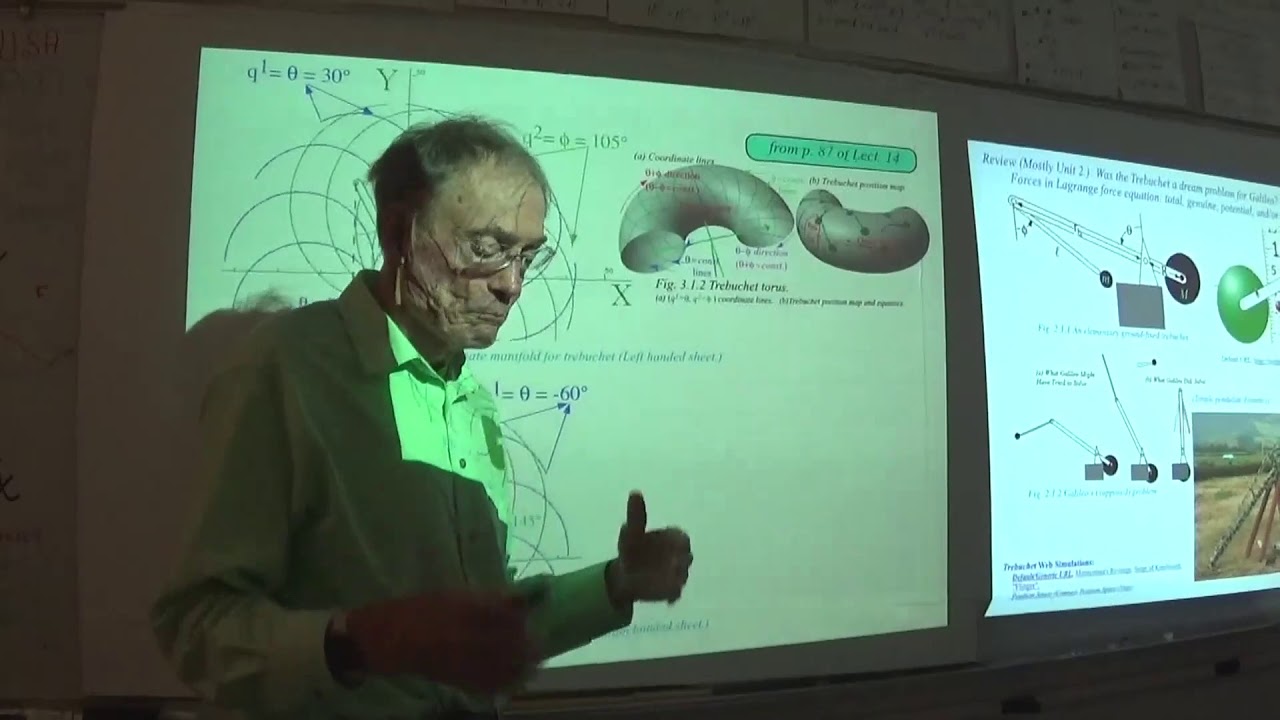
Classical Mechanics with a Bang! (2019 Fall) - Lecture #15
Keywords
Summary
182 words
Critical Evaluation
Value of the Information & Strength of the Argument
The lecture provides a thorough and rigorous treatment of the mathematical concepts underlying classical mechanics, with a clear geometric interpretation. The argumentation is solid, building from basic definitions to more complex ideas, and uses a concrete example (the trebuchet) to illustrate abstract concepts. The instructor’s explanations are detailed and well-paced, making the material accessible to advanced students. The value lies in the deep understanding it offers of the mathematical structure of mechanics, which is essential for advanced study in physics, including relativity and quantum mechanics.
Scientific Rigor, Source Quality, Title Accuracy
The lecture is scientifically rigorous, with a clear logical structure and accurate mathematical derivations. The sources are primarily the course textbook and lecture notes, which are provided in the description. The title accurately reflects the content, as it is a lecture on classical mechanics with a geometric approach. The presentation is consistent with standard treatments in the field, and the instructor’s expertise is evident. The lecture is part of a well-established course, adding to its credibility.
176 words
Title / Content Match
The title accurately reflects the content, which is a lecture on classical mechanics with a geometric approach, as part of a series.
Quality & Reliability
8/10
The lecture is part of a graduate course at the University of Arkansas, given by a professor with expertise in the field. The content is mathematically rigorous and consistent with standard treatments of differential geometry and mechanics. The presentation is clear and well-structured, with references to course materials and a textbook.
Key Moments
Markers derived by PSI from the transcript: the creator did not define chapters.
- Introduction to the Riemann equation and its relevance to general relativity.
- Review of covariant and contravariant vectors using the trebuchet example.
- Explanation of the torus as a playground for the trebuchet's variables.
- Demonstration of the trebuchet motion on the torus using computer programs.
- Derivation of the covariant basis vectors from partial derivatives.
- Introduction of the contravariant basis vectors and their orthogonality to covariant ones.
- Discussion of the metric tensor and its role in measuring lengths.
- Transformation between different coordinate systems and the invariance of physical quantities.
- Connection to quantum mechanics: covariant and contravariant vectors as kets and bras.
- Homework problems and further applications of the concepts.
Cited Sources
- Course Web site — Course materials and information.
- Lecture #15 slide presentation (pdf) — Slides used in the lecture.
Concurring Sources
- Classical Mechanics with a Bang! — The textbook used for the course, which covers the same material.
Contribution & Novelties
The lecture provides a clear and detailed geometric explanation of covariant and contravariant vectors, which is often a challenging topic for students. It uses a concrete physical example (the trebuchet) to illustrate abstract mathematical concepts, making them more accessible. The discussion of the metric tensor and its role in measuring lengths and areas is particularly valuable. The lecture also highlights the connection between classical mechanics and modern physics, such as general relativity and quantum mechanics, by showing how these mathematical tools are used in those fields.
Pour aller plus loin :
- Covariance and contravariance of vectors — A comprehensive overview of the concepts.
- Metric tensor — Detailed explanation of the metric tensor and its applications.
- Christoffel symbols — Relevant to the Riemann equation mentioned in the lecture.
- General relativity — The field where these concepts are crucial.
137 words
Radar Profile
The radar profile shows high scores in technical level and information quality, indicating a rigorous and detailed lecture. The quantity of information is also high, but the accessibility might be limited to advanced students. The overall reliability is strong, given the academic context.