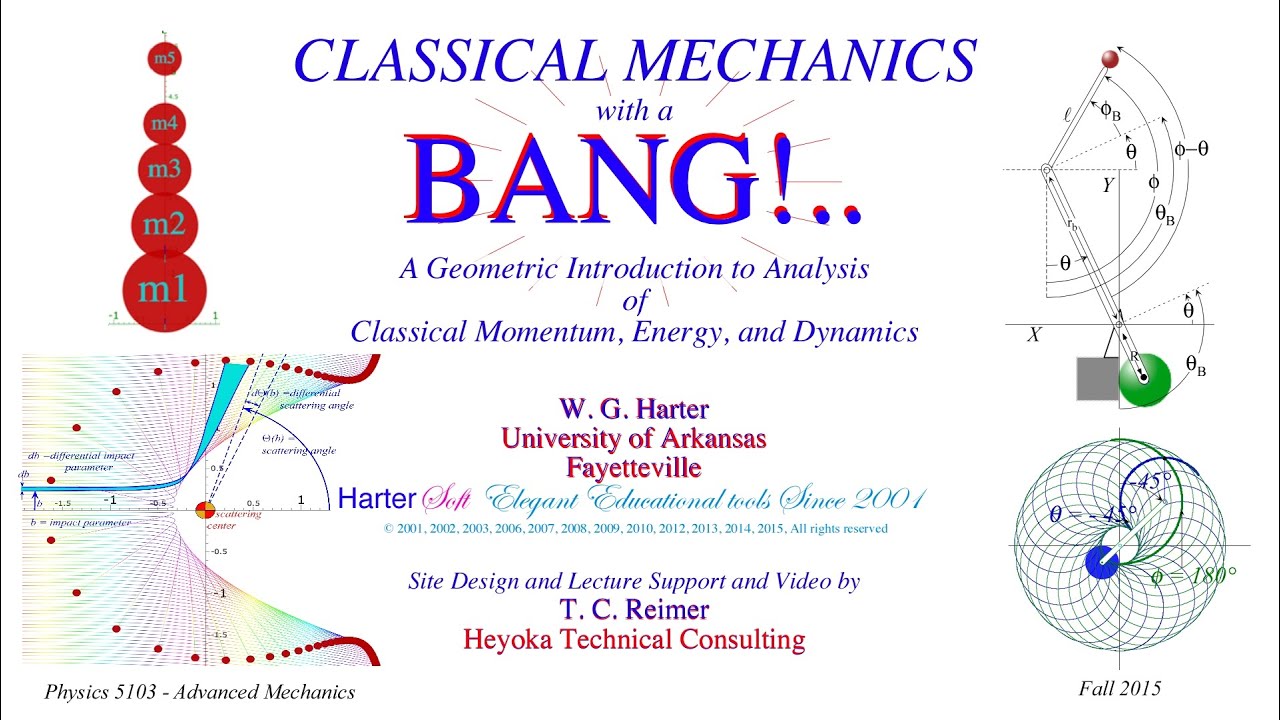
Classical Mechanics with a Bang! (2015Fa) - Lecture #31
Keywords
Summary
156 words
Critical Evaluation
Value of the Information & Strength of the Argument
The lecture provides a unique and insightful geometric approach to special relativity, using wave interference patterns to construct Minkowski diagrams. This perspective clarifies the meaning of length contraction and time dilation, and reveals the underlying hyperbolic geometry. The argumentation is rigorous, building from basic wave concepts to derive relativistic effects. The use of animations and visual aids enhances understanding. The lecture is valuable for advanced students familiar with calculus and basic physics, offering a fresh viewpoint that complements traditional treatments.
Scientific Rigor, Source Quality, Title Accuracy
The lecture is scientifically rigorous, based on the professor’s own textbook and course materials. The sources are limited to the course website and PDF slides, which are appropriate for a lecture. The title accurately reflects the content, as it is part of a series on classical mechanics with a ‘bang’ (i.e., a geometric approach). The lecture does not cite external references, but the internal consistency and mathematical derivations support its reliability.
166 words
Title / Content Match
The title accurately reflects the lecture content, which is part of a series on classical mechanics with a geometric approach.
Quality & Reliability
8/10
Lecture by a professor, part of a graduate course, with a dedicated course website and PDF slides. The content is advanced and internally consistent, but no external sources are cited beyond the course materials.
Key Moments
Markers derived by PSI from the transcript: the creator did not define chapters.
- Introduction and overview of the lecture topics.
- Review of the Minkowski diagram from previous lecture, showing Doppler-shifted wave zeros.
- Discussion of length contraction and time dilation in the geometric framework.
- Introduction of the 'baseball diamond' invariant area and hyperbolic coordinates.
- Exploration of the relationships between phase and group velocities, wavelengths, and periods.
- Discussion of the golden ratio velocity and coincidences among hyperbolic functions.
- Animations of space-time diagrams showing wave propagation and Doppler shifts.
- Historical note on Minkowski and Einstein's contributions.
- Further geometric derivations and preview of relativistic quantum mechanics.
Cited Sources
- Course Web site — Course website for 'Classical Mechanics with a Bang!' providing resources and materials.
- Lecture #31 slide presentation (pdf) — PDF slides for this specific lecture, used as visual aid.
Concurring Sources
- Course Web site — Official course resources align with the lecture content.
Contribution & Novelties
This lecture offers a distinctive geometric interpretation of special relativity, using wave interference to construct Minkowski diagrams. It provides a visual and intuitive understanding of relativistic effects, which is often lacking in traditional treatments. The approach highlights the role of hyperbolic functions and reveals invariant quantities, such as the area of the ‘baseball diamond’, that unify space and time transformations. This perspective is valuable for advanced students and researchers seeking a deeper conceptual grasp of relativity.
Pour aller plus loin :
- Minkowski diagram — Visual representation of spacetime, central to this lecture.
- Hyperbolic functions — Mathematical basis for the transformations discussed.
- Special relativity — Foundational theory, context for the lecture.
- Doppler effect — Physical phenomenon used to construct the wave diagrams.
121 words
Radar Profile
The radar profile shows high scores in quantity, quality, technical level, and reliability, indicating a dense, rigorous, and advanced lecture. The technical level is particularly high, reflecting the graduate-level content.
💬 Sur les 0 commentaires analysés, aucune tendance n'est disponible.