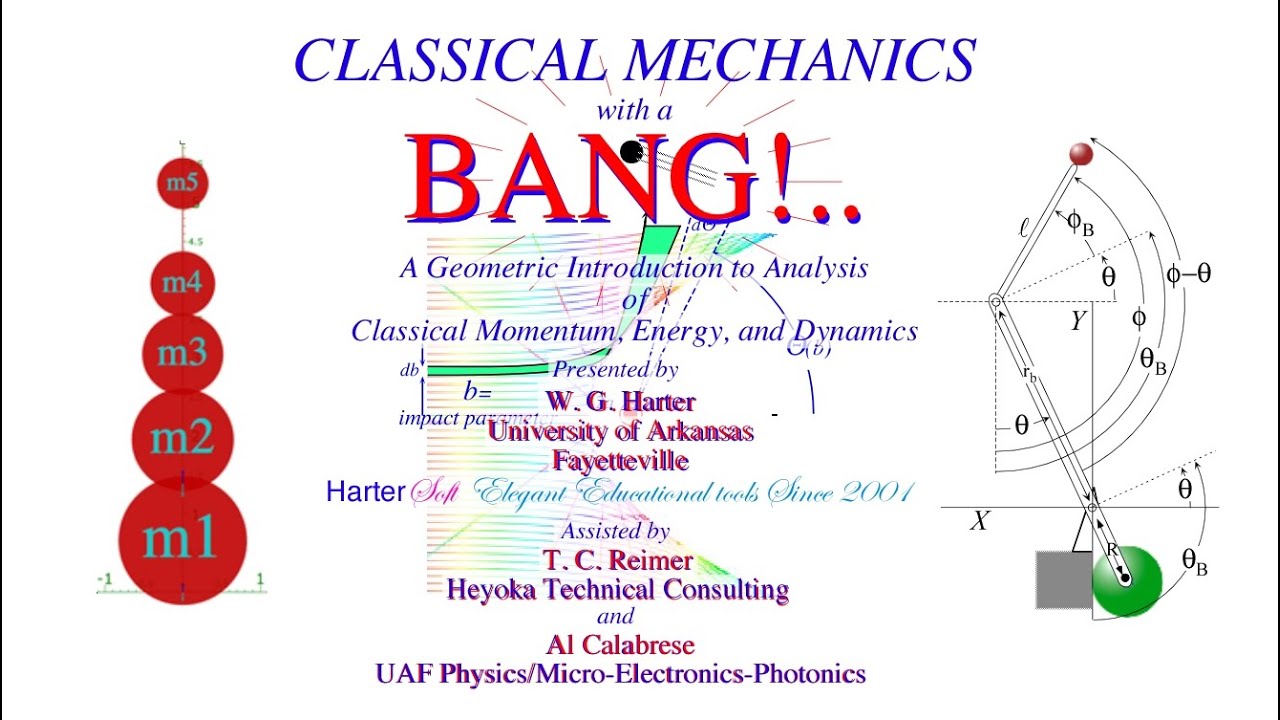
Classical Mechanics with a Bang! - Lecture 7
Keywords
Summary
173 words
Critical Evaluation
Value of the Information & Strength of the Argument
The lecture provides valuable insights into the geometric interpretation of potential energy and force laws, offering a unique perspective that is often missing in standard textbooks. The instructor effectively uses simulations to visualize abstract concepts, making the material more accessible. The argumentation is solid, grounded in classical mechanics principles, and supported by historical anecdotes and real-world examples. The discussion of the superball’s nonlinear force law and its implications for energy dissipation is particularly enlightening. The instructor also connects the material to broader topics such as shock waves and rocket science, demonstrating the relevance of classical mechanics in various contexts.
Scientific Rigor, Source Quality, Title Accuracy
The lecture demonstrates scientific rigor by building on fundamental principles and using simulations to verify theoretical predictions. The instructor references historical figures like Thales and mentions the Wham-O company and the Superball project, but does not provide explicit citations to academic sources. The title ‘Classical Mechanics with a Bang!’ is catchy and accurately reflects the dynamic and engaging style of the lecture, which covers classical mechanics with a focus on collisions and potential energy. The content is well-structured and aligns with the title.
197 words
Title / Content Match
The title 'Classical Mechanics with a Bang!' reflects the dynamic and engaging approach of the lecture, which covers classical mechanics topics with a focus on collisions and potential energy. The content matches the title well.
Quality & Reliability
8/10
Lecture by a university professor, part of a graduate course, with a clear pedagogical structure and references to historical and experimental contexts. The content is based on established physics principles and includes simulations and real-world examples. However, the video is a recording of a live lecture with limited production quality and no peer review.
Key Moments
Markers derived by PSI from the transcript: the creator did not define chapters.
- Introduction to the lecture topics: potential energy, force laws, and bouncing balls.
- Derivation of the force law for a spherical ball using Thales geometry.
- Discussion of the three cases: constant force, linear force, and nonlinear force.
- Simulation of a ball bouncing with gravity and nonlinear force, showing potential and force diagrams.
- Explanation of the work-energy theorem and the relationship between force and potential energy.
- Analysis of a daredevil diving into a shallow pool, illustrating energy dissipation.
- Story of the Superball project at USC and visit to Wham-O company.
- Discussion of many-body collisions and superelastic models.
- Conclusion and summary of key concepts.
Cited Sources
- Classical Mechanics with a Bang! (textbook) — The lecture is based on this textbook developed by Prof. William G. Harter.
Concurring Sources
- Classical Mechanics (Goldstein) — Standard graduate textbook covering classical mechanics, including potential energy and force laws.
Contribution & Novelties
The lecture offers a unique geometric approach to classical mechanics, emphasizing the visualization of potential energy and force laws. It provides a detailed analysis of the nonlinear force law for a superball, which is not commonly covered in standard courses. The use of simulations to illustrate concepts is innovative and enhances understanding. The lecture also connects classical mechanics to real-world phenomena, such as daredevil stunts and the Superball project, making the material engaging and relevant.
Pour aller plus loin :
- Hooke’s law — Fundamental linear force law for elastic materials.
- Work-energy theorem — Relates work done by forces to change in kinetic energy.
- Nonlinear dynamics — Study of systems where the principle of superposition does not apply.
117 words
Radar Profile
The radar profile shows high scores in quantity and quality of information, indicating a comprehensive and well-structured lecture. The technical level is also high, suitable for graduate students. The overall reliability is strong, given the academic context and the instructor's expertise.