Keywords
Summary
169 words
Critical Evaluation
Value of the Information & Strength of the Argument
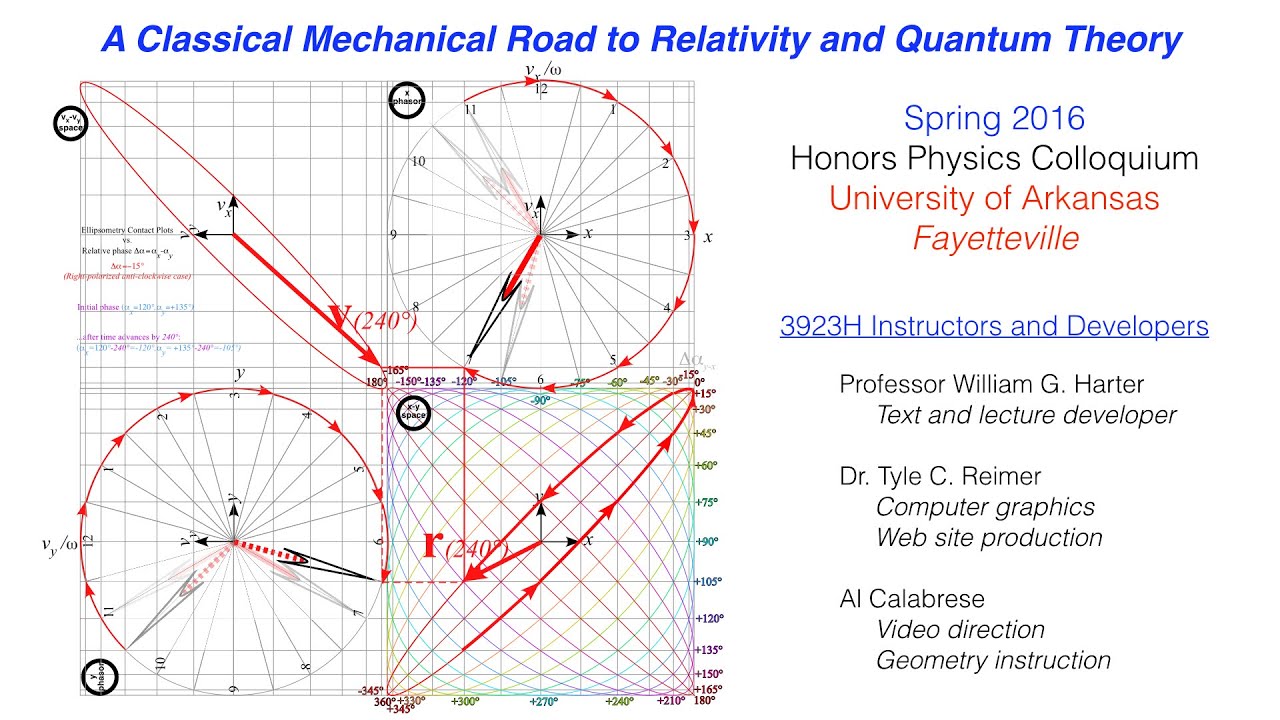
The lecture provides valuable insights into the deep connections between classical mechanics, group theory, and quantum mechanics. The argumentation is solid, built on mathematical derivations and geometric interpretations. Harter effectively demonstrates how symmetry principles underlie both classical and quantum theories, and his use of projection operators offers a powerful tool for simplifying complex problems. The emphasis on the half-sum and half-difference identities is particularly valuable, as it clarifies the separation of amplitude and phase, a fundamental concept in quantum mechanics. The lecture is well-structured, building from simple examples to more general principles, and the use of animations enhances understanding. However, the argumentation is dense and may require prior knowledge of the subject to fully appreciate.
Scientific Rigor, Source Quality, Title Accuracy
The lecture is scientifically rigorous, with a clear logical progression and mathematical precision. The instructor references his own textbook and course materials, which are credible sources. However, no external scientific literature is cited, limiting the breadth of sources. The title accurately reflects the content, as it is a lecture in a series of honors physics colloquia. The lecture’s focus on geometric methods and symmetry is consistent with the course’s stated goals. The quality of sources is adequate for an educational lecture, but the lack of external references may be a limitation for those seeking broader context.
226 words
Title / Content Match
The title accurately reflects the content: a colloquium lecture in an honors physics course.
Quality & Reliability
8/10
Lecture by a professor with deep expertise, based on a textbook and course materials. The content is mathematically rigorous and internally consistent, but no external sources are cited beyond the course materials.
Key Moments
Markers derived by PSI from the transcript: the creator did not define chapters.
- Introduction to the lecture and review of two-dimensional oscillator
- Introduction of projection operators and group theory
- Derivation of half-sum and half-difference identities
- Application to classical and quantum mechanical problems
- Discussion of phase lag and amplitude separation
- Use of animations to illustrate oscillator behavior
- Connection to relativity and quantum mechanics
- Further examples and homework assignment
- Conclusion and summary of key points
Cited Sources
- Course Web site — Course materials and information
- Lecture #21 slide presentation (pdf) — Slides used in the lecture
Concurring Sources
- Course Web site — Provides context and additional resources for the lecture series.
Contribution & Novelties
The lecture offers a novel pedagogical approach by using group theory and projection operators to unify classical and quantum mechanics. It emphasizes the geometric interpretation of phase and amplitude, which is often underappreciated. The method of constructing Hamiltonians from group multiplication tables is an innovative teaching tool. The lecture also highlights the importance of symmetry in understanding physical systems.
Pour aller plus loin :
- Group theory — Foundational concept for the lecture’s approach.
- Projection operator — Key mathematical tool used in the lecture.
- Quantum mechanics — The ultimate subject of the course.
- Classical mechanics — The starting point of the lecture.
101 words
Radar Profile
The radar profile shows high scores in technical level and information quality, reflecting the advanced and rigorous nature of the lecture. The lower score in information quantity is due to the focused scope of the lecture, which is appropriate for a single session.