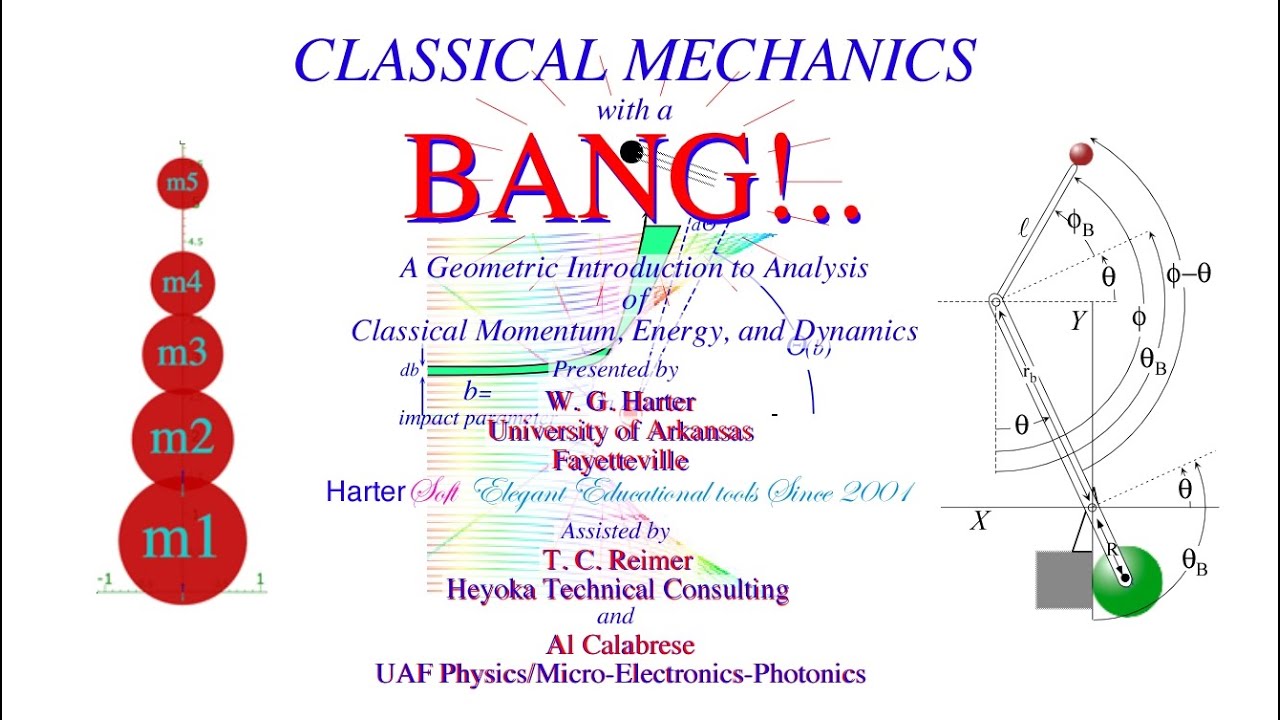
Classical Mechanics with a Bang! - Lecture 29 & 30
Keywords
Summary
184 words
Critical Evaluation
Value of the Information & Strength of the Argument
The lecture provides a deep and original insight into classical mechanics by emphasizing the geometric interpretation of the eccentricity vector. The argumentation is rigorous, with step-by-step derivations and visual constructions that clarify the underlying physics. The professor’s approach offers a powerful alternative to traditional methods, making complex orbital problems more intuitive. The value lies in the unification of various conic sections and the smooth transition between bound and unbound orbits, which is elegantly handled by the eccentricity vector. The argumentation is solid, relying on mathematical derivations and geometric reasoning, and is presented in a clear, pedagogical manner.
Scientific Rigor, Source Quality, Title Accuracy
The scientific rigor is high, as the lecture is based on a textbook developed by the professor and follows standard classical mechanics principles. However, no external sources are cited, and the content is presented as original lecture material. The title accurately reflects the content, which is a lecture on classical mechanics with a focus on the eccentricity vector. The lecture is part of a graduate course and assumes a high level of prior knowledge, which is appropriate for the target audience. The adequacy between title and content is good, as the lecture indeed covers classical mechanics with a ‘bang’ in the sense of providing powerful geometric tools.
219 words
Title / Content Match
The title accurately reflects the content, which is a lecture on classical mechanics with a focus on the eccentricity vector and its applications.
Quality & Reliability
8/10
Lecture by a university professor, based on a textbook, with rigorous mathematical derivations and geometric constructions. The content is advanced and consistent with standard classical mechanics, though no external sources are cited.
Key Moments
Markers derived by PSI from the transcript: the creator did not define chapters.
- Introduction to the eccentricity vector and its role in describing orbits.
- Explanation of the eccentricity vector as a conserved vector and its analogy to the spin vector for harmonic oscillators.
- Discussion of the geometric construction of orbits using the eccentricity vector.
- Derivation of the eccentricity vector components and its relation to energy and angular momentum.
- Introduction of the ratio of kinetic to potential energy and its role in determining the type of orbit.
- Geometric construction using graph paper and protractor to find the focus locus.
- Examples of elliptical, hyperbolic, and parabolic orbits and their corresponding eccentricity vectors.
- Discussion of repulsive Coulomb potentials and their hyperbolic orbits.
- Algebraic derivation of the eccentricity vector and its components in terms of initial conditions.
- Summary of the geometric construction and its advantages over traditional methods.
Contribution & Novelties
The lecture presents a novel geometric approach to classical mechanics, emphasizing the eccentricity vector as a powerful tool for understanding and constructing orbits. This approach provides a unified framework for all conic sections and offers a more intuitive understanding of orbital mechanics. The lecture also highlights the connection to quantum mechanics through the O(4) symmetry, suggesting unexplored avenues for research.
Pour aller plus loin :
- Laplace-Runge-Lenz vector — This Wikipedia article provides a comprehensive overview of the vector, its properties, and its applications in classical and quantum mechanics.
- Kepler orbit — This article discusses the different types of orbits (elliptical, hyperbolic, parabolic) and their parameters, complementing the lecture’s content.
- O(4) symmetry of the hydrogen atom — This section explains the hidden symmetry of the hydrogen atom, which is related to the eccentricity vector and is mentioned in the lecture.
139 words
Radar Profile
The radar profile shows high scores in technical level and information quality, indicating a rigorous and advanced lecture. The quantity of information is also high, but the reliability score is slightly lower due to the lack of external sources. Overall, the lecture is highly specialized and suitable for advanced students or researchers.