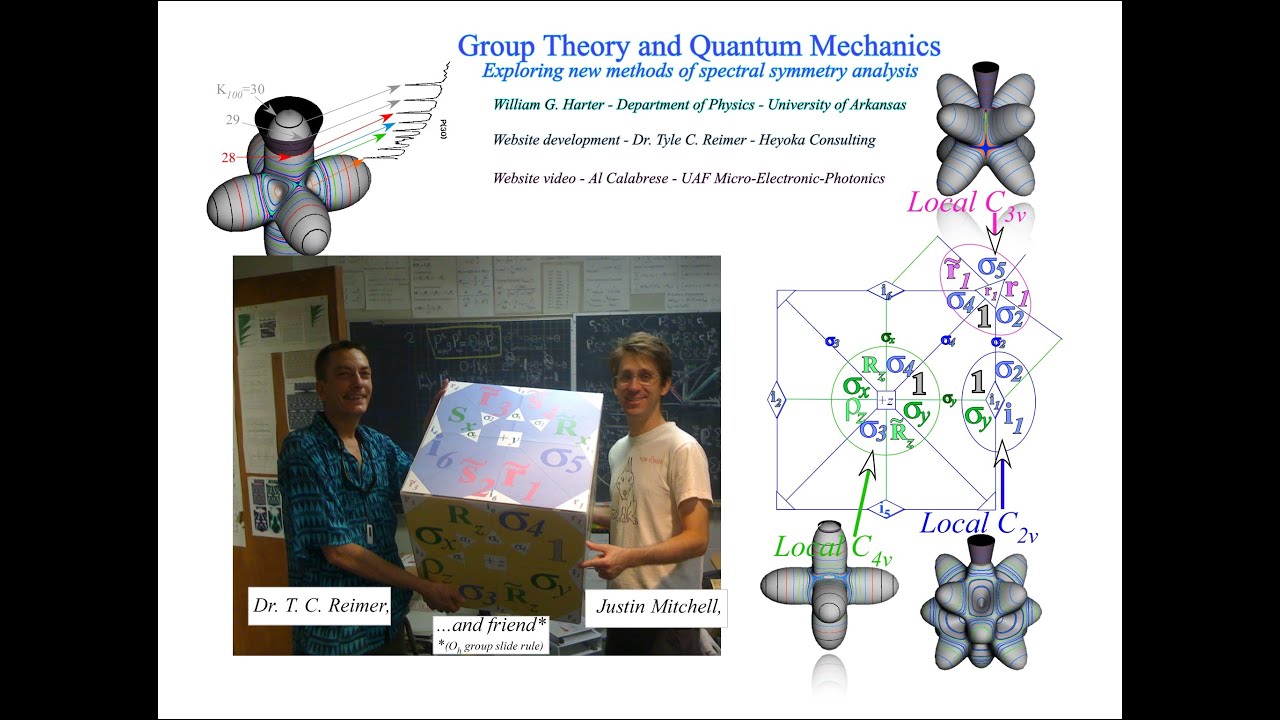
Applications of Group Theory to Physics - Lecture 13
Keywords
Summary
173 words
Critical Evaluation
Value of the Information & Strength of the Argument
The lecture provides valuable insights into the application of group theory to physical systems, particularly the clever technique of using a cyclic system to model a linear one. The argumentation is solid, built on mathematical derivations and physical reasoning. The instructor clearly explains the connection between symmetry, boundary conditions, and observable phenomena such as revivals and band structures. The use of simulations and spectral analysis adds practical value, demonstrating the concepts in action. The discussion of symmetry breaking and its effects on degeneracies is particularly instructive. The argumentation is coherent and well-supported by the mathematical framework presented.
Scientific Rigor, Source Quality, Title Accuracy
The lecture is scientifically rigorous, based on established textbooks by the instructor and standard group theory methods. The sources cited are the course website and the lecture slides, which provide additional materials. The title accurately reflects the content, as the lecture indeed applies group theory to physics, specifically to cyclic symmetry systems. The presentation is well-structured, with clear explanations and mathematical derivations. The instructor’s expertise is evident, and the content aligns with the course objectives. The lecture is part of a series, so it builds on previous material, but it is self-contained enough for advanced students.
208 words
Title / Content Match
The title accurately reflects the content, which applies group theory to physics, specifically cyclic symmetry systems and their use in linear systems.
Quality & Reliability
8/10
Lecture by a university professor, based on established textbooks and course materials, with clear mathematical derivations and physical interpretations. The content is rigorous and well-structured, though it is a recorded lecture without peer review.
Key Moments
Markers derived by PSI from the transcript: the creator did not define chapters.
- Introduction to the lecture topic: using cyclic systems to model linear systems.
- Review of rotor vs. infinite square well dynamics and revival phenomena.
- Explanation of the technique to simulate a linear chain using a cyclic system with sine-wave boundary conditions.
- Discussion of symmetry breaking by altering every other site, leading to acoustical and optical modes.
- Simulation of a six-particle linear chain and spectral analysis.
- Comparison of C3×C2 and C6 groups and introduction to non-cyclic symmetry groups.
- Further discussion on band gaps and avoided crossings.
- Preview of next lecture on real group theory with D2 example.
Cited Sources
- Course Web site — Course materials and additional content.
- Lecture 13 slide presentation (pdf) — Slides used in this lecture.
Concurring Sources
- Course Web site — Provides additional course materials that align with the lecture content.
Contribution & Novelties
The lecture offers a novel pedagogical approach to understanding linear chains by leveraging cyclic symmetry, which is a creative and insightful technique. It bridges the gap between idealized cyclic systems and realistic finite systems, providing a deeper understanding of boundary conditions and their physical consequences. The discussion of symmetry breaking and its effects on band structure is particularly valuable for modern applications in materials science.
Pour aller plus loin :
- Group theory — Foundational concept for the lecture.
- Quantum mechanics — The physical framework in which the lecture operates.
- Band structure — Directly related to the discussion of energy bands and gaps.
- Graphene — A modern material where these concepts are applied.
112 words
Radar Profile
The radar profile shows high scores in technical level and information quality, indicating a rigorous and detailed lecture. The quantity of information is also high, but the overall note is slightly lower due to the specialized nature and lack of broader accessibility.