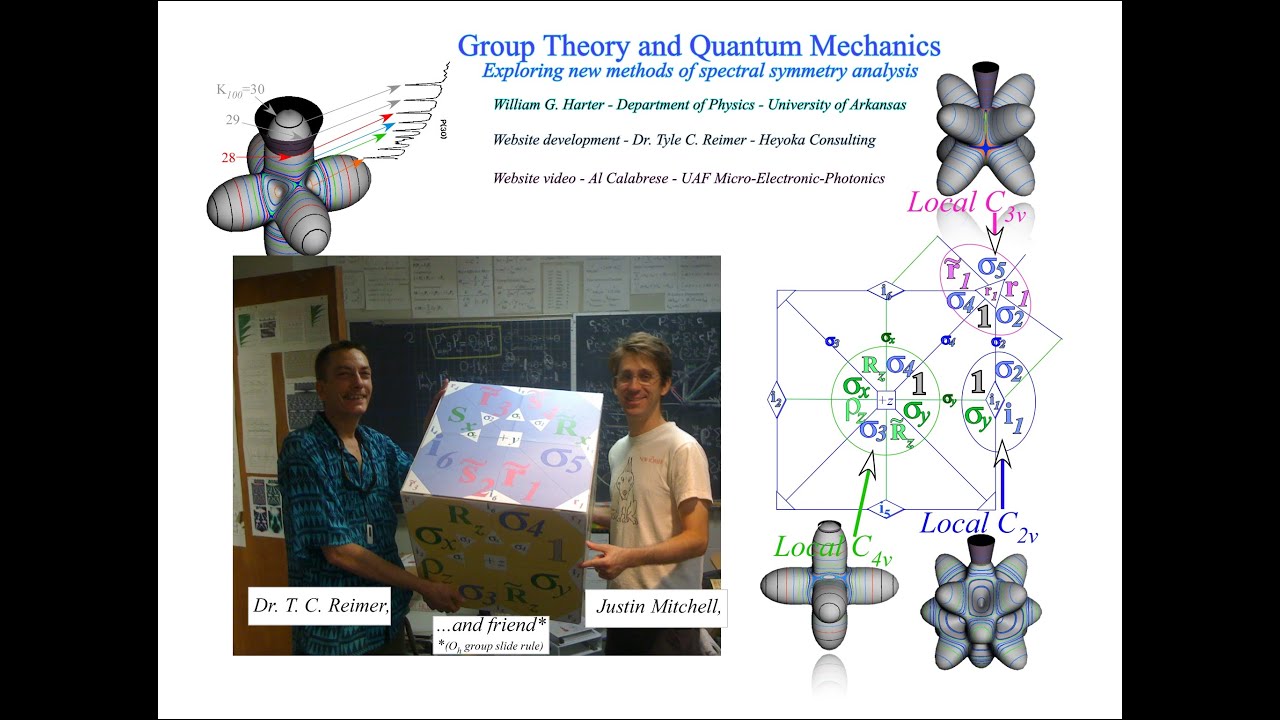
Applications of Group Theory to Physics - Lecture 7
Keywords
Summary
206 words
Critical Evaluation
Value of the Information & Strength of the Argument
The lecture provides a high-value, in-depth exploration of the mathematical structure underlying two-state quantum systems. Harter’s argumentation is solid, building from the basic commutation relations of the Pauli matrices to the derivation of the exponential of a Hamiltonian, which is central to time evolution in quantum mechanics. He uses multiple representations (matrices, quaternions, vectors) to clarify the abstract concepts, and he connects the mathematics to physical examples (polarization, spin resonance, ammonia maser). The historical narrative adds context and helps motivate the formalism. The lecture is technically rigorous and suitable for an advanced audience, but it assumes prior knowledge of quantum mechanics and linear algebra.
Scientific Rigor, Source Quality, Title Accuracy
The lecture is scientifically rigorous, based on the professor’s own textbooks and course materials, which are referenced in the description. The sources cited include the course website and the PDF slides for this lecture, which provide additional detail. The title accurately reflects the content, as the lecture indeed applies group theory to physics, focusing on U(2) and its applications. The lecture is well-structured and the mathematical derivations are careful. However, as a single lecture, it does not provide a comprehensive review of the literature, and the sources are limited to the professor’s own works. The video has very few views and comments, so there is no public feedback to assess.
229 words
Title / Content Match
The title accurately reflects the content: the lecture applies group theory (specifically SU(2) and quaternions) to physics, focusing on two-state systems and spin.
Quality & Reliability
8/10
Lecture by a professor with deep expertise in group theory and quantum mechanics, based on his own textbooks and course materials. The content is mathematically rigorous and historically contextualized. However, it is a single lecture without peer review or external verification, and the video quality is low (288 views).
Key Moments
Markers derived by PSI from the transcript: the creator did not define chapters.
- Introduction to lecture 7: U(2) group, two-state systems, and quaternions.
- Review of lecture 6: 2D oscillators and Newton-Hooke equations.
- Introduction of the three famous two-state systems: Stokes, spin resonance, and Feynman-Vernon-Heller.
- Discussion of the Hamiltonian as a linear combination of Pauli operators.
- Derivation of the multiplication table for Pauli matrices, showing quaternion structure.
- Definition of the spin vector operator and its properties.
- Introduction of the 'crazy thing theorem' for exponentiating the Hamiltonian.
- Historical note on Hamilton's quaternions and Gibbs' vector notation.
- Preview of lecture 8: operator space and the full exponential formula.
Cited Sources
- Course Web site: Group Theory in Quantum Mechanics — Course website with additional content and resources.
- Lecture 7 slide presentation (PDF) — Slides used in this lecture, providing detailed mathematical derivations.
Concurring Sources
- Course Web site: Group Theory in Quantum Mechanics — The course website provides additional materials that align with the lecture content.
Contribution & Novelties
This lecture offers a pedagogical approach to group theory in quantum mechanics, emphasizing the geometric and historical connections between quaternions, Pauli matrices, and rotations. It provides a clear derivation of the exponential of a Hamiltonian in terms of SU(2) generators, which is fundamental for understanding time evolution in two-state systems. The lecture also highlights the ‘crazy thing theorem’ that links the exponential of a linear combination of Pauli matrices to a rotation in 3D space, a result that is often taken for granted in standard treatments.
Pour aller plus loin :
- Pauli matrices — Essential for understanding the algebraic structure used in the lecture.
- Quaternions — Historical and mathematical background for the quaternion algebra discussed.
- Spin (physics) — Physical context for the two-state systems and spin operators.
- Group theory — General framework for symmetry analysis in physics.
137 words
Radar Profile
The radar profile shows high scores in technical level and information quality, reflecting the advanced mathematical content and the professor's expertise. The quantity of information is also high, as the lecture covers a substantial amount of material. However, the global reliability score is slightly lower, likely due to the lack of external verification and the niche audience.