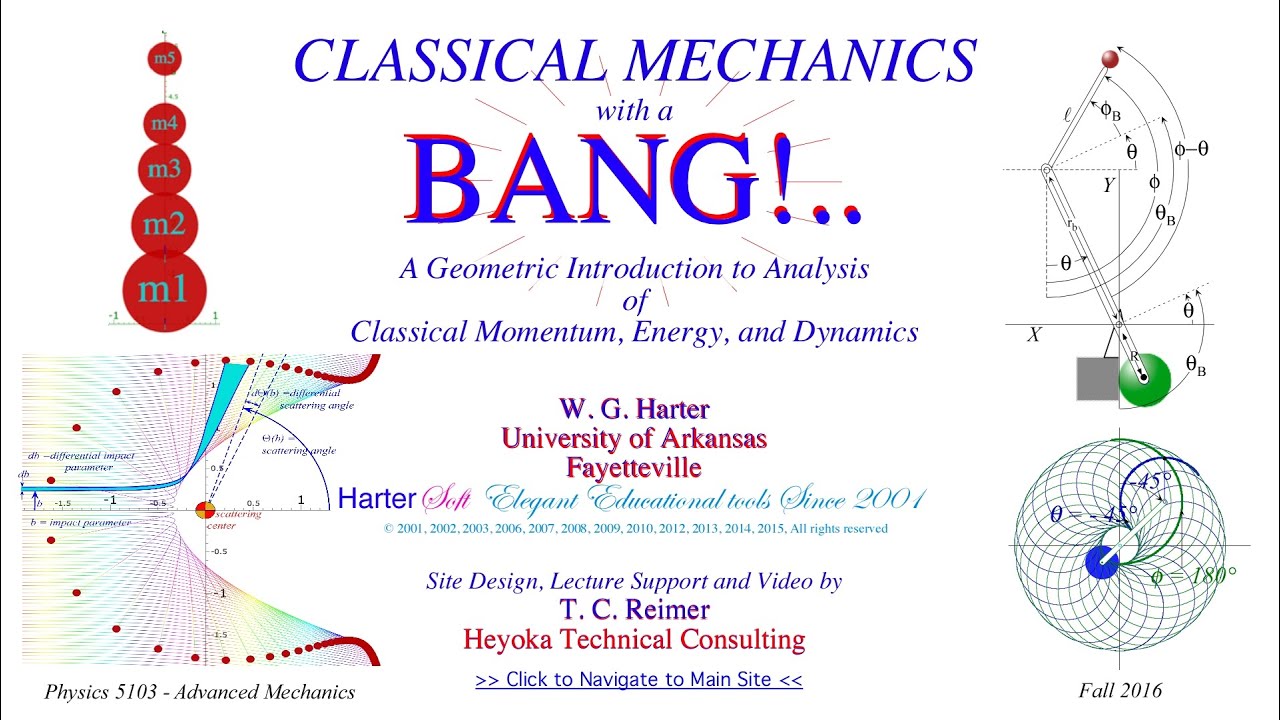
Classical Mechanics with a Bang! (2016 Fall) - Lecture #9
Keywords
Summary
144 words
Critical Evaluation
Value of the Information & Strength of the Argument
The lecture provides a rigorous derivation of Lagrange’s equations from Newton’s second law in generalized coordinates. The argumentation is logical and step-by-step, with clear explanations of the mathematical tricks involved. The professor emphasizes the geometric interpretation and the historical development, which adds depth. The value lies in the clear exposition of a fundamental topic in classical mechanics, making it accessible to graduate students. The use of examples like polar coordinates and the mention of applications to circuits and relativity enhance the relevance.
Scientific Rigor, Source Quality, Title Accuracy
The lecture is part of a structured course, and the professor references the course textbook and website. The mathematical derivations are standard and correct. The title accurately reflects the content. The video is a raw lecture recording, so the production quality is low, but the scientific content is sound. No external sources are cited beyond the course materials.
155 words
Title / Content Match
The title accurately reflects the content: a lecture on classical mechanics, part of a series titled 'Classical Mechanics with a Bang!'.
Quality & Reliability
8/10
Lecture by a university professor, part of a graduate course, with a clear pedagogical structure and references to course materials. The content is based on established mathematical methods (Lagrangian mechanics, tensor analysis) and is presented with derivations. However, it is a single lecture without external citations or peer review, and the video quality is low.
Key Moments
Markers derived by PSI from the transcript: the creator did not define chapters.
- Introduction and overview of the lecture topics: generalized coordinates, Jacobians, and Lagrange's equations.
- Review of previous lecture: first and second equations of Lagrange and Hamilton.
- Introduction to generalized curvilinear coordinates using polar coordinates as an example.
- Derivation of the Jacobian matrix and its inverse for coordinate transformations.
- Discussion of the implicit summation convention and its practical use.
- Derivation of acceleration in generalized coordinates, leading to the second lemma.
- Derivation of Lagrange's equations from Newton's second law using the product rule and lemmas.
- Discussion of conservative forces and the introduction of the Lagrangian as T - V.
- Summary of the two forms of Lagrange's equations and the duality of covariant and contravariant vectors.
Cited Sources
- Course Website: Classical Mechanics with a Bang! — Course materials and information for the graduate course PHYS 5103.
- Lecture #9 Slides (PDF) — The slide presentation used in this lecture.
Concurring Sources
- Classical Mechanics (Goldstein et al.) — Standard textbook covering Lagrangian mechanics and generalized coordinates.
Contribution & Novelties
The lecture provides a clear and rigorous derivation of Lagrange’s equations in generalized coordinates, emphasizing the geometric and historical context. It bridges the gap between Newtonian mechanics and more advanced formulations, preparing students for relativity and quantum mechanics.
Pour aller plus loin :
- Lagrangian mechanics — Overview of the Lagrangian formulation.
- Curvilinear coordinates — General theory of coordinate systems.
- Jacobian matrix and determinant — Mathematical tool for coordinate transformations.
- Covariance and contravariance of vectors — Duality concept in tensor analysis.
80 words
Radar Profile
The radar profile shows high scores in technical level and information quality, indicating a dense and rigorous lecture. The moderate score in information quantity reflects the focused scope, while the high reliability score is due to the academic context and standard content.