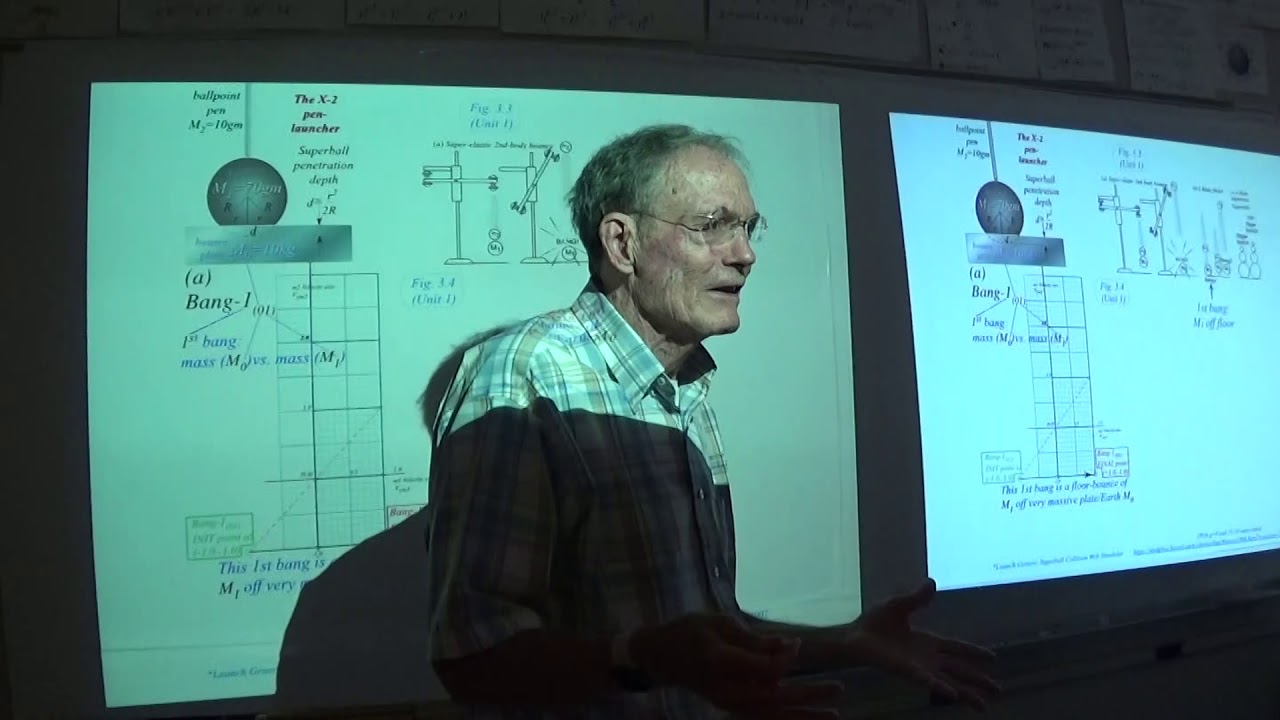
Classical Mechanics with a Bang! (2019 Fall) - Lecture #2 - Part 1/2
Keywords
Summary
182 words
Critical Evaluation
Value of the Information & Strength of the Argument
The lecture provides a clear and insightful explanation of a non-trivial physical phenomenon using a simple model and geometric methods. The argumentation is solid: the independent bounce model is introduced, justified, and applied to derive quantitative predictions that are then verified with a demonstration. The geometric approach is shown to be powerful for visualizing and solving collision problems, and the lecture encourages critical thinking by asking students to estimate outcomes. The historical context (discovery of the effect, project at USC) adds interest, but the core value lies in the pedagogical clarity and the demonstration of a useful technique.
Scientific Rigor, Source Quality, Title Accuracy
The lecture is based on the instructor’s own textbook ‘Classical Mechanics with a Bang!’ and is part of a structured course. The course website and PDF slides are provided in the description, which are reliable sources for the content. The title accurately reflects the content: it is a lecture on classical mechanics with a focus on collisions and a ‘bang’ (the superball demonstration). The experimental demonstrations are qualitative and approximate, but they serve to illustrate the theory. The lecture does not cite external sources beyond the course materials, but the instructor mentions a paper in the American Journal of Physics and the work of Stirling Colgate, though no specific references are given. Overall, the scientific rigor is appropriate for a graduate lecture, with the caveat that it is not peer-reviewed.
243 words
Title / Content Match
The title accurately reflects the content: a lecture on classical mechanics with a focus on collisions and geometric methods, including a 'bang' (the superball demonstration).
Quality & Reliability
8/10
Lecture by a university professor, based on a textbook and accompanied by a course website and PDF slides. The content is pedagogically structured, with demonstrations and geometric constructions. However, it is a lecture, not peer-reviewed, and the experimental demonstrations are approximate.
Key Moments
Markers derived by PSI from the transcript: the creator did not define chapters.
- Introduction to the superball demonstration and its history.
- Demonstration of the superball with a pen; discussion of the independent bounce model.
- Introduction to velocity-space diagrams and the geometric approach.
- Construction of the collision line for a 7:1 mass ratio.
- Using a compass to find the final velocity; calculation of height increase.
- Exploration of different mass ratios and the 'pencil' of lines.
- Discovery that a 3:1 mass ratio gives 100% energy transfer.
- Demonstration with a 3:1 mass ratio; discussion of the final locus.
Cited Sources
- Course website: Classical Mechanics with a Bang! — Course website for the textbook and lectures.
- Lecture #2 slides (PDF) — Slides used in this lecture.
Concurring Sources
- Course website — Provides the textbook and lecture materials, consistent with the content.
Contribution & Novelties
The lecture presents a clear geometric method for solving collision problems, specifically the superball problem, using the independent bounce model. It demonstrates how velocity-space diagrams and simple geometric constructions (lines, circles) can provide intuitive and quantitative solutions. The lecture also highlights the historical development of the model and its connection to astrophysics (supernovae).
Pour aller plus loin :
- Independent bounce model — This concept is central to the lecture; the Wikipedia article may not exist, but it is a useful search term.
- Elastic collision — The collisions discussed are elastic; this page provides background.
- Center-of-momentum frame — The geometric construction uses the center-of-momentum point.
- Supernova Type Ia — Mentioned in the lecture as an application of the superball effect.
119 words
Radar Profile
The radar profile shows high scores in quantity and quality of information, with slightly lower technical level and reliability. This reflects a lecture that is rich in content and well-structured, but not peer-reviewed and with some approximations in demonstrations.