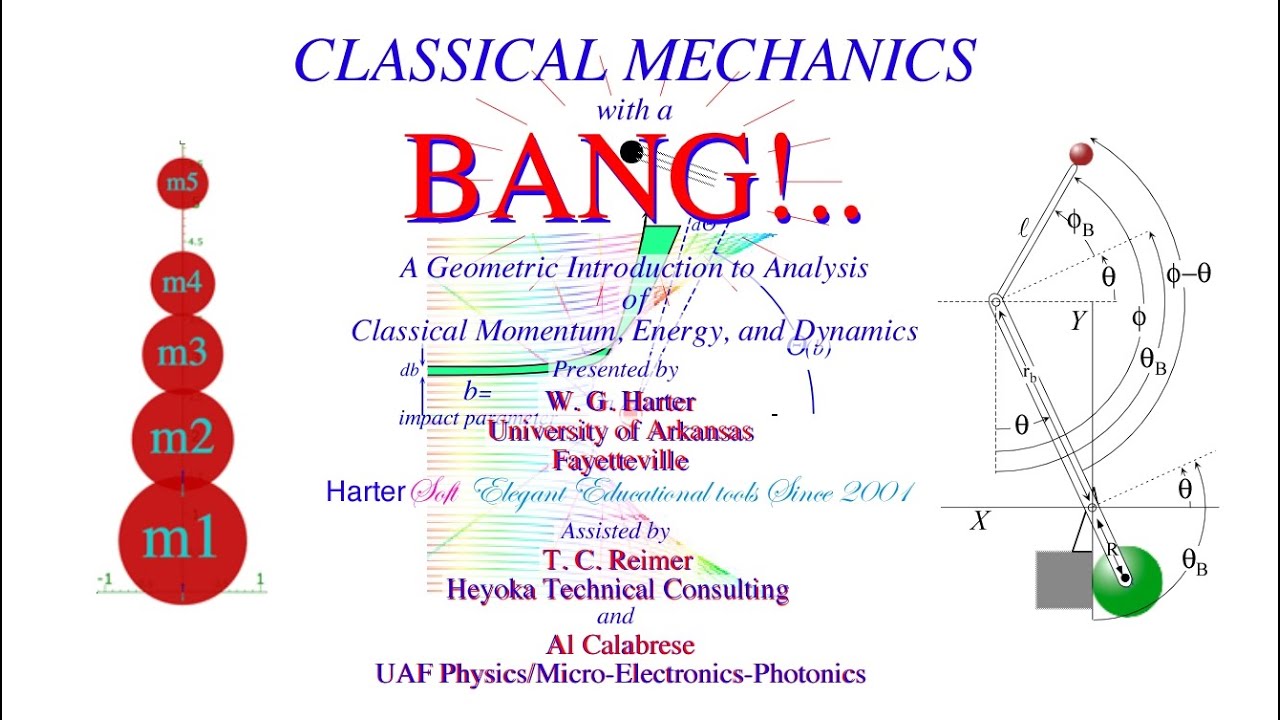
Classical Mechanics with a Bang! - Lecture 8
Keywords
Summary
134 words
Critical Evaluation
Value of the Information & Strength of the Argument
The lecture provides a unique geometric perspective on classical mechanics, offering visual constructions that clarify the relationships between potentials, forces, and conic sections. The argumentation is logically structured, building from simple geometric constructions to more complex applications. The instructor’s explanations are thorough and demonstrate a deep understanding of the subject. However, the value is primarily pedagogical, and the content is not novel in terms of physics, but rather in the presentation method.
Scientific Rigor, Source Quality, Title Accuracy
The lecture is scientifically rigorous, with mathematically sound derivations and constructions. The instructor does not cite external sources, but the content is based on established classical mechanics principles. The title is somewhat informal but accurately reflects the course’s approach. The lecture is part of a university course, lending credibility to the content. No external sources are cited, but the course website is provided for further reference.
153 words
Title / Content Match
The title 'Classical Mechanics with a Bang!' is a catchy phrase for a course, and this lecture covers classical mechanics topics (oscillator and Coulomb potentials) with geometric methods, so it is adequately aligned.
Quality & Reliability
8/10
Lecture from a university graduate course by a professor, presenting geometric constructions for classical mechanics potentials. The content is mathematically rigorous and internally consistent, but relies on the instructor's presentation without external citations or peer review.
Key Moments
Markers derived by PSI from the transcript: the creator did not define chapters.
- Introduction to the lecture: geometric approach to oscillator and Coulomb potentials.
- Geometric construction of exponential functions using zigzag method.
- Application of zigzag to construct parabolas and power-law functions.
- Discussion of parabolic geometry: focus, directrix, and latus rectum.
- Optical analogy for parabolic mirrors and reflection.
- Construction of Coulomb potential and force curves using geometric methods.
- Introduction to the 'sophomore physics Earth' and its internal potential.
- Discussion of orbits inside the Earth as conic sections.
- Preview of neutron starlet and its orbits.
Cited Sources
- Course Website: Classical Mechanics with a Bang! — Official course website for the textbook and lectures.
Concurring Sources
- Classical Mechanics (Goldstein) — Standard graduate textbook covering classical mechanics, including harmonic oscillator and central forces.
Contribution & Novelties
The lecture offers a distinctive geometric visualization of classical mechanics concepts, particularly the construction of potentials using a zigzag method. This approach may help students intuitively grasp the relationships between forces and potentials. The lecture also connects classical mechanics to quantum mechanics through the harmonic oscillator.
Pour aller plus loin :
- Harmonic oscillator — Fundamental concept in physics, relevant to the oscillator potential discussed.
- Conic section — Geometric shapes that describe orbits, as mentioned in the lecture.
- Coulomb’s law — Underlies the Coulomb potential discussed.
85 words
Radar Profile
The radar profile shows high scores across all dimensions, indicating a well-rounded lecture with substantial information, solid quality, technical depth, and reliability. The lecture is particularly strong in technical content and information quality, reflecting its graduate-level nature.