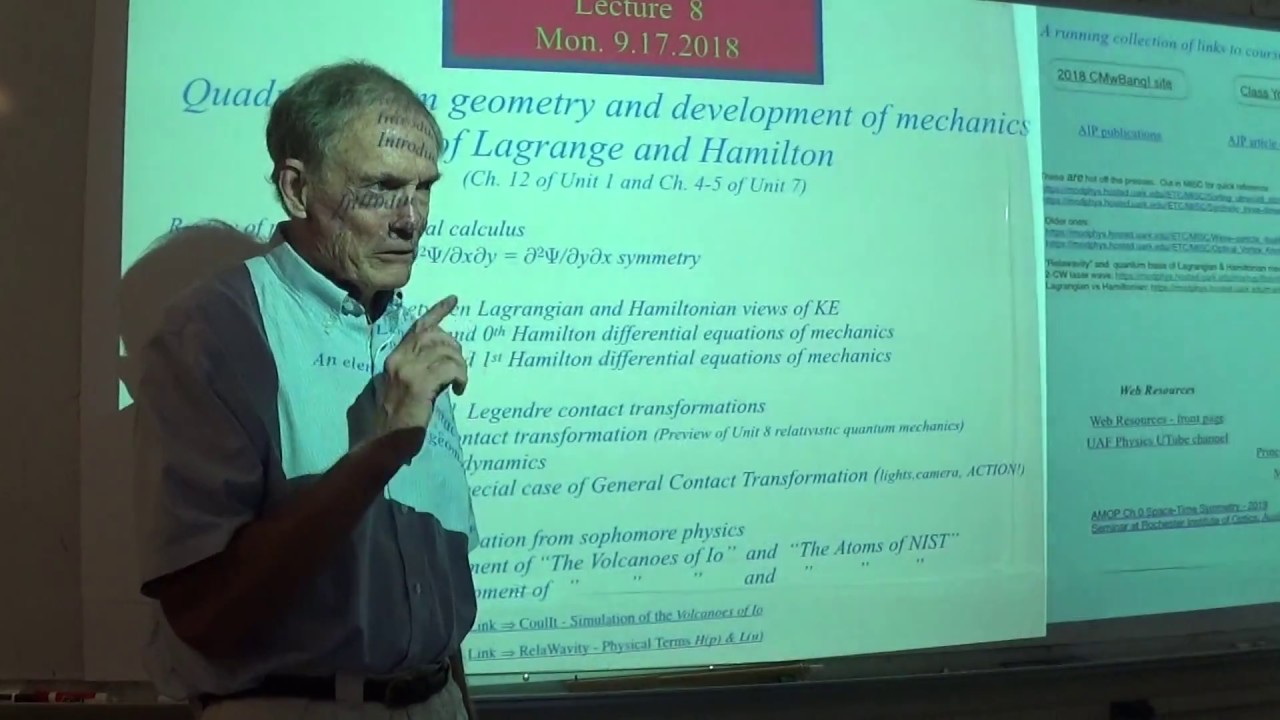
Classical Mechanics with a Bang! (2018 Fall) - Lecture #8 Part 1/2
Keywords
Summary
142 words
Critical Evaluation
Value of the Information & Strength of the Argument
The lecture provides a deep and insightful exploration of the geometric structure underlying classical mechanics. It offers a unique perspective by emphasizing the role of contact geometry and the Legendre transformation, which are often glossed over in standard treatments. The argumentation is rigorous, building from fundamental principles and using visual aids to clarify abstract concepts. The instructor’s use of the boathouse analogy for partial derivatives and the ellipse/paraboloid diagrams for quadratic forms effectively conveys the mathematical ideas. The demonstration of the web tool adds practical value, allowing students to interact with the concepts. The argument that classical mechanics follows from the constancy of the speed of light is presented as a logical consequence, though it is only sketched in this lecture.
Scientific Rigor, Source Quality, Title Accuracy
The lecture is based on the instructor’s own textbook ‘Classical Mechanics with a Bang!’ and is part of a structured graduate course. The course website and lecture slides are provided in the description, offering supplementary materials. The scientific rigor is high, with careful mathematical derivations and attention to conceptual clarity. The title accurately reflects the content, which is a detailed lecture on classical mechanics. No external sources are cited beyond the course materials, but the instructor’s expertise and the coherent presentation lend credibility. The lecture does not include any advertising or sponsored content.
229 words
Title / Content Match
The title accurately reflects the content: a lecture on classical mechanics with a focus on geometric and algebraic foundations.
Quality & Reliability
8/10
Lecture by a university professor, based on a textbook and course materials, with a rigorous mathematical approach. The content is advanced and internally consistent, but not peer-reviewed in this format.
Key Moments
Markers derived by PSI from the transcript: the creator did not define chapters.
- Introduction to the lecture's focus on partial derivatives and the geometric approach.
- Review of partial derivatives and symmetry, using the boathouse analogy.
- Introduction to Lagrangian and Hamiltonian mechanics, emphasizing their dependence on velocity and momentum respectively.
- Discussion of the Legendre transformation and its role in connecting the two formulations.
- Geometric interpretation of quadratic forms and the relationship between ellipses in velocity and momentum space.
- Demonstration of the web-based interactive tool showing the relationship between Lagrangian and Hamiltonian, including relativistic effects.
- Sketch of how the constancy of the speed of light underlies classical mechanics, hinting at wave mechanics.
Cited Sources
- Course Website: Classical Mechanics with a Bang! — Course materials and resources for the graduate course PHYS 5103.
- Lecture #8 Slides (PDF) — The slide presentation for this specific lecture.
Concurring Sources
- Classical Mechanics (Goldstein et al.) — Standard graduate textbook covering similar topics, though not explicitly cited in the lecture.
Contribution & Novelties
This lecture offers a distinctive geometric perspective on classical mechanics, emphasizing the role of contact geometry and the Legendre transformation. It provides a clear visual and conceptual bridge between the Lagrangian and Hamiltonian formulations, which is often lacking in standard textbooks. The interactive web tool is a novel pedagogical aid that allows students to explore the relationships dynamically. The lecture also hints at deeper connections to wave mechanics and relativity, providing a foundation for further study.
Pour aller plus loin :
- Legendre transformation — A key mathematical concept used to connect Lagrangian and Hamiltonian mechanics.
- Contact geometry — The geometric framework underlying the transformations discussed.
- Hamiltonian mechanics — A formulation of classical mechanics in terms of momentum and energy.
119 words
Radar Profile
The radar profile shows high scores in technical level and information quality, reflecting the advanced and rigorous nature of the lecture. The lower score in information quantity is due to the focused scope of a single lecture, while the overall reliability is high given the academic context.