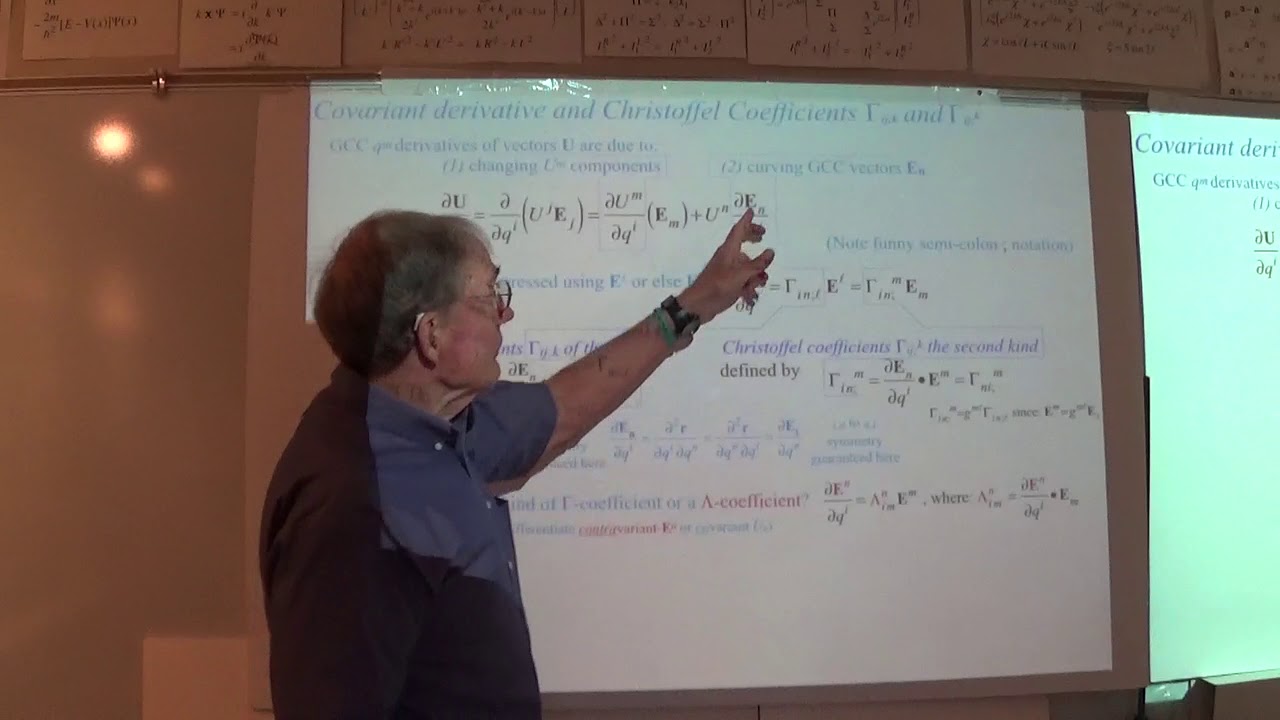
Classical Mechanics with a Bang! (2017 Fall) - Lecture #17
Keywords
Summary
190 words
Critical Evaluation
Value of the Information & Strength of the Argument
The lecture provides a rigorous and detailed exposition of Christoffel symbols and covariant derivatives, which are fundamental tools in differential geometry and general relativity. The professor carefully explains the definitions, derivations, and the distinction between tensors and non-tensors, which is crucial for understanding the mathematics of curved spaces. The argumentation is solid, building from basic definitions to more complex concepts, and he emphasizes the physical relevance by connecting to Newton’s laws. The use of examples like spherical and cylindrical coordinates, and the mention of a physical vortex, helps to illustrate the abstract concepts. However, the lecture is very dense and assumes a high level of mathematical maturity, which might limit its accessibility. The value lies in its clear pedagogical approach to a challenging topic, making it a useful resource for advanced students.
Scientific Rigor, Source Quality, Title Accuracy
The lecture is part of a university course, and the professor is an expert in the field. The content is based on standard mathematical physics, and the derivations follow established methods. The sources cited are the course website and the lecture slides, which are provided in the description. The title accurately reflects the content, as it is a lecture on classical mechanics with a geometric approach. The lecture does not cite external research papers but relies on the textbook and the professor’s expertise. The scientific rigor is high, as the mathematical derivations are correct and the presentation is coherent. The adequacy between title and content is excellent, as the lecture indeed covers the geometric approach to classical mechanics.
265 words
Title / Content Match
The title accurately reflects the content: a lecture on classical mechanics with a geometric approach, part of a series.
Quality & Reliability
8/10
The lecture is delivered by a university professor, part of a graduate course, with a clear pedagogical structure. The content is based on established mathematical physics (tensor analysis, Christoffel symbols) and is presented with derivations. However, it is a single lecture without peer review, and the video has very low viewership, so the reliability is high but not perfect.
Key Moments
Markers derived by PSI from the transcript: the creator did not define chapters.
- Introduction to the lecture topic: generalized curvilinear coordinates and Christoffel coefficients.
- Definition of the two kinds of Christoffel coefficients and their relation to the metric tensor.
- Discussion on the symmetry properties of Christoffel symbols.
- Derivation of the formula for Christoffel symbols in terms of metric derivatives.
- Explanation of why Christoffel symbols are not tensors and transformation rules.
- Introduction of the covariant derivative and semicolon notation.
- Application to Newton's second law in curved space.
- Mention of using Mathematica for calculations and a physical example of a vortex.
Cited Sources
- Course Web site — Course materials and information.
- Lecture #17 slide presentation (pdf) — Slides used in the lecture.
Concurring Sources
- Christoffel symbols - Wikipedia — Standard reference for the topic.
Contribution & Novelties
This lecture provides a clear and detailed explanation of Christoffel symbols and covariant derivatives, which are essential for understanding general relativity and differential geometry. The professor’s approach emphasizes the geometric interpretation and the distinction between tensors and non-tensors, which is often a source of confusion. The lecture also connects these mathematical concepts to physical applications, such as Newton’s laws in curved space, making it a valuable resource for advanced physics students.
Pour aller plus loin :
- Christoffel symbols - Wikipedia — Provides a comprehensive overview of the topic.
- Covariant derivative - Wikipedia — Explains the concept in detail.
- Tensor calculus - Wikipedia — Background on tensor analysis.
107 words
Radar Profile
The radar profile shows high scores in technical level and information quality, indicating a dense, advanced lecture. The quantity of information is also high, but the accessibility might be limited due to the advanced nature. The reliability is high, reflecting the academic context.