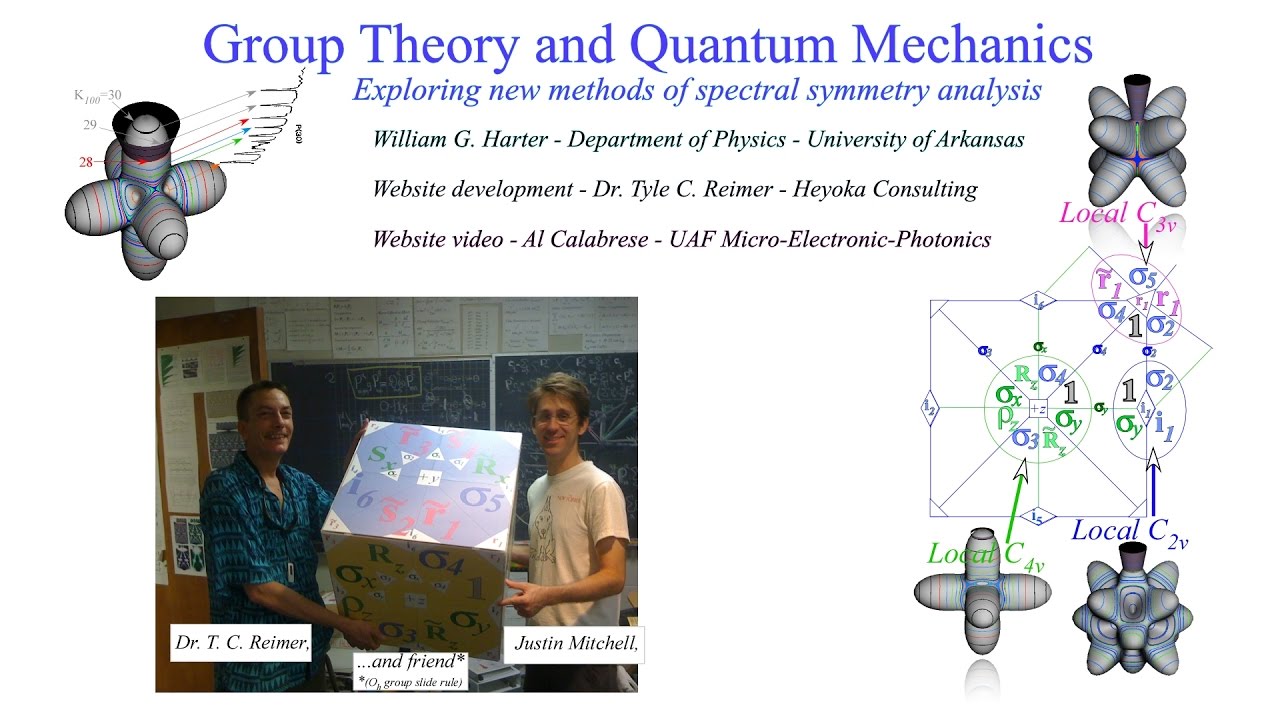
Group Theory in Quantum Mechanics (2017 Sp) - Lecture #29
Keywords
Summary
149 words
Critical Evaluation
Value of the Information & Strength of the Argument
The value of the information is high for a graduate-level physics audience, as it covers advanced topics in group theory applied to quantum mechanics. The argumentation is likely rigorous, based on mathematical derivations and physical reasoning. However, the transcription is so garbled that the actual arguments cannot be assessed. The lecture appears to be part of a well-structured course, with slides and supplementary materials provided.
74 words
Title / Content Match
The title accurately reflects the content, which is a lecture on group theory applied to quantum mechanics.
Quality & Reliability
7/10
The lecture is part of a graduate physics course, presented by a professor with expertise in the field. The content is based on established textbooks and includes mathematical derivations. However, the transcription is severely garbled, making it difficult to verify the accuracy of the presented material. The low view count and lack of engagement limit external validation.
Key Moments
Markers derived by PSI from the transcript: the creator did not define chapters.
Cited Sources
- Group Theory in Quantum Mechanics Course Website — Course website with additional content and resources.
- Lecture #29 Slides (PDF) — Slides used in this lecture.
Concurring Sources
- Group Theory in Quantum Mechanics Course Website — Official course resource.
Contribution & Novelties
The lecture provides a rigorous introduction to group theory as applied to quantum mechanics, emphasizing the physical interpretation of mathematical symmetries. It is part of a comprehensive course that integrates theory with practical applications in spectroscopy.
Pour aller plus loin :
- Group theory — Foundational concepts.
- Representation theory — Key mathematical framework.
- Molecular symmetry — Application to molecules.
58 words
Radar Profile
The radar profile shows high scores in technical level and information quantity, reflecting the advanced nature of the lecture. Quality and reliability are moderate due to the garbled transcription, but the academic context suggests high reliability.