David London: 2022 CAP-CRM Prize in Theoretical and Mathematical Physics
Keywords
Summary
157 words
Critical Evaluation
Value of the Information & Strength of the Argument
The talk provides a valuable overview of the current understanding of the quark-gluon plasma, synthesizing results from lattice QCD, hydrodynamic modeling, and experimental data. The argumentation is solid, based on established theoretical frameworks and supported by comparisons with measurements. The speaker clearly explains the methodology for extracting transport coefficients and temperature, and acknowledges uncertainties in the calculations. The presentation is coherent and logically structured, making a compelling case for the success of the hydrodynamic description of heavy-ion collisions.
Scientific Rigor, Source Quality, Title Accuracy
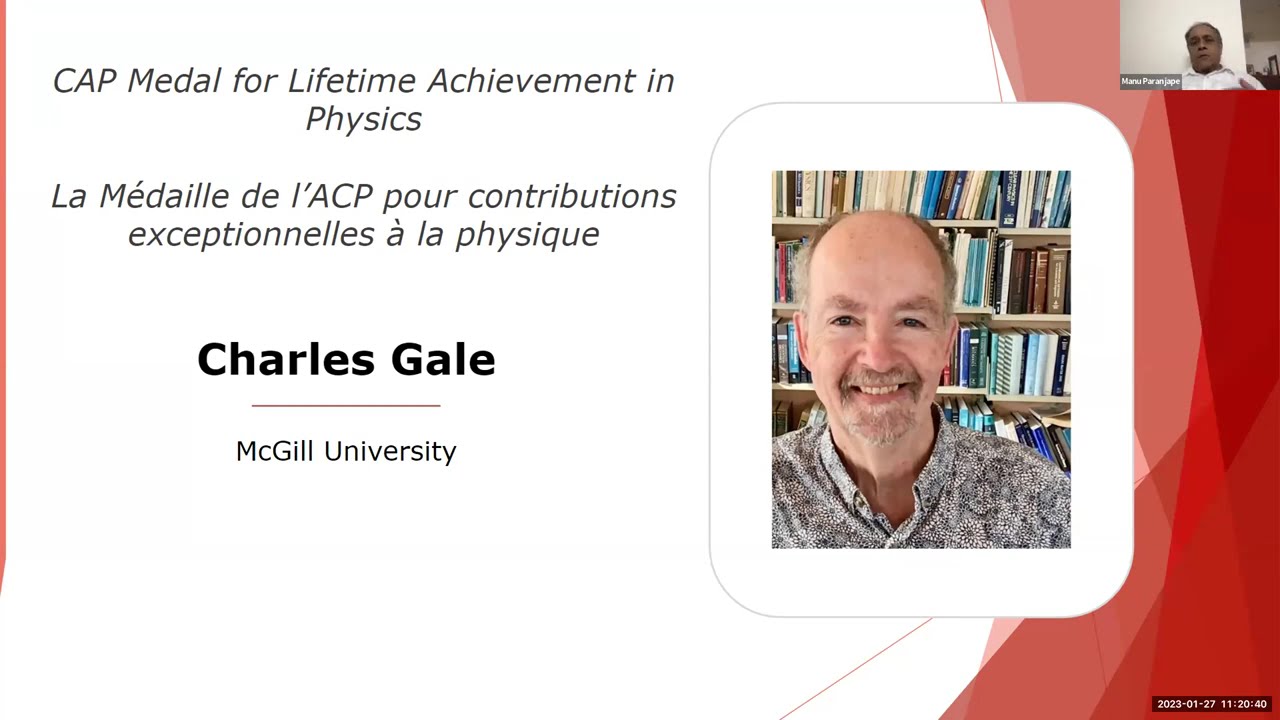
The talk is scientifically rigorous, referencing lattice QCD calculations, hydrodynamic codes (MUSIC), and experimental collaborations (PHENIX, ALICE, CMS). However, specific citations are not provided in the talk itself; the speaker mentions general results and collaborations. The title of the video is misleading as it announces a talk by David London, but the actual lecture is by Charles Gale. This discrepancy affects the adequacy of the title. The content is of high quality, but the lack of explicit references limits the ability to verify all claims.
178 words
Title / Content Match
The title indicates a prize lecture by David London, but the actual talk is by Charles Gale on QCD and quark-gluon plasma, which is a mismatch.
Quality & Reliability
8/10
The talk is given by a renowned physicist (Charles Gale) presenting established results from heavy-ion collisions, with references to lattice QCD and hydrodynamic modeling. The content is scientifically sound, but the presentation is a condensed overview without detailed derivations or exhaustive citations.
Key Moments
Markers derived by PSI from the transcript: the creator did not define chapters.
- Introduction and announcement of the talk by Charles Gale on QCD and quark-gluon plasma.
- Discussion of QCD basics: gauge theory, quarks, gluons, and running coupling.
- Phase transition in QCD and lattice QCD results showing crossover.
- Heavy-ion collisions and the standard picture: initial state, hydrodynamics, hadronization.
- Introduction to transport coefficients: shear and bulk viscosity.
- Azimuthal flow harmonics (v2, v3, etc.) and their sensitivity to viscosity.
- Extraction of viscosity from data using Bayesian analysis (Matt Heffernan's work).
- Photons as penetrating probes to measure temperature.
- Conclusion: RHIC and LHC as viscometers and thermometers; future directions.
Cited Sources
- MUSIC hydrodynamic code — Mentioned as a state-of-the-art hydrodynamic code developed at McGill University.
- PHENIX collaboration — Mentioned as an experiment at RHIC measuring photon spectra.
- ALICE collaboration — Mentioned as an experiment at the LHC measuring photon spectra.
- CMS collaboration — Mentioned as an experiment at the LHC measuring flow harmonics.
Concurring Sources
- Lattice QCD calculations of the QCD phase diagram — Supports the existence of a crossover transition as discussed.
- Hydrodynamic modeling of heavy-ion collisions — Reviews the success of hydrodynamics in describing collective flow.
Dissenting Sources
- Alternative models for the initial state — The talk focuses on the IP-Glasma model; other models like the Color Glass Condensate with different implementations may yield different results.
Contribution & Novelties
The talk provides a comprehensive overview of the current state of heavy-ion physics, emphasizing the successful extraction of transport coefficients and temperature from experimental data. It highlights recent Bayesian analyses and the development of hydrodynamic codes. The speaker also discusses the connection between QCD and neutron star physics.
Pour aller plus loin :
- Quark-gluon plasma — Overview of the QGP and its properties.
- Relativistic heavy-ion collision — Information on RHIC and heavy-ion collisions.
- Lattice QCD — Method used to calculate QCD thermodynamics.
- MUSIC hydrodynamic code — The code mentioned in the talk for hydrodynamic simulations.
95 words
Radar Profile
The radar profile shows high scores in all dimensions, indicating a well-rounded and informative talk. The strongest aspects are the quantity and quality of information, as well as the technical level, reflecting the speaker's expertise. The reliability is also high, though the lack of explicit citations slightly reduces the score.
💬 No comments were provided for analysis.