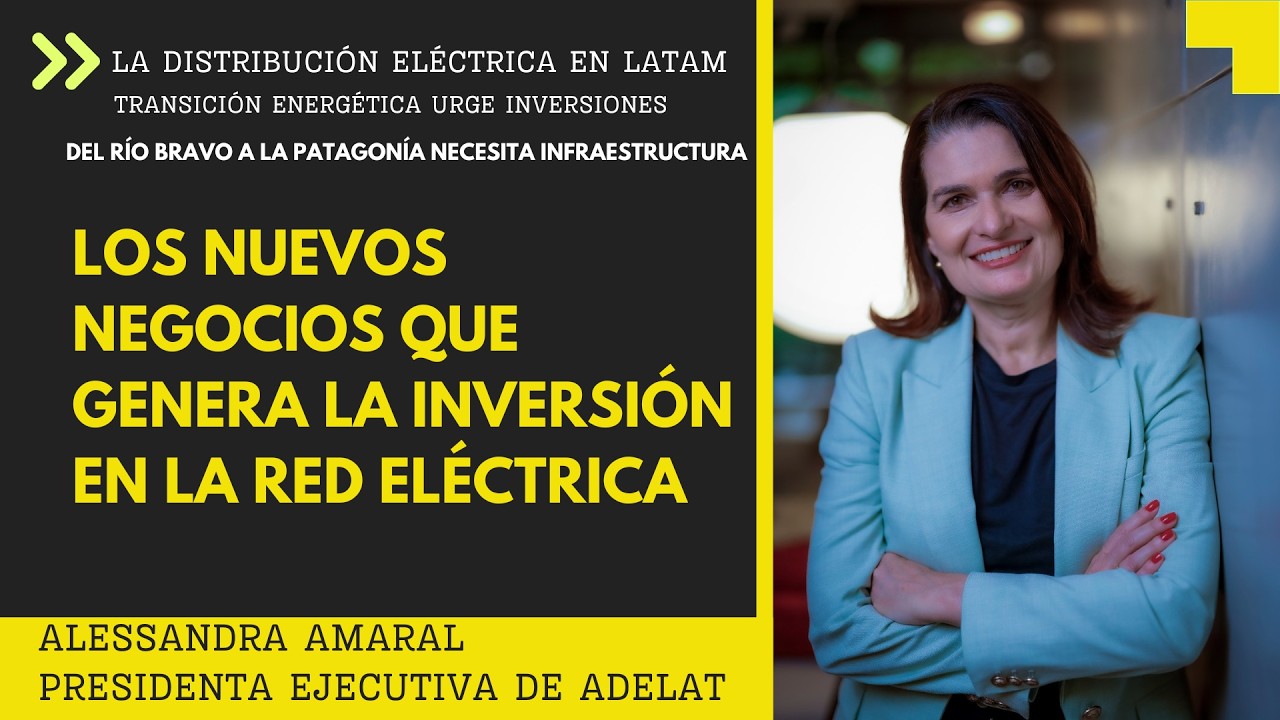
Sector Eléctrico en LATAM: Las 3D abren oportunidades de negocio
Keywords
Summary
174 words
Critical Evaluation
Value of the Information & Strength of the Argument
The interview provides valuable insights into the current state and future direction of the electricity sector in Latin America, based on the expertise of a key industry leader. The argumentation is coherent and grounded in practical examples, such as regulatory sandboxes in Brazil and the ADELAT study on investment needs. However, the discussion remains at a strategic level, with limited technical depth and no detailed data or case studies. The value lies in the authoritative perspective on regional trends and the emphasis on the ‘3D’ framework as a lens for business opportunities.
Scientific Rigor, Source Quality, Title Accuracy
The scientific rigor is moderate: the interviewee references an ADELAT study from 2024 and specific regulatory initiatives, but no direct sources or URLs are provided in the video or description. The title accurately represents the content, focusing on the ‘3D’ concept and business opportunities. The interview is based on expert opinion rather than peer-reviewed research, which is appropriate for its format. No comments were provided for analysis.
174 words
Title / Content Match
The title accurately reflects the content, focusing on the '3D' (digitalization, decarbonization, decentralization) and business opportunities in the Latin American electricity sector.
Quality & Reliability
7/10
The interview features a recognized industry leader (Alessandra Amaral, President of ADELAT) providing informed perspectives on the Latin American electricity sector. Claims are supported by references to an ADELAT study (2024) and specific regulatory examples, but lack detailed citations or verifiable data within the video itself.
Key Moments
Markers derived by PSI from the transcript: the creator did not define chapters.
- Introduction and context of the interview, mentioning ADELATM 2026 event.
- Amaral provides a general diagnosis of distribution networks in Latin America, highlighting new technologies and climate change challenges.
- Discussion on the need for flexibility and resilience in grids due to renewable integration and extreme weather events.
- Amaral mentions the role of ADELAT in promoting best practices and exchanging experiences among Latin American countries.
- Examples of advanced metering in Uruguay and Costa Rica, and Brazil's concession renewal with new regulatory requirements.
- Discussion on regulatory evolution, including reference company models and tariff sandboxes in Brazil.
- Key parameters for investors: regulatory stability, predictability, and recognition of investments within tariff cycles.
- Regional comparison: Costa Rica leads in smart metering, Brazil in distributed generation, but storage lags everywhere.
- Mexico's potential in solar energy, storage, and electric mobility, plus the impact of AI and data centers on electricity demand.
- Business opportunities from the 3D trends: cost reductions, new services, and market opening.
Cited Sources
- ADELAT Study 2024 on Investment Needs — Referenced in the interview as a study measuring investments needed for the energy transition in Latin American distribution companies.
Concurring Sources
- IEA Report on Electricity Grids — Supports the need for grid investment and modernization globally, aligning with the interview's emphasis on investment needs.
Contribution & Novelties
The interview provides a concise overview of the ‘3D’ trends (digitalization, decarbonization, decentralization) shaping the Latin American electricity sector, with insights from a regional industry leader. It highlights specific country examples and investment figures, offering a strategic perspective on business opportunities.
Pour aller plus loin :
- Energy transition in Latin America — General context on the global energy transition.
- Smart grid — Relevant to digitalization and advanced metering discussed.
- Distributed generation — Key concept for decentralization and Brazil’s example.
- Regulatory sandbox — Mentioned in the context of Brazil’s tariff experiments.
90 words
Radar Profile
The radar profile shows balanced scores across information quantity, quality, technical level, and reliability, indicating a well-rounded but not deeply technical interview. The moderate technical level suggests it is accessible to a general audience while still providing expert insights.