Lecture 5 OFCM2025
Keywords
Summary
180 words
Critical Evaluation
Value of the Information & Strength of the Argument
The lecture provides solid foundational knowledge in set theory, with clear definitions and a strong emphasis on proof techniques. The instructor’s Socratic approach actively engages students, reinforcing understanding through questioning. The argumentation is logically sound, particularly in demonstrating the necessity of proving both inclusions for set equality. The examples are well-chosen to illustrate common pitfalls, such as ignoring repetition or order in sets. The lecture effectively builds from simple definitions to more complex problems, fostering critical thinking.
Scientific Rigor, Source Quality, Title Accuracy
The scientific rigor is high for a tutorial: definitions are precise, and proofs are structured. However, no external sources are cited, which is typical for a lecture but limits verifiability. The title is generic but accurately reflects the content as a lecture in a series. The instructor’s explanations are mathematically correct, and the interactive format helps clarify misconceptions. The lecture adheres to standard mathematical conventions.
157 words
Title / Content Match
The title 'Lecture 5 OFCM2025' is generic but accurately reflects the content as a lecture in a series.
Quality & Reliability
7/10
The lecture is a structured tutorial on set theory, with rigorous definitions and proofs. The instructor engages students in a Socratic method, ensuring understanding. No external sources are cited, but the mathematical content is standard and accurate.
Key Moments
Markers derived by PSI from the transcript: the creator did not define chapters.
- Introduction and overview of set theory topics.
- Definition of union and intersection.
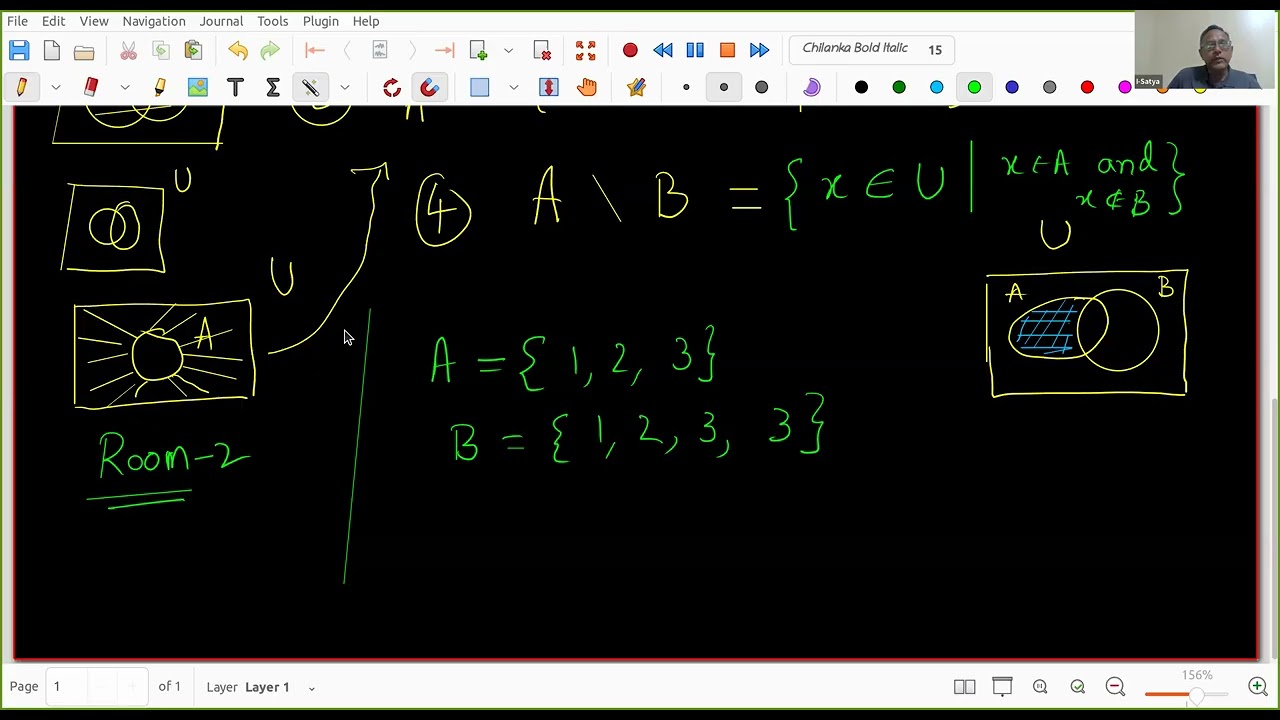
- Definition of complement and set difference.
- Discussion on set equality and the importance of proving both inclusions.
- Example with repeated elements: A = {1,2,3} and B = {1,2,3,3}.
- Example with different orderings: A = {1,2,3} and B = {2,1,3}.
- Proving set equality for {x ∈ R : x² = 1} = {1, -1}.
- Introduction of the set Δ and membership questions.
- Discussion on proving 1, 3, 5, 7 belong to Δ.
- Challenge for room 5: does 9 belong to Δ?
Contribution & Novelties
The lecture provides a clear pedagogical approach to teaching set theory, emphasizing the rigorous proof of set equality. It offers a structured method for students to understand and apply the concept of mutual inclusion. The interactive format encourages active learning.
Pour aller plus loin :
- Set theory (Wikipedia) — Foundational concepts.
- Mathematical proof (Wikipedia) — Techniques for proving statements.
- Zermelo–Fraenkel set theory (Wikipedia) — Axiomatic foundation.
66 words
Radar Profile
The radar profile shows high scores in quality of information and reliability, with moderate scores in quantity and technical level. This indicates a focused, well-explained tutorial that may not cover a vast amount of material but provides depth in key concepts.