Lecture 4 OFCM2025
Keywords
Summary
178 words
Critical Evaluation
Value of the Information & Strength of the Argument
The lecture provides a solid foundation in logical reasoning, emphasizing the distinction between a statement, its converse, and its contrapositive. The argumentation is clear and methodical, using relatable examples to illustrate abstract concepts. The instructor actively engages students, prompting them to think critically and provide counterexamples, which strengthens the understanding of logical equivalence. The value lies in its pedagogical approach, making the material accessible and reinforcing the importance of precise reasoning in mathematics.
Scientific Rigor, Source Quality, Title Accuracy
The lecture is scientifically rigorous in its treatment of logical concepts, with no factual errors. However, it does not cite any external sources, relying solely on the instructor’s explanations. The title ‘Lecture 4 OFCM2025’ is appropriate but lacks specificity. The content aligns well with the title, as it is a continuation of a course on mathematical logic. No comments were provided for analysis.
151 words
Title / Content Match
The title 'Lecture 4 OFCM2025' is generic but accurately indicates the content's nature as a lecture in a series.
Quality & Reliability
7/10
The lecture is a formal educational session on mathematical logic, specifically conditional statements, converse, and contrapositive. The content is accurate and well-structured, with clear examples and interactive questioning. However, it is a lecture without citations or references, and the presentation style is informal with some digressions.
Key Moments
Markers derived by PSI from the transcript: the creator did not define chapters.
- Introduction and review of previous class on compound statements.
- Introduction of conditional statement 'if x in A then x in B' and definition of subset.
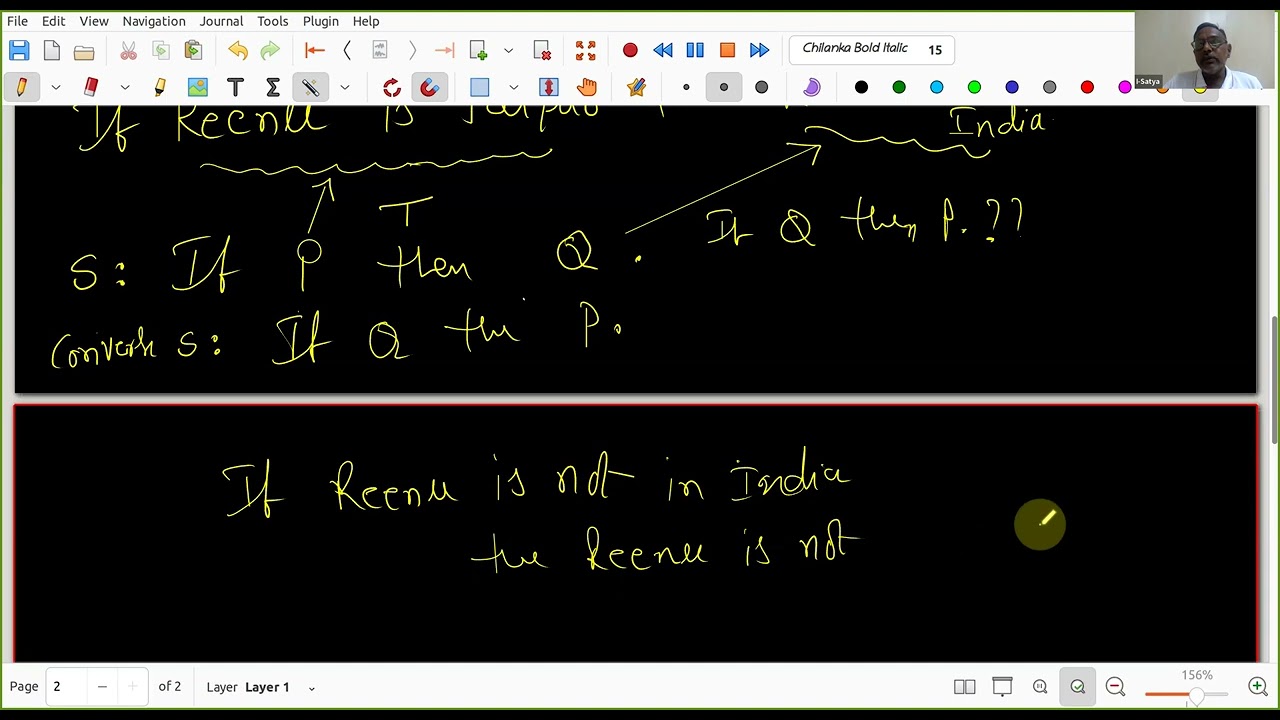
- Example: 'If Renu is in Jaipur then Renu is in India' - discussion of necessary condition.
- Definition of converse and contrapositive with examples.
- Example: Mother's promise - when is the promise violated? Truth table for conditional.
- Example: 'If x > 2 then x > 1' - converse is not always true, counterexample 1.5.
- Example: 'If 4 divides x then 2 divides x' - converse false, counterexample x=2.
- Discussion on whether contrapositive is true when original statement is false.
- Further examples and student questions on logical equivalence.
Contribution & Novelties
The lecture provides a clear pedagogical explanation of conditional statements, converse, and contrapositive, with emphasis on logical equivalence and counterexamples. It does not introduce new mathematical concepts but reinforces foundational logic in an accessible manner.
Pour aller plus loin :
- Conditional statement — Wikipedia article on conditional statements in logic.
- Contraposition — Wikipedia article on contraposition and its logical equivalence.
- Truth table — Wikipedia article on truth tables, useful for understanding the truth conditions of logical connectives.
77 words
Radar Profile
The radar profile shows high scores in quality of information and fiabilité, reflecting the accurate and well-structured content. The lower score in niveau technique indicates that the lecture is introductory, targeting students new to formal logic. The overall balance suggests a reliable educational resource for beginners.