Lecture 6 OFCM2025
Keywords
Summary
158 words
Critical Evaluation
Value of the Information & Strength of the Argument
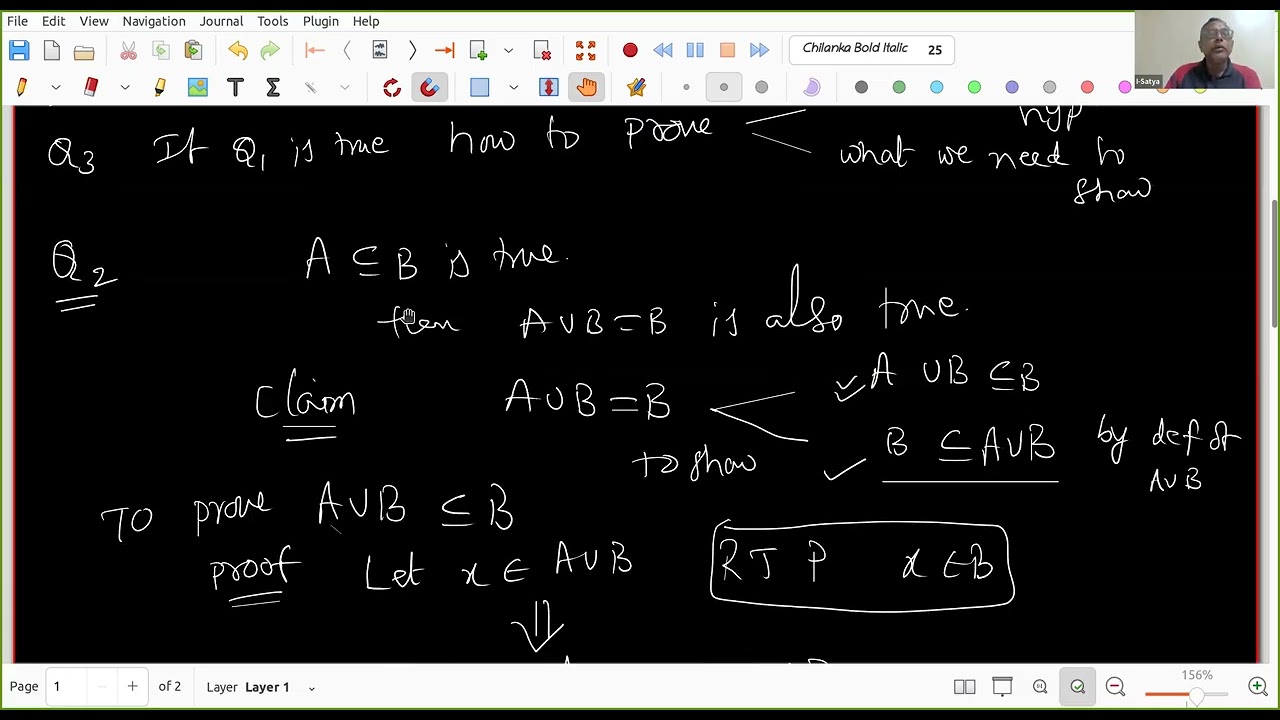
The lecture provides a solid foundation in set theory proofs, emphasizing rigorous argumentation. The instructor carefully guides students through the proof of A ∪ B = B given A ⊆ B, breaking it down into two inclusions and using the hypothesis appropriately. The value lies in the pedagogical approach: students are actively involved, and the instructor clarifies common mistakes, such as not using the hypothesis or misunderstanding the definition of union. The argumentation is sound, with each step justified by definitions or the hypothesis. The discussion on the minimum number of proofs to establish equivalence is particularly valuable, as it encourages students to think about logical dependencies and proof optimization. However, the lecture’s informal style and occasional digressions may reduce its efficiency for some learners.
Scientific Rigor, Source Quality, Title Accuracy
The mathematical content is rigorous and correct, with proofs following standard set theory conventions. The instructor does not cite external sources, which is appropriate for a foundational lecture. The title ‘Lecture 6 OFCM2025’ is generic and does not convey the specific topic, but it is consistent with a series of lectures. The adequacy between title and content is acceptable, as it is a lecture in a series. No comments were provided, so no analysis of public reception is possible.
219 words
Title / Content Match
The title 'Lecture 6 OFCM2025' is generic and does not describe the content, but it is consistent with a series of lectures. The content matches the title as it is a lecture in a series.
Quality & Reliability
7/10
The lecture is a live interactive session focused on set theory proofs. The mathematical content is correct and rigorous, but the video quality is low (92 views, 2 likes) and the presentation is informal with many interruptions and repetitions. The instructor demonstrates a clear pedagogical method, but the lack of structured visuals and the conversational style may reduce clarity for some viewers.
Key Moments
Markers derived by PSI from the transcript: the creator did not define chapters.
- Introduction and review of homework; start with room number eight.
- Discussion of problem: if A subset of B, then A union B = B. Students confirm truth.
- Proof of A union B subset of B using cases and hypothesis.
- Analogy of lunchbox to explain when to use hypothesis.
- Converse: if A union B = B, then A subset of B. Student proves it.
- Equivalence of statements: A subset of B, A union B = B, A intersection B = A, B complement subset of A complement.
- Discussion on minimum number of proofs needed to establish equivalence; students suggest six or four.
- Further discussion on proof dependencies and direct implications.
- Wrap-up and transition to next topic.
Contribution & Novelties
The lecture’s original contribution lies in its interactive pedagogical approach to teaching set theory proofs, emphasizing the logical structure of equivalence proofs and the minimum number of proofs required. It provides a clear framework for understanding how different set-theoretic statements are interconnected.
Pour aller plus loin :
- Set theory (Wikipedia) — Foundational concepts.
- Mathematical proof (Wikipedia) — Methods of proof.
- De Morgan’s laws (Wikipedia) — Related to complement operations.
69 words
Radar Profile
The radar profile shows high scores in quality of information and reliability, reflecting the correctness of the mathematical content. The quantity of information is moderate, and the technical level is intermediate, suitable for a foundational lecture. The overall balance indicates a solid educational resource.