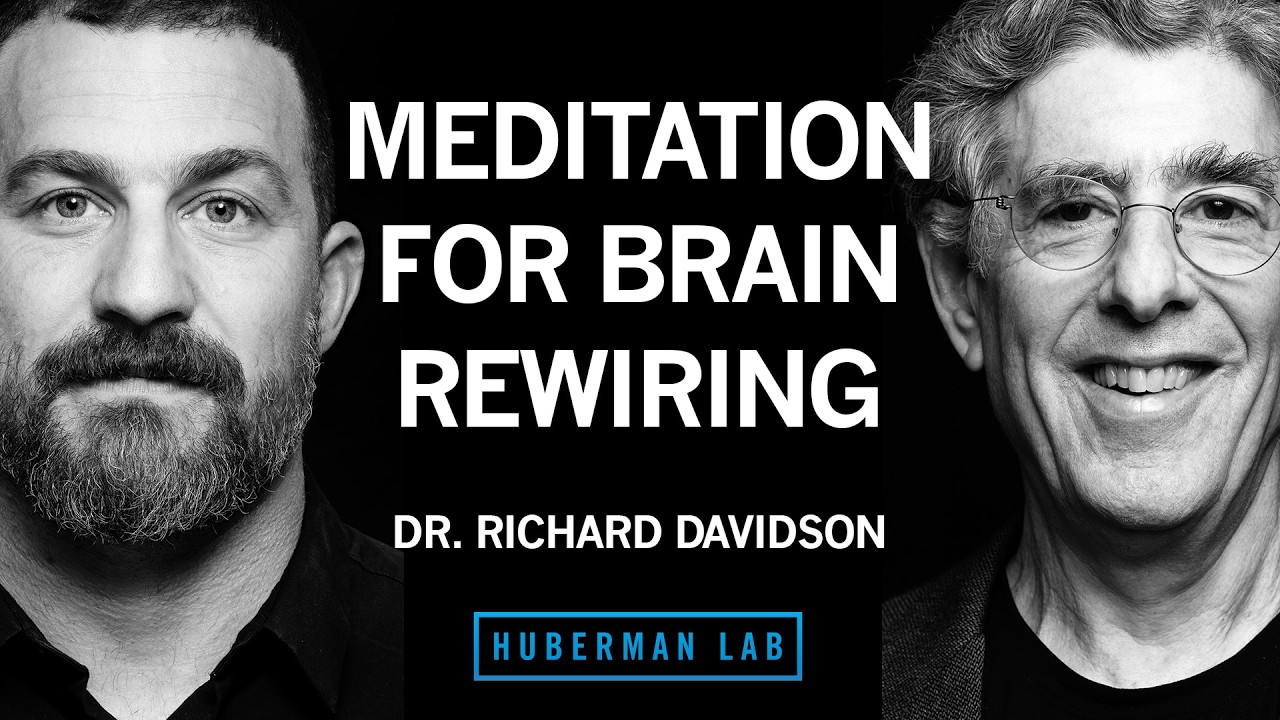
Science-Based Meditation Tools to Improve Your Brain & Health | Dr. Richard Davidson
Keywords
Summary
193 words
Critical Evaluation
This episode provides a comprehensive and scientifically grounded discussion on meditation, featuring Dr. Richard Davidson, a leading researcher in the field. The conversation is rich in content, covering both the theoretical underpinnings and practical applications of meditation. Dr. Davidson’s expertise is evident as he explains complex concepts such as states versus traits, brain oscillations, and the neuroplastic changes associated with meditation. The discussion is well-structured, moving from foundational ideas to specific tools and protocols, making it accessible to a broad audience while maintaining scientific rigor.
The scientific validity of the information is high, as Dr. Davidson references numerous randomized controlled trials and his own research at the Center for Healthy Minds. The emphasis on the ’lactate of the mind’ analogy provides a compelling framework for understanding the discomfort that can arise during meditation, and it is supported by evidence that brief daily practice can yield significant benefits. The episode also addresses common myths, such as the idea that meditation is about clearing the mind, and instead frames it as a practice of observation and awareness.
One potential limitation is that the podcast format includes sponsor segments and personal anecdotes, which, while clearly disclosed, may introduce bias. However, the core scientific content is robust and well-referenced. The discussion on advanced topics like psychedelics and neuromodulation is brief and may leave some listeners wanting more depth, but it serves as a teaser for further exploration.
The adéquation between the title and content is excellent; the episode indeed focuses on science-based meditation tools for brain and health. The practical tools provided, such as the 5-minute daily meditation and the appreciation practice, are actionable and evidence-based. Overall, this episode is a valuable resource for anyone interested in the science of meditation and its application for mental and physical well-being.
295 words
Title / Content Match
The title accurately reflects the content: a science-based discussion on meditation tools for brain and health, featuring Dr. Richard Davidson.
Quality & Reliability
8/10
The episode features a leading expert in contemplative neuroscience, Dr. Richard Davidson, with a strong track record of peer-reviewed research. The discussion is grounded in scientific evidence, including randomized controlled trials and brain imaging studies. However, as a podcast format, it includes personal anecdotes and practical advice that may not be universally applicable. The presence of sponsors is clearly disclosed, and the content is generally accurate and well-referenced.
Chapters
- Richard "Richie" Davidson
- States of Mind vs Traits
- Wakeful Brain Activity vs Deep Sleep
- Sponsors: David & Eight Sleep
- Brain Activity Across Sleep, Wakefulness, Meditation & Insight
- Mediation & Sleep Compensation?; Meditation Timing & Liminal States
- Types of Mediation, Shifting from Thinking to Being
- Self-Monitoring, Undistracted Non-Mediation, "Stickiness"
- Tool: Beginning Daily Meditation, "Richie's 5 Meditation"; Health Benefits
- Meditation Practice History, Kindness & Nurturing Goodness
- Sponsor: AG1
- Beginners, Expect Chaos in Mind, Exercise & Lactate Analogy
- Tool: Beginning Mediation, Embrace Anxiety; Meta-Awareness, Flow
- Creativity; Capturing Thoughts, Unconscious Mind
- Meditation for Kids; Flourishing, Tool: Parent & Teacher Meditation
- Sponsor: Joovv
- Beyond Stimulus & Response
- Meditation Need; Gaining Insight Into Mind, Transcendence
- Contemplating Death, Long-Term Meditation
- Richie's Meditation Practice; Tools: Pairing Meditation, Appreciation Practice
- Consistency, Balancing Discipline vs Surrender
- Social Media & Validating Existence, Digital Hygiene
- Meditation & Impulsivity; Discipline & "No Go's", Phone
- Physical Discomfort & Pain During Meditation; Retreat Practice
- Phone Detox, Self-Control
- Sponsor: Waking Up
- Overcoming Resistance, Making Peace With Your Mind
- Meditation & Connectivity; Consistency, Prayer; Sleepiness; Meta-Awareness
- Tools: Pillars of Flourishing; Appreciation Practice, Loving-Kindness Practice
- Awareness & Insight, Tools: Outside View; Task Connection
- Cultivating Flourishing, Familiarity with Resistance
- Psychedelics, Guides, Clinical vs Non-Clinical Use
- Neuromodulation & Meditation, Sleep; Tool: Pre-Sleep Meditation
- Open Monitoring Meditation & Creativity
- Zero-Cost Support, YouTube, Spotify & Apple Follow, Reviews & Feedback, Sponsors, Protocols Book, Social Media, Neural Network Newsletter
Cited Sources
- Center for Healthy Minds - Science Overview — Dr. Davidson's research center, providing an overview of scientific studies on meditation and well-being.
- PubMed - Publications by Richard Davidson — A list of peer-reviewed publications by Dr. Davidson, supporting the scientific claims made in the episode.
- Richard Davidson's Academic Profile — Official academic profile at the University of Wisconsin-Madison, confirming his credentials and affiliations.
- Richard Davidson's Personal Website — Official website with information about his work, books, and public engagements.
- Born to Flourish (Book) — Dr. Davidson's new book, mentioned in the episode, which expands on the themes of flourishing and well-being.
- Humin — A project associated with Dr. Davidson, likely related to human flourishing and meditation.
- Dharma Lab — A Substack publication possibly related to Dr. Davidson's work on meditation and science.
Concurring Sources
- Center for Healthy Minds - Science Overview — The research center's overview aligns with the scientific claims made in the episode, providing further evidence for the benefits of meditation.
- PubMed - Publications by Richard Davidson — Peer-reviewed publications support the statements about meditation's effects on depression, anxiety, and inflammation.
External References
Contribution & Novelties
This episode offers a unique synthesis of Dr. Davidson’s decades of research on meditation, presenting both the scientific evidence and practical tools in an accessible format. The ’lactate of the mind’ analogy provides a novel way to understand the discomfort during meditation as a beneficial stressor. The emphasis on brief daily practice (5 minutes) is a practical takeaway that is supported by randomized controlled trials. The discussion on states vs. traits and the ‘after is the before for the next during’ concept offers a framework for understanding how meditation can lead to lasting changes.
Pour aller plus loin :
- Neuroplasticity — The brain’s ability to reorganize itself, central to the episode’s discussion on meditation-induced changes.
- Mindfulness-based stress reduction (MBSR) — A structured program that incorporates meditation, relevant to the practical applications discussed.
- Default mode network — A brain network involved in self-referential thought, often studied in relation to meditation.
- Inflammatory cytokine IL-6 — The episode mentions IL-6 reduction with meditation; this link provides background on its role in inflammation.
169 words
Radar Profile
The radar profile shows high scores in quantity and quality of information, with a slightly lower but still strong score in technical level, indicating that the content is detailed and scientifically robust but remains accessible. The reliability score is high, reflecting the credibility of the guest and the evidence-based approach.
💬 Très positif. Sur les 30 commentaires analysés, les auditeurs expriment une gratitude et un enthousiasme marqués pour l'épisode, partageant des expériences personnelles de méditation et soulignant l'impact positif de la pratique sur leur vie.