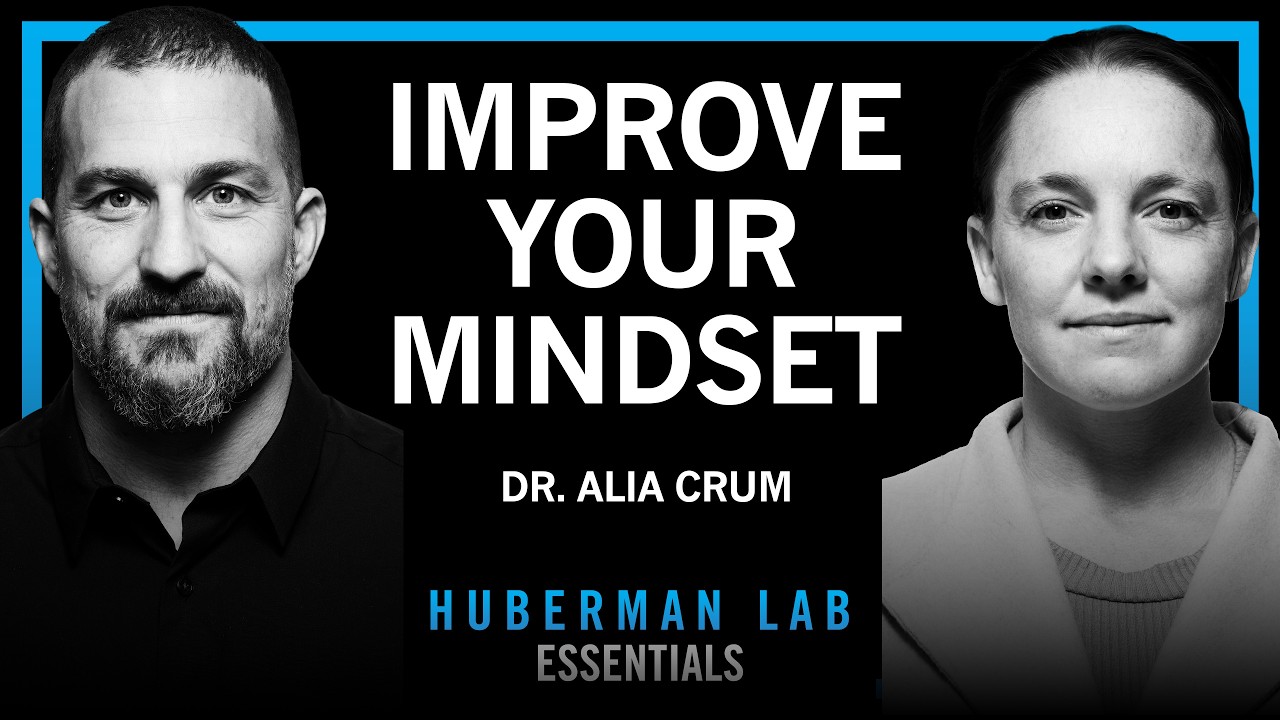
Essentials: Science of Mindsets for Health & Performance | Dr. Alia Crum
Keywords
Summary
179 words
Critical Evaluation
The episode provides a compelling overview of mindset research, grounded in peer-reviewed studies from Dr. Crum’s lab. The scientific rigor is high, with clear explanations of mechanisms such as ghrelin response and placebo effects. The argumentation is solid, avoiding overgeneralization by acknowledging that mindset effects interact with objective reality. The sources are credible, with references to specific studies and the Stanford Mind & Body Lab. The content is well-structured, moving from definitions to examples to practical tools. The title accurately reflects the content. The episode excels in making complex research accessible without oversimplifying. One minor limitation is that the ‘Essentials’ format condenses the original conversation, potentially omitting some nuances. Overall, the information is valuable and actionable, with a strong scientific foundation.
121 words
Title / Content Match
The title accurately reflects the content, focusing on the science of mindsets for health and performance.
Quality & Reliability
8/10
The episode features Dr. Alia Crum, a Stanford professor and director of the Mind & Body Lab, discussing peer-reviewed research on mindsets. The content is well-structured, references specific studies (milkshake study, hotel housekeepers study), and includes practical tools. However, it is a condensed 'Essentials' episode, so some nuances may be simplified.
Chapters
- Alia Crum
- Mindset, Core Beliefs; Examples of Mindset
- Mindset Shapes Body’s Response, Placebo Effects, Tool: Mindset for Weight Loss
- Different Diets & Mindset
- Nocebo Effect
- Exercise Mindsets, Weight Loss & Health Benefits
- Stress, Tool: Stress is Enhancing Mindset, Mental & Physical Benefits
- Mindset, Stress, Motivation & Physiology; Hormones
- Mindsets as Portals to Unconscious, Tool: Stress Mindset Awareness
- Leverage Stress, Tool: Adopt a Stress is Enhancing Mindset
- Mindsets Matter, Athletics
- Resources, Toolkits & Acknowledgements
Cited Sources
- Episode show notes — Official show notes for this episode, likely containing references to studies and resources.
- Full-length episode — The original full-length Huberman Lab episode featuring Dr. Alia Crum.
- Huberman Lab website — Official website with additional resources and episode information.
Concurring Sources
- Placebo effect — General reference on placebo effects, which support the idea that beliefs can influence physiology.
- Carol Dweck's mindset research — Related work on growth mindset, which aligns with the concept of mindsets shaping behavior.
External References
Contribution & Novelties
This episode synthesizes key findings from Dr. Alia Crum’s research on mindsets, highlighting how beliefs can shape physiological responses. It offers practical tools for adopting adaptive mindsets, such as viewing stress as enhancing and perceiving healthy foods as indulgent. The novelty lies in the clear presentation of evidence that mindset effects are not merely subjective but have measurable biological impacts.
Pour aller plus loin :
- Placebo effect — Provides background on placebo effects, which underpin the discussion of mindset effects.
- Carol Dweck’s mindset theory — Relevant for understanding growth vs. fixed mindsets, which are foundational to the field.
- Stanford Mind & Body Lab — Official lab page with publications and ongoing research on mindsets.
114 words
Radar Profile
The radar profile shows high scores across all dimensions, indicating a well-rounded and reliable episode. The strengths are particularly notable in information quality and reliability, while the technical level is slightly lower, reflecting its accessible presentation.
💬 Très positif. Sur les 30 commentaires analysés, les spectateurs expriment une forte appréciation, soulignant l'impact transformateur des idées et la clarté de l'explication, avec quelques demandes de prolongement.