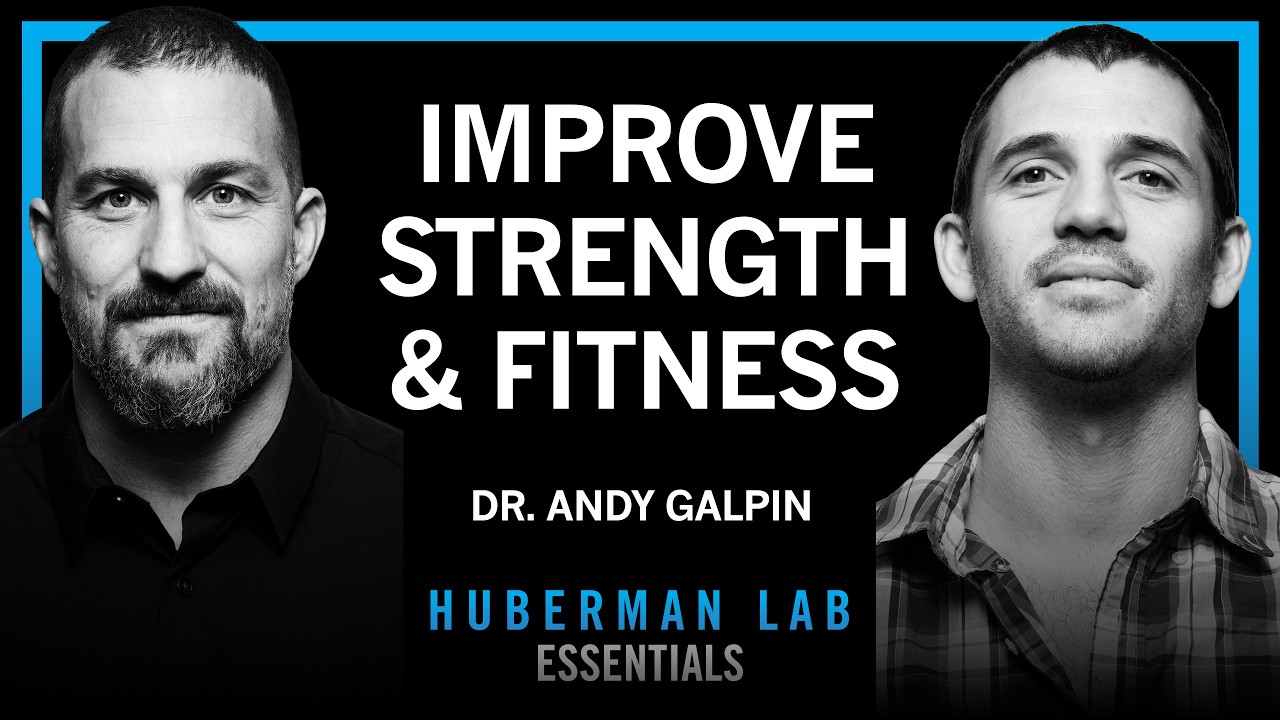
Essentials: How to Build Strength, Muscle Size & Endurance | Dr. Andy Galpin
Keywords
Summary
200 words
Critical Evaluation
The video provides a comprehensive overview of strength and hypertrophy training principles, presented by Dr. Andy Galpin, a recognized expert in exercise physiology. The information is scientifically grounded and aligns with current exercise science literature. Galpin’s explanation of the nine exercise adaptations offers a useful framework for understanding different training goals. He correctly emphasizes progressive overload as a fundamental principle, and his breakdown of modifiable variables (choice, intensity, volume, rest, progression, frequency) is practical and actionable. The discussion on exercise selection, advocating for full range of motion and balanced movement patterns, is supported by research showing benefits for strength and hypertrophy. The distinction between strength and hypertrophy training variables is well-articulated, with clear guidance on rep ranges, sets, and rest intervals. Galpin’s advice to avoid excessive soreness and prioritize frequency is sensible and evidence-based. The inclusion of the mind-muscle connection and breathing techniques adds a holistic dimension. However, the video is an expert opinion format rather than a systematic review, and specific studies are not cited within the video. While the information is reliable, viewers seeking detailed scientific references would need to consult the show notes. The production quality is high, and the content is well-structured. The title accurately reflects the content, and the video delivers on its promise. Overall, this is a valuable resource for individuals seeking science-based guidance on strength training, though it is not a substitute for individualized coaching or medical advice.
235 words
Title / Content Match
The title accurately reflects the content, which covers principles for building strength, muscle size, and endurance.
Quality & Reliability
8/10
The content is presented by Dr. Andy Galpin, an expert in exercise physiology, and hosted by Dr. Andrew Huberman, a neuroscientist. The information is evidence-based and aligns with established exercise science principles. However, it is an expert opinion format without direct citations to specific studies within the video, and the claims are not systematically referenced. The production quality is high, and the information is consistent with current scientific consensus.
Chapters
- Andy Galpin
- 9 Exercise Adaptations; Progressive Overload
- Progressive Overload, One-Rep Max, Soreness, Tool: Modifiable Variables
- Full-Body Workout, Exercise Selection
- Training Intensity, Repetitions, Sets, Rest Intervals, Supersets
- Hypertrophy vs Strength Training Recovery
- Training Volume & Frequency for Hypertrophy
- Hypertrophy Rep Ranges, Frequency & Recovery; Cell Mechanisms
- Tool: 3 x 5 Protocol; Power vs Strength
- Mental Awareness in Training; Mind-Muscle Connection
- Activating Muscle Groups, Awareness, Tool: Eccentric Overload
- Tool: Resistance Training Breathing & Post-Training
- Acknowledgments
Cited Sources
- Show notes for this episode — Official show notes with additional resources and references.
- Perform with Dr. Andy Galpin — Podcast by Dr. Andy Galpin for further in-depth discussions.
- Dr. Andy Galpin's website — Personal website with information about Dr. Galpin's work and research.
- Huberman Lab website — Official website for the Huberman Lab podcast and resources.
Concurring Sources
- American College of Sports Medicine position stand on resistance training — Supports the recommended rep ranges and training variables for strength and hypertrophy.
- Schoenfeld et al. on resistance training variables — Meta-analysis on the effects of training volume and frequency on muscle hypertrophy.
Dissenting Sources
- Some experts argue for higher training frequency for hypertrophy — While Galpin suggests 2-3 times per week for hypertrophy, some research indicates that higher frequencies (e.g., 4-5 times per week) may be more effective for some individuals, though the overall evidence is mixed.
External References
Contribution & Novelties
This episode distills complex exercise physiology into actionable principles, emphasizing the importance of manipulating training variables to achieve specific adaptations. It provides a clear framework for understanding the differences between strength, hypertrophy, and endurance training, and offers practical tools like the 3x5 protocol. The discussion on the mind-muscle connection and post-workout downregulation adds a unique perspective.
Pour aller plus loin :
- Progressive overload on Wikipedia — Foundational concept for training adaptation.
- Hypertrophy on Wikipedia — Overview of muscle growth mechanisms.
- American College of Sports Medicine guidelines — Evidence-based recommendations for resistance training.
- Motor unit recruitment — Key physiological mechanism underlying strength gains.
102 words
Radar Profile
The radar profile shows high scores across all dimensions, indicating a well-rounded and reliable source of information. The video excels in providing actionable, evidence-based guidance, with strong scientific credibility and technical depth.
💬 Très positif. Sur les 30 commentaires analysés, les spectateurs expriment une grande appréciation pour la clarté et l'actionnabilité des informations, certains les qualifiant de 'gold' et de 'record pour le contenu le plus actionnable par minute'.