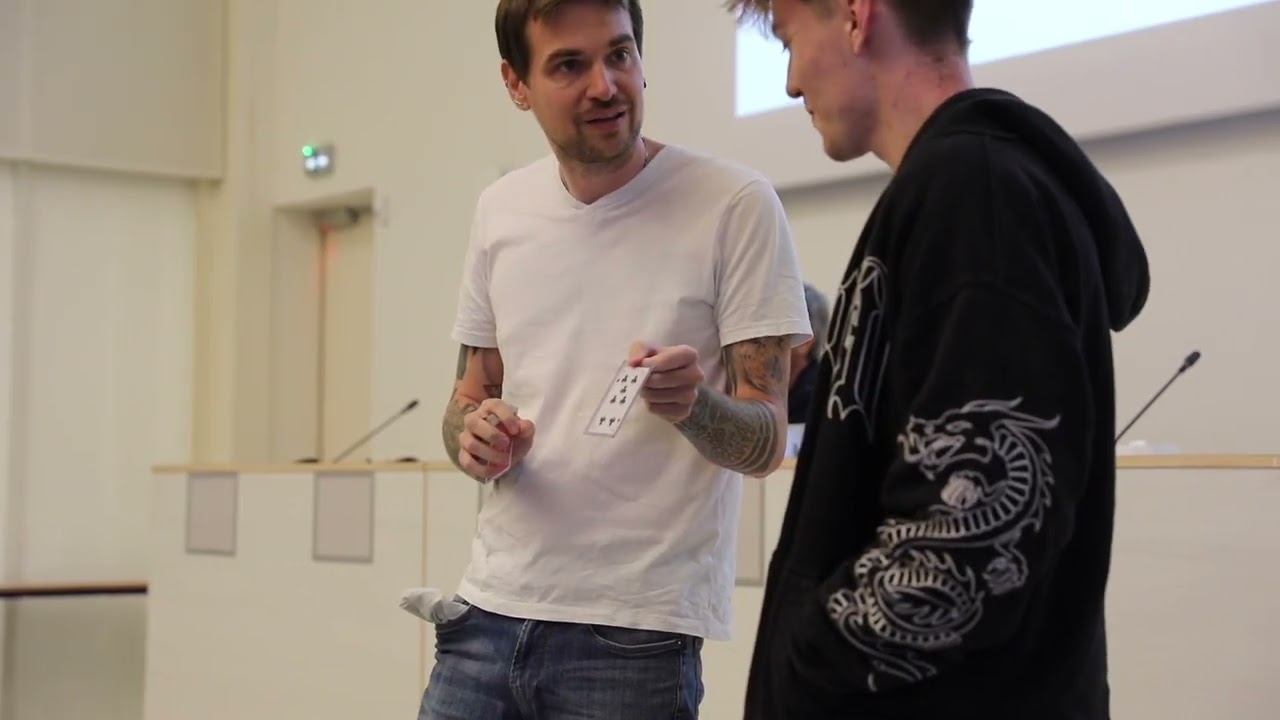
Comment les magiciens manipulent notre esprit
Keywords
Summary
146 words
Critical Evaluation
Value of the Information & Strength of the Argument
The value of the information is high for a general audience, as it presents established psychological concepts in an engaging and accessible manner. The argumentation is solid, grounded in well-known studies (e.g., Simons & Chabris) and the speakers’ dual expertise in psychology and magic. The live demonstrations effectively illustrate the concepts, making the argumentation more convincing. However, the presentation is more descriptive than analytical, and some claims could benefit from more rigorous scientific backing.
Scientific Rigor, Source Quality, Title Accuracy
The scientific rigor is good for a popular science talk. The speakers reference classic studies (e.g., the invisible gorilla) and historical figures (Binet), but they do not provide detailed citations or a systematic review of the literature. The title accurately reflects the content, and the presentation is well-structured. The live demonstrations and examples help clarify the concepts, but the lack of specific source references limits the ability to verify all claims.
160 words
Title / Content Match
The title accurately reflects the content, as the conference explores how magicians exploit cognitive biases and attentional limits to manipulate perception and choice.
Quality & Reliability
8/10
The conference is given by two cognitive psychology researchers, one of whom is also a professional magician, providing both scientific and practical expertise. The content is based on established psychological phenomena (inattentional blindness, attention capture, etc.) and includes live demonstrations. However, it is a popular science presentation rather than a peer-reviewed study, and some claims are presented without detailed citations.
Key Moments
Markers derived by PSI from the transcript: the creator did not define chapters.
- Introduction to the conference and the presenters' backgrounds in cognitive psychology and magic.
- Discussion of Alfred Binet's historical interest in magic and his use of chronophotography to analyze tricks.
- Live card trick demonstration with audience participation, illustrating attention misdirection.
- Explanation of inattentional blindness using the 'invisible gorilla' experiment and its implications for magic.
- Discussion of how magicians use gaze, verbal patter, and cognitive load to control attention.
- Presentation of a study on a clown on a unicycle, showing how attention is limited and can be captured.
- Demonstration of how magicians can influence seemingly free choices, using a card trick with a PowerPoint.
- Conclusion summarizing the key insights about cognitive limitations and magic.
Cited Sources
- Alfred Binet's work on magic — Mentioned as historical background, but no specific source provided.
- Simons & Chabris (1999) 'Gorillas in our midst' — Referenced as the source of the invisible gorilla experiment.
Concurring Sources
- Simons & Chabris (1999) 'Gorillas in our midst' — The invisible gorilla experiment is a classic demonstration of inattentional blindness, consistent with the talk's claims.
Contribution & Novelties
The conference provides an engaging and accessible overview of how magic exploits cognitive biases, particularly attention. It bridges the gap between scientific psychology and the practical knowledge of magicians, offering a unique perspective. The live demonstrations make the concepts tangible. However, the content is not novel for experts in the field, as it summarizes known phenomena.
Pour aller plus loin :
- Inattentional blindness — Key concept discussed in the talk.
- Attention — Fundamental cognitive process underlying the talk.
- Magic and psychology — Academic article on the relationship between magic and psychology.
91 words
Radar Profile
The radar profile shows high scores in information quantity, quality, and reliability, with a moderate technical level. This indicates a well-balanced presentation that is informative and credible, but not overly technical, making it suitable for a general audience.