D’une nécropole antique du Haut-Empire à la naissance de la ville d’Auxerre au IVe siècle
Keywords
Summary
183 words
Critical Evaluation
Value of the Information & Strength of the Argument
The value of the information is high, as it presents new archaeological data from a recent excavation, offering fresh insights into Roman funerary practices and urban transformation. The argumentation is solid, based on stratigraphic observations and preliminary analyses. The speaker clearly explains the context, methodology, and significance of the findings, and appropriately acknowledges uncertainties where interpretations are preliminary. The comparison with other sites, such as Les Bolards, strengthens the argument for the uniqueness of the Auxerre necropolis.
Scientific Rigor, Source Quality, Title Accuracy
The scientific rigor is evident in the detailed description of the excavation process and the cautious interpretation of results. The speaker relies on archaeological evidence and references to known sites and practices. The title accurately reflects the content, focusing on the transition from a High Empire necropolis to the 4th-century city. The presentation is well-structured and aligns with current archaeological knowledge. No external sources are cited in the video, but the speaker’s affiliation with INRAP lends credibility.
169 words
Title / Content Match
The title accurately reflects the content, focusing on the transition from a High Empire necropolis to the foundation of the city of Auxerre in the 4th century.
Quality & Reliability
8/10
The presentation is based on a recent preventive excavation by INRAP, with detailed stratigraphic observations and preliminary analyses. The speaker is a professional archaeologist, and the content is consistent with current scientific knowledge on Roman funerary practices and urban transformations. However, the final report is not yet published, and some interpretations remain preliminary.
Key Moments
Markers derived by PSI from the transcript: the creator did not define chapters.
- Introduction and context of the excavation on Place du Maréchal Leclerc in Auxerre.
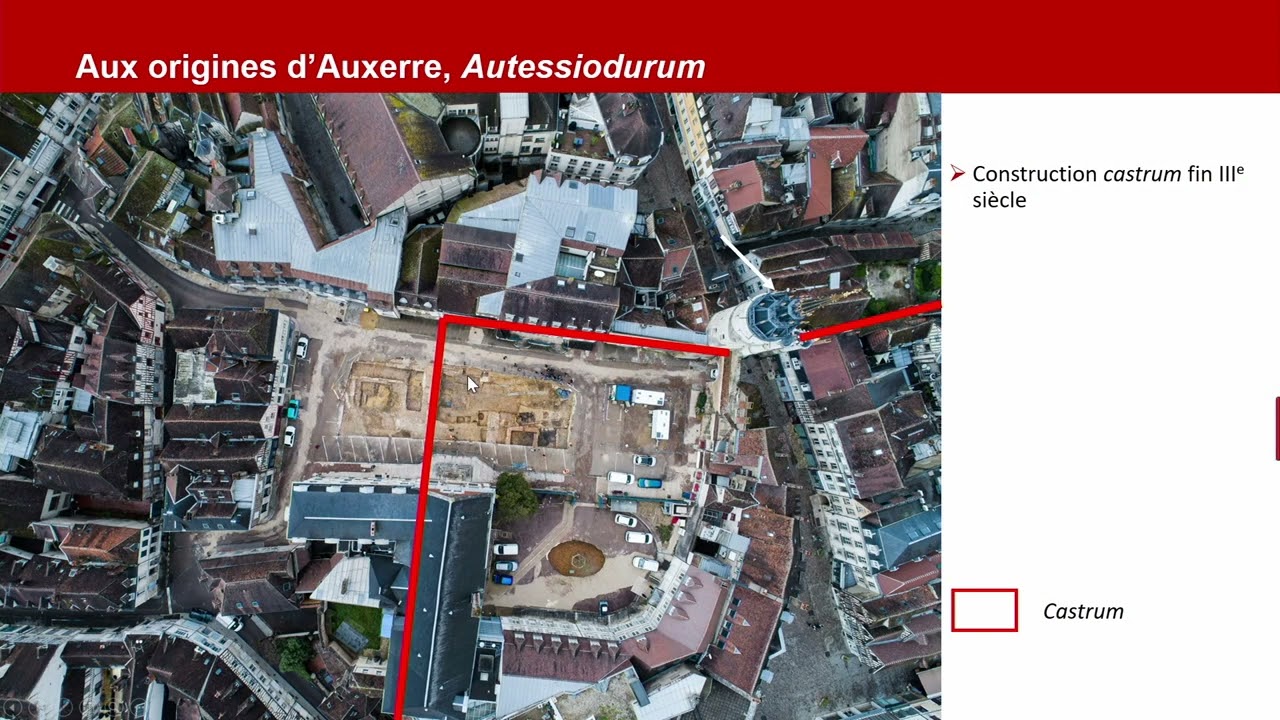
- Historical background of Auxerre, including the location of the High Empire city and the castrum.
- Presentation of the excavation methodology and the two phases of research.
- Discovery of the necropolis: 250 funerary features, mostly perinatal infants, in a small area.
- Description of funerary practices: imbrices, wooden coffins, ceramic containers, and superposition.
- Discussion of the significance of the necropolis and comparison with other sites.
- The 4th-century castrum and its construction over the necropolis, marking the city's refoundation.
- Later periods: medieval and modern structures, and the role of the site as a place of power.
Concurring Sources
- Les Bolards (Nuits-Saint-Georges) — Reference site for a large number of infant burials in Roman Gaul, used for comparison.
Contribution & Novelties
The excavation provides unprecedented evidence for a concentrated perinatal necropolis in Roman Gaul, with 250 individuals in a small area, which is unique in the Roman world. This challenges previous assumptions about the disposal of infant remains and offers new data for studying infant mortality and funerary practices. The site also clarifies the location and construction of the 4th-century castrum, contributing to the understanding of the urban transformation of Auxerre.
Pour aller plus loin :
- Roman infant burial practices — Overview of infant burial customs in the Roman world.
- Perinatal mortality in archaeology — Definition and archaeological significance of perinatal remains.
- Castrum — Roman military fortification type, relevant to the 4th-century enclosure.
112 words
Radar Profile
The radar profile shows high scores in quantity and quality of information, reflecting the detailed presentation of new archaeological data. The technical level is moderate, suitable for a general audience but with specific terminology. The overall reliability is high due to the professional context and cautious interpretation.
💬 No comments were provided for analysis.