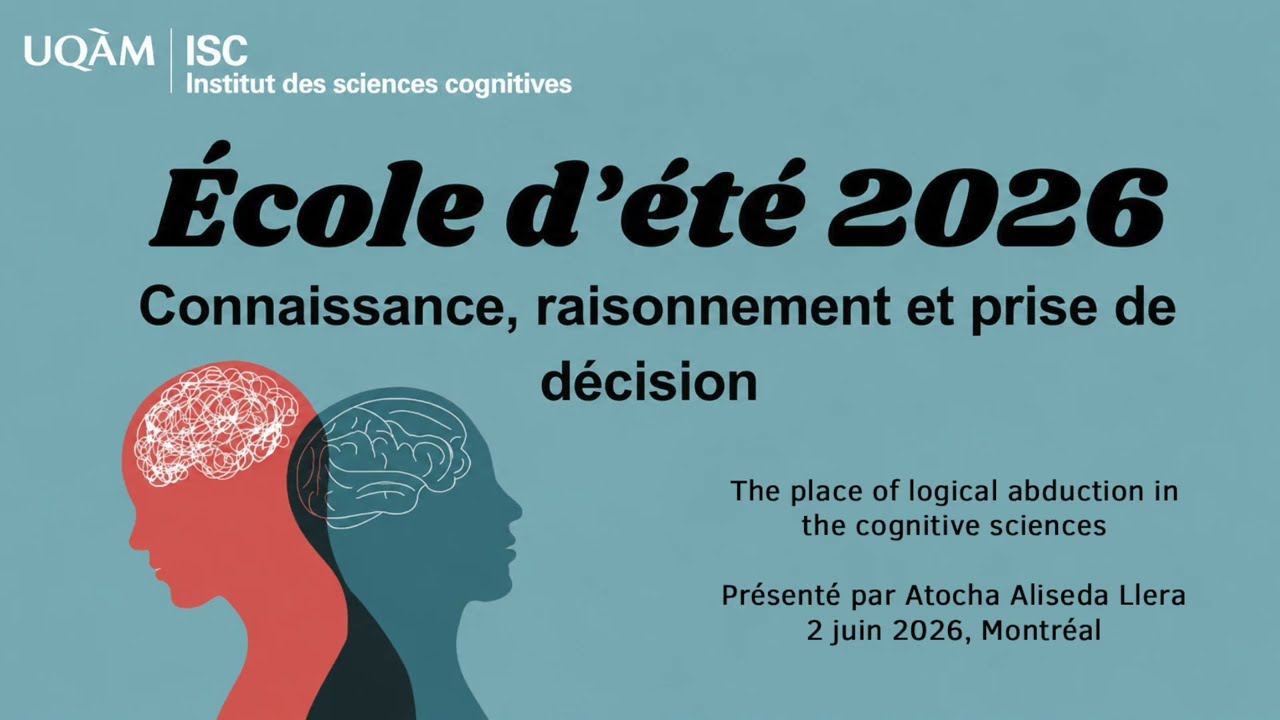
The place of logical abduction in the cognitive sciences
Keywords
Summary
198 words
Critical Evaluation
Value of the Information & Strength of the Argument
The talk provides a valuable overview of abduction, tracing its origins in Peirce and its development in modern logic and AI. Aliseda’s argument that abduction is creative but limited to combinatorial novelty is well-supported by references to Peirce, Anderson, and Simon. She effectively distinguishes between different types of creativity and clarifies the role of abduction in scientific discovery. The discussion of AI, while brief, raises important questions about the nature of intelligence and creativity, and whether machines can truly be creative. The argumentation is coherent and grounded in philosophical and logical traditions, though some points could benefit from more detailed examples or empirical evidence.
Scientific Rigor, Source Quality, Title Accuracy
Aliseda demonstrates strong scientific rigor by grounding her talk in her own published work and citing key figures like Peirce, Simon, and Turing. She references specific papers and books, such as the Springer collection on model-based science and the handbook on model-based science. The sources are credible and relevant. The title accurately reflects the content, though the talk also touches on AI and creativity, which are not fully captured in the title. The lecture is well-structured and the arguments are logically presented, but as a talk, it lacks the detailed citations and peer-review that a formal paper would have.
218 words
Title / Content Match
The title accurately reflects the content, which focuses on the role of logical abduction in cognitive science, though the talk also covers broader philosophical and AI topics.
Quality & Reliability
8/10
The speaker is a recognized expert in logic and philosophy of science, with a solid academic background. The talk is based on her published work and includes references to Peirce, Simon, and others. However, it is a lecture, not a peer-reviewed article, and some claims are presented without detailed evidence.
Key Moments
Markers derived by PSI from the transcript: the creator did not define chapters.
- Introduction and acknowledgment of organizers
- Peirce's formulation of abduction and its role in synthetic reasoning
- Discussion of Peirce's criteria for hypotheses: testability and economy
- Logical models of abduction: adaptive logics, dynamic epistemic logic, and paraconsistent logics
- The creative aspect of abduction: combinatorial creativity and the limits of novelty
- Herbert Simon's view on scientific discovery and the gradual emergence of new ideas
- Alan Turing's 1950 paper and the Turing test
- Comparison of Turing test with modern AI like ChatGPT
- The Dartmouth conference and the birth of AI
- Conclusion: from intelligence to creativity, the quest for artificial creative cognition
Cited Sources
- The place of logic in creative reasoning — One of the papers by the speaker, published in a Springer collection, which forms the basis of the talk.
- From intelligence to creativity: the quest for automatic creative cognition — Second paper by the speaker, in a volume in honor of Lorenzo Magnani, mentioned as the basis for the second part of the talk.
- Handbook of Model-Based Science — Edited by Magnani and Bertolotti, includes a section on the logic of hypothetical reasoning, which the speaker contributed to.
Concurring Sources
- Abductive Reasoning (Stanford Encyclopedia of Philosophy) — Provides a philosophical overview of abduction, supporting the speaker's discussion of Peirce and logical models.
Dissenting Sources
- The Logic of Scientific Discovery (Karl Popper) — Popper's emphasis on falsification and deductive testing contrasts with the speaker's focus on abduction as a creative logic.
Contribution & Novelties
The talk provides a clear synthesis of Peirce’s abduction and its relevance to contemporary AI, arguing that abduction is creative but limited to combinatorial novelty. It offers a nuanced perspective on the Turing test and the quest for artificial creativity, suggesting a shift from simulating intelligence to fostering creativity. The speaker’s distinction between different types of creativity and the role of abduction in scientific discovery is insightful.
Pour aller plus loin :
- Abductive reasoning - Wikipedia — Overview of abduction, its history, and applications.
- Charles Sanders Peirce - Stanford Encyclopedia of Philosophy — Comprehensive entry on Peirce’s philosophy, including his theory of abduction.
- Herbert A. Simon - Wikipedia — Information on Simon’s work on scientific discovery and artificial intelligence.
- Turing test - Wikipedia — Explanation of the Turing test and its implications.
132 words
Radar Profile
The radar profile shows high scores in quality of information and reliability, reflecting the speaker's expertise and solid references. The quantity of information is moderate, as the talk is concise, and the technical level is high, suitable for an academic audience. The overall balance indicates a well-structured and informative lecture.