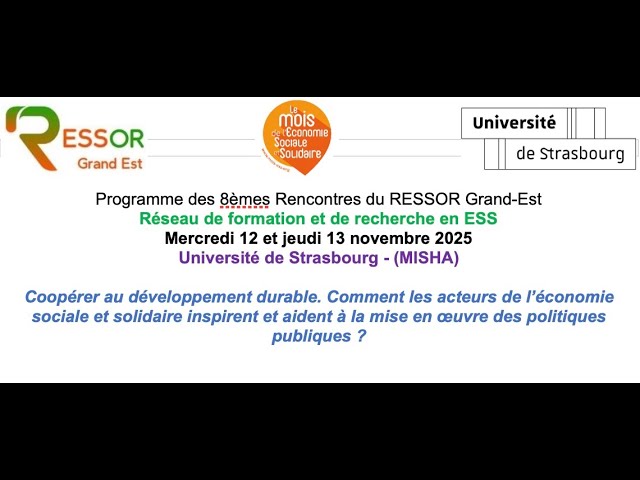
8èmes Rencontres du RESSOR Grand-Est --- 12/11/25 --- 15h30-16h45
Keywords
Summary
182 words
Critical Evaluation
Value of the Information & Strength of the Argument
The video provides valuable insights into ongoing research on sustainable food systems. The first presentation offers a detailed description of a study design, including the theoretical model (CADM) and the planned methodology, which is useful for researchers in the field. The second presentation presents preliminary findings from a qualitative study, using institutional theory to explain the gap between policy and practice in school canteens. The argumentation is solid, grounded in established theories and empirical data. However, the presentations are preliminary, and the lack of results limits the strength of the conclusions.
Scientific Rigor, Source Quality, Title Accuracy
The scientific rigor is generally high, with presenters referencing established theories and prior research. The first presentation mentions the Comprehensive Action Determination Model and other behavioral theories, but does not provide specific citations. The second presentation references institutional theory and the concept of decoupling, but again, specific sources are not mentioned. The title accurately reflects the content of the session. The video is a conference recording, so the sources are not explicitly listed, but the presentations are based on academic work.
187 words
Title / Content Match
The title accurately describes the event: the 8th RESSOR Grand-Est meetings, with the date and time. The content matches the session's theme of research presentations on sustainable food systems.
Quality & Reliability
7/10
The video is a recording of a scientific conference session, featuring two research presentations. The content is academic, with clear methodological frameworks and references to established theories. However, the video has low production quality, and the transcription contains many errors and interruptions, making it difficult to fully assess the details. The presentations are preliminary, with no results yet for the first study.
Key Moments
Markers derived by PSI from the transcript: the creator did not define chapters.
- Introduction by moderator Lena Bloemertz, welcoming participants and outlining the session.
- Heike Rossman begins her presentation on the influence of nutrition education on sustainable nutrition attitudes.
- Rossman explains the Comprehensive Action Determination Model (CADM) and its components.
- Rossman describes the study design, including the intervention (escape game) and data collection methods.
- Q&A session for Rossman's presentation, with questions about sample size and model adaptation.
- Sébastien Mainhagu begins his presentation on competencies of head chefs in implementing sustainable development in school canteens.
- Mainhagu discusses institutional theory and the concept of decoupling in the context of the EGalim law.
- Mainhagu presents his methodology, including case studies and interviews with chefs and other stakeholders.
- Mainhagu shares preliminary findings, highlighting differences in compliance among chefs.
- Q&A session for Mainhagu's presentation, with questions about the role of training and organizational support.
Cited Sources
- Comprehensive Action Determination Model (CADM) — Mentioned as the theoretical framework for the study on nutrition education.
- Theory of Planned Behavior — Referenced as one of the theories integrated into CADM.
- Norm Activation Model — Referenced as one of the theories integrated into CADM.
- Value-Belief-Norm Theory — Referenced as one of the theories integrated into CADM.
- Institutional Theory and Decoupling (Meyer & Rowan) — Referenced in the second presentation to explain the gap between policy and practice.
Concurring Sources
- Planetary Health Diet — Referenced in the first presentation as a sustainable diet example.
Contribution & Novelties
The video presents ongoing research that contributes to the understanding of sustainable food transitions. The first study applies the Comprehensive Action Determination Model to nutrition education, which is a novel application. The second study uses institutional theory to analyze the implementation of the EGalim law in school canteens, providing insights into the role of individual competencies and organizational factors. The research is still in progress, but the methodological approaches and preliminary findings offer valuable contributions to the field.
Pour aller plus loin :
- Comprehensive Action Determination Model — Overview of the model and its components.
- Theory of Planned Behavior — Background on one of the foundational theories.
- Institutional Theory — Explanation of institutional theory and decoupling.
116 words
Radar Profile
The radar profile shows a balanced performance across all dimensions, with slightly higher scores in information quantity and quality, reflecting the substantive content of the presentations. The technical level is moderate, suitable for an academic audience, and the overall reliability is good, though the preliminary nature of the research limits the strength of conclusions.
💬 No comments were provided for this video.